- What Is BIM? A Clear Definition
- How BIM Works In Construction – The Process Explained
- The Benefits Of BIM In Construction – With Statistics
- BIM vs Traditional 2D Documentation – How They Compare
- Types of BIM Modeling Services – What Each Delivers
- Who Uses BIM And On What Types Of Projects?
- Accessing BIM Without Building In-House Capability
- Work With A BIM Team That Delivers Results, Not Just Models
- FAQs
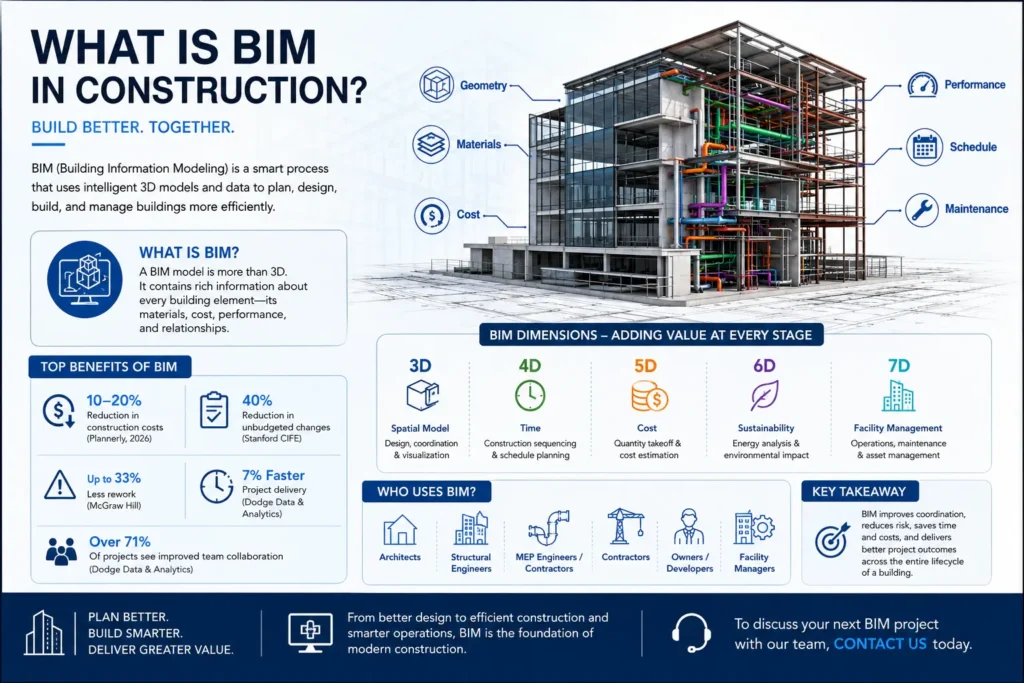
In short: BIM, or Building Information Modelling, refers to the creation and management of a cohesive digital model of a building that includes not only the geometry of the building elements but also all relevant information, such as the material, specification, cost, program, and performance of each element. BIM does away with disjointed two-dimensional drawings and introduces an integrated source of information for the entire project team to collaborate from. Construction benefits from using BIM, with 10% to 20% savings, up to 40% less rework, and fewer RFIs due to coordination issues being resolved beforehand.
If you’ve been involved in a construction project within the past ten years, then you have definitely come across BIM, whether working with BIM models, receiving BIM outputs from a design team, or being required to develop BIM content for a client. However, what BIM is and what it can really do are two things that tend to be misinterpreted.
BIM is not a software application. Revit is a software application. Navisworks is a software application. BIM is a process that involves the development, management, and utilization of building information data from the beginning of a project all the way through construction, occupancy, and finally demolition.
This guide outlines what BIM is, how it is implemented, the proven advantages of BIM (including statistics), why BIM is different from traditional 2D drawings, and what you need to know about BIM as a contractor, developer, and engineer in order to use it on your projects.
What Is BIM? A Clear Definition
A Building Information Model (BIM), developed through professional BIM modeling services, provides digital information about the physical and functional features of a structure. The BIM model is not merely a three-dimensional design; rather, it is an intelligent model containing comprehensive data on each component of the building. Each component is rich in information regarding its nature, performance, material, cost, and relationship with all other components of the building.
The keyword is ‘information’. A wall in the conventional two-dimensional CAD system will appear as a line. In contrast, a wall in a BIM model will be an object in the building that will possess certain characteristics like its material, fire resistance, sound resistance, heat resistance, cost per square meter, order of installation, and maintenance. All these features will be stored in the database and can be utilized throughout the process.
According to the definition of the National BIM Standard (NBIMS-US), Building Information Modeling (BIM) means: ‘digital representation of both the physical and functional characteristics of a facility. The BIM is a shared resource for information about a facility that forms a reliable basis for decision-making throughout the lifecycle of the project.’
Scale:
As per industry analysis, the value of the BIM market worldwide in 2024 was $9.9 billion and is estimated to rise to $14.68 billion in 2028. BIM implementation within the US, UK, and worldwide markets will continue to grow rapidly in 2026, as a result of governmental directives for public infrastructure projects and client demands in large-scale commercial construction projects.
BIM Level 2 is mandatory in the UK for all centrally procured government projects and is also being increasingly mandated by large private property developers in the country. For the United States, the application of BIM technology is made mandatory in federal government contracts, and it is standard for health care facilities, data centers, and commercial tall buildings. Globally, the ISO 19650 standard is referenced in construction project contracts in over 40 countries.
How BIM Works In Construction – The Process Explained
The BIM Model vs A 3D Drawing
The biggest myth concerning BIM technology is that it is nothing more than a 3D form of CAD drawings. That is false. A 3D CAD model represents geometry. A BIM model represents a building with all the information associated with each element embedded in the model and linked to it.
This distinction matters because it is the information, not the geometry, that drives BIM’s value. Once a structural engineer makes any modifications to a particular beam in BIM, such modifications will reflect in the cost estimates, schedules, material quantities, and the entire set of relevant drawings. This level of integration is not possible with traditional CAD.
The Federated Model – Where Coordination Happens
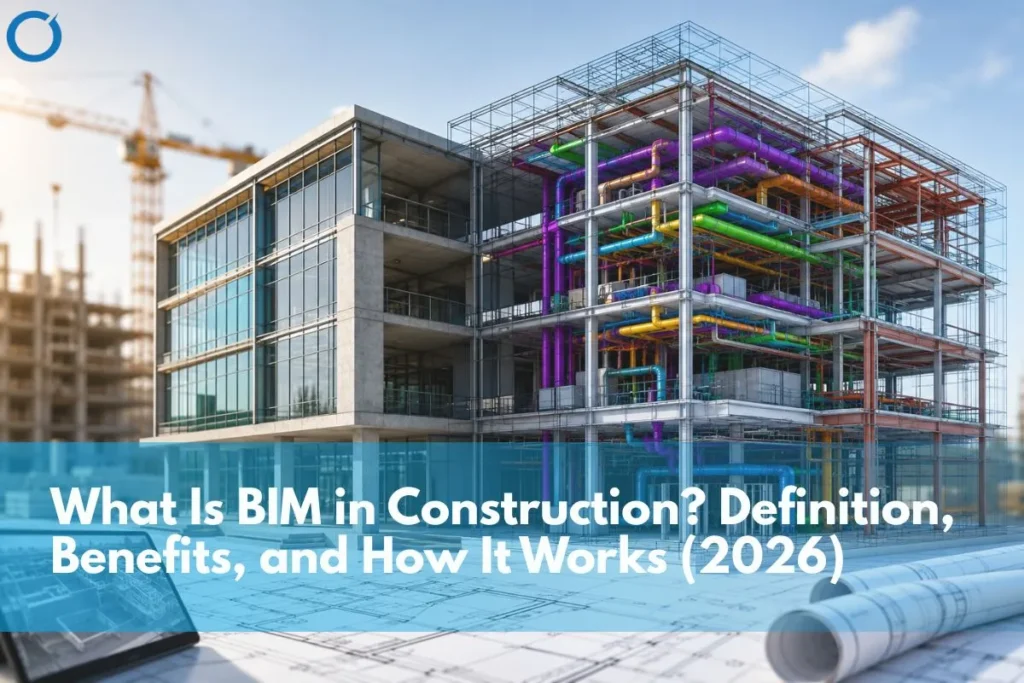
On a construction project, BIM models are typically produced by multiple disciplines: the architect produces an architectural model, the structural engineer produces a structural model, and the MEP contractor produces MEP models. A federated model combines all of these into a single coordinated environment, where conflicts between disciplines can be identified and resolved.
This coordination process, producing a federated model and running clash detection to identify conflicts before construction, is where BIM delivers its most direct and measurable commercial value. For a detailed explanation of how coordination works, see our guide on the role of BIM coordination in construction.
BIM Dimensions – From 3D to 7D
BIM can be extended beyond geometry (3D) to include additional dimensions of information. Each dimension adds a layer of value to the model.
| Dim. | Name | What it adds | Primary use |
|---|---|---|---|
| 3D | Spatial model | Geometry, spatial relationships, and clash detection | Coordination, visualisation, and construction documentation |
| 4D | Time | Construction programme linked to model elements | Sequencing, logistics, programme validation |
| 5D | Cost | Quantities and cost data linked to model elements | Cost estimating, procurement, and budget management |
| 6D | Sustainability | Energy, carbon, and environmental data | Sustainability analysis, green certification, energy modelling |
| 7D | Facility management | Asset information, maintenance schedules, operational data | Building management, planned maintenance, lifecycle management |
In construction, the three most common dimensions utilized are 3D, 4D, and 5D. To learn more about 4D BIM sequencing and how it helps avoid delays on site, check out the article What is 4D BIM sequencing?
The Benefits Of BIM In Construction – With Statistics
BIM’s benefits are well-documented across research literature, industry surveys, and project case studies. The headline numbers are consistent.
| 10–20% Reduction in construction costs (Plannerly, 2026) | 40% Reduction in unbudgeted project changes (Stanford CIFE) | Up to 33% Cost reduction from digital construction methods (UK Govt.) | 75% Of BIM users report positive ROI (McKinsey) |
Benefit 1 – Significant Cost Reduction
Projects using BIM consistently report construction cost reductions of 10–20% compared to equivalent projects using traditional documentation methods. These savings come from multiple sources: fewer change orders, reduced rework, better material management, more accurate cost estimation, and shorter programmes.
A Stanford University Center for Integrated Facilities Engineering (CIFE) study of 32 major BIM-assisted projects found reductions in unbudgeted project changes of up to 40%, and savings of up to 10% of contract value from timely clash detection alone. These are not theoretical projections; they are measured outcomes from live projects.
Benefit 2 – Dramatic RFI Reduction
RFIs (Requests for Information) are one of the most disruptive and expensive problems in construction delivery. Every RFI represents a gap in the documentation, something that was not resolved before the project reached the site. BIM addresses this at the source by producing construction documentation from a coordinated model rather than from disconnected 2D drawings. For a detailed breakdown of how BIM modeling services reduce RFIs specifically, see our guide: What BIM modeling services work best for reducing RFIs?
Projects with effective BIM coordination usually generate fewer RFIs, fewer change orders, and tighter cost control than similar projects that rely on conventional 2D documentation. The reason is straightforward. BIM coordination solves any discrepancies before construction begins.
Benefit 3 – Rework Reduction
Rework occurs when teams must repeat work because they completed it incorrectly the first time, making it one of the largest controllable cost items in construction. The Construction Industry Institute (CII) consistently finds rework accounts for 5–15% of total project costs. Thorough BIM coordination can reduce this to 2–3% (Plannerly, 2026).
The mechanism is the same as RFI reduction: conflicts resolved in the model do not become rework on site. When the team identifies a duct clash in Navisworks during preconstruction, they can resolve it at a fraction of the cost of discovering the same conflict after fabricating the duct sections and erecting the steel.
Benefit 4 – Better Programme Performance
BIM improves schedule performance through two mechanisms. First, 4D sequencing validates the construction programme spatially before construction begins, eliminating sequence conflicts that would cause stoppages. Second, fewer RFIs and less rework mean fewer unplanned disruptions to the construction programme once work begins.
Global data shows that 4D BIM reduces schedule overruns by up to 30% and improves site productivity by 15–20% (Arkance, 2025). Projects that invest in BIM pre-construction consistently finish closer to their planned programme than equivalent projects without BIM coordination.
Benefit 5 – Accurate Cost Estimating From The Model
One of the most under utilized advantages of BIM is its ability to extract precise quantity information directly from the model for use in construction estimating services. Model-derived quantities are more accurate than manual takeoffs from 2D drawings, and they update automatically when the model changes. The Stanford CIFE study found that BIM reduced the time required to generate a cost estimate by 80% compared to manual methods.
This level of accuracy also has a tangible effect on business: improved bids, less risk of cost overrun, and better financial management of the project.
Benefit 6 – Improved Stakeholder Communication
Three-dimensional BIM models and 4D animations help all project stakeholders visualize the construction process more clearly, especially when they find standard 2D drawings difficult to understand. They can visualize the structure in three dimensions, study the construction process, and make decisions earlier on.
This communication benefit reduces the risk of late-stage design changes, which are among the most expensive events in construction project delivery.
Benefit 7 – Construction-Ready Documentation
When teams use construction documentation services based on a coordinated BIM model, the construction documents, shop drawings, coordination drawings, and set-out data reflect the accuracy of that model. The documentation and the model agree because they are from the same source. This removes the interpretation gaps that create RFIs when teams produce documentation manually from 2D drawings.
Benefit 8 – Facility Management and Digital Twin
At LOD 500, the as-built BIM model functions as a digital twin of the completed building. It records every element exactly as the construction team installed it. This model supports facility management, planned maintenance, asset tracking, and future renovation or fit-out. For building owners, the long-term operational value of an LOD 500 model typically exceeds the value delivered during construction.
For a full explanation of BIM LOD levels and what each delivers, see our guide: BIM LOD levels explained.
BIM vs Traditional 2D Documentation – How They Compare
The table below compares BIM against traditional 2D documentation across eight dimensions that directly affect project cost, schedule, and quality.
| Area | Without BIM | With BIM |
|---|---|---|
| Coordination | Manual 2D overlay — clashes discovered on site | Federated 3D model — clashes resolved in pre-construction |
| RFI Volume | Highly ambiguous documentation generates constant queries | Low — model-derived documentation is precise and consistent |
| Cost Estimation | Manual takeoff from 2D drawings — error-prone | Model-derived quantities — accurate and automatically updated |
| Programme Planning | Gantt chart — no spatial validation | 4D sequencing — sequence validated in 3D before construction |
| Change Management | Slow — changes must be redrawn across all affected drawings | Fast — changes propagate automatically through the coordinated model |
| Stakeholder Communication | Technical drawings — difficult for non-specialists to interpret | 3D visualisations and animations — accessible to all parties |
| Rework Rate | 5–15% of project cost (CII benchmarking) | Reduced to 2–3% with thorough BIM coordination (Plannerly 2026) |
| As-built Documentation | Manual as-built surveys — time-consuming and imprecise | LOD 500 model — field-verified digital twin of the completed building |
For a full comparison of BIM and traditional documentation across cost, speed, and RFI reduction, see our detailed guide: BIM modeling vs traditional documentation.
Types of BIM Modeling Services – What Each Delivers
BIM is not just one service. It brings together specialist services that solve different problems before construction begins.
BIM Modeling
Creating BIM models in 3D at the appropriate LOD level for each stage of the project. Specialist modelers develop architectural, structural, and MEP models using software such as Revit.
BIM Coordination and Clash Detection
The process of combining discipline models into a federated environment and running automated clash detection services to identify and resolve conflicts before construction. This is the highest-value BIM service for RFI reduction and cost protection.
MEP BIM Coordination
Coordination of specialist areas for mechanical, electrical, and plumbing systems is the most complex part of construction from a spatial perspective. MEP BIM services ensure that the HVAC ducting, pipework, cable trays, and sprinklers are all coordinated to LOD 350 before fabrication starts.
4D BIM Sequencing
Integrating the 3D model into the construction schedule to simulate and test the construction process before construction. Detects space clashes, constructability problems, and critical path problems during the pre-construction phase.
Scan to BIM
Transformation of point cloud survey data from laser scans to coordinated BIM modeling. Applications include renovations and refurbishment, where accurate capture of the existing geometries is necessary.
BIM for Estimating
Extracting precise quantity takeoffs directly from the BIM model for use in construction estimating services. Model-derived quantities are more accurate than manual takeoffs and update automatically with design changes.
Who Uses BIM And On What Types Of Projects?
Construction teams use BIM across all project phases and construction project types.
Who Uses BIM
- Architect/Designer – For design modeling and visualization, and for producing construction drawings
- Structural Engineer – For structural modeling and coordination with architects and MEP
- MEP Engineer/Contractor – For MEP systems modeling, coordination, and BIM shop drawing services
- General contractors – for programme validation, subcontractor coordination, and site logistics
- Developers and owners – for design review, cost management, and facility management post-completion
- Quantity surveyors – for model-derived quantity takeoffs and cost estimating
Types of Projects Where BIM Provides The Highest Value
- High-rise commercial – intricate multi-storey MEP system distribution and multi-trade coordination
- Healthcare facilities – dense, specialist MEP systems with strict regulatory clearance requirements
- Data centers – highly compacted power, cooling, and data networking requirements
- Manufacturing industrial buildings – intricate process, pipe, and mechanical requirements
- Infrastructure and civil projects – multi-phase programmes with complex dependencies
- Large residential developments – shared MEP infrastructure and multi-block coordination
Accessing BIM Without Building In-House Capability
The high cost associated with creating a BIM environment is one of the main reasons why many developers and contractors do not fully utilize BIM technology. BIM coordinators, specialized BIM software (such as Revit, Navisworks, and BIM 360), and a BIM team management cost a lot.
Offshore BIM modeling services have changed this calculation. A dedicated offshore BIM team provides specialist coordination capability, federated model development, clash detection, MEP coordination, 4D sequencing, and construction documentation at 40–70% below local rates, with no headcount overhead and the flexibility to scale with your project pipeline.
For a complete guide to choosing the right BIM partner, see: How to choose the right BIM modeling service provider. And if you are looking for a dedicated BIM partner now, work with a BIM modeling team that understands coordination, sequencing, and construction-ready deliverables.
Work With A BIM Team That Delivers Results, Not Just Models
At Optimar Precon, we provide dedicated BIM modeling services, BIM coordination, clash detection, and MEP BIM services for contractors, developers, and engineers across commercial, industrial, healthcare, and residential projects globally. Our offshore team delivers the coordination quality that the construction industry’s leading firms use as standard at offshore rates, without the overhead of an in-house team. Get in touch to discuss your next project.
FAQs
The acronym BIM stands for Building Information Modeling. This refers to the creation and management of an intelligent computer model of a building that holds information about the geometry of all the parts of a building (its physical dimensions and spatial location), as well as nongeometric information, such as material details, specifications, cost estimates, and maintenance. NBIMS-US officially defines BIM, while ISO 19650 guides BIM information management internationally.
The CAD system will provide 2D drawings or 3D geometry for building components. However, the BIM technology creates intelligent and rich models where each component has intelligence about its nature, functionality, and relationship with other components. A wall in CAD is a pair of lines. The same wall in BIM is a building element with a fire rating, thermal value, material specification, cost, and installation sequence. On the other hand, BIM allows coordination between different disciplines through the federation model, while CAD does not.
Project teams can use the BIM model for coordination, clash detection, construction documentation, shop drawing extraction, coordination drawings, setting out data, quantity takeoffs, 4D scheduling, 3D communication, animations, and facilities management through an as-built LOD 500 model.
Some of the major advantages of using BIM in construction include: cost savings ranging between 10% and 20% (Plannerly, 2026); saving up to 40% in change orders not included in budget planning (Stanford CIFE); schedule savings of up to 30% using 4D BIM (Arkance, 2025); reducing rework from 5-15% to 2-3% of the total cost of the project by properly coordinating BIM; achieving 80% faster cost estimates based on model quantity takeoffs (Stanford CIFE).
No. Although BIM provides maximum value for complicated projects involving multiple trades, like hospitals, data centers, commercial skyscrapers, and industrial projects, BIM is valuable for any type of project. Even the simplest commercial or residential projects can benefit from the coordination of BIM documents, resulting in less RFI, more accurate costing, and construction documents that the construction team can rely on. Offshore BIM service providers have made it possible for even small-scale construction companies to get their hands on high-quality BIM documents without breaking the bank.
Architectural, structural, and MEP teams commonly use Autodesk Revit as BIM authoring software. Autodesk Navisworks is the primary tool for federated model assembly and clash detection. Autodesk BIM 360 and its successor Autodesk Construction Cloud (ACC) provide cloud-based model management and coordination. Specific market segments also use Bentley OpenBuildings and Graphisoft ArchiCAD. Infrastructure teams widely use Synchro for 4D sequencing.
A BIM model helps project teams represent what they plan to build or what they are already constructing. The digital twin is an operating model of the finished building, and it comprises live sensor data, occupancy data, and system performance data linked together with the finished building’s BIM model. The finished BIM model LOD 500 is usually the first step toward making the digital twin. BIM makes the digital twin possible, but live sensor data and operations data make the digital twin operate.