- What Is Traditional Construction Documentation?
- What Is BIM Modeling?
- BIM Modeling vs Traditional Documentation – Full Comparison
- When Does Traditional Documentation Still Make Sense?
- Making BIM Accessible: The Offshore Advantage
- The Verdict: BIM Modeling Wins on Every Commercial Measure That Matters
- Ready To Move From Traditional Documentation To Coordinated BIM?
- FAQs
In the argument between BIM and conventional 2D documentation, the question has long been resolved. However, the transition process is far from being over. As per the National BIM Report, more than 70 per cent of UK contractors have adopted BIM practices in some of their projects. The trend in the US is also growing rapidly, thanks to the government mandate in all publicly funded projects.
However, not enough is known about the comparative advantages of BIM over conventional methods, vice versa, and most importantly, what is the true cost difference when considering the entire scope of work from pre-construction to post-construction stages.
In this guide, we look into each and every aspect where one method prevails over the other, including the cost, RFI reductions, time taken, ease of collaboration, precision in documentation, and scalability, among others.
What Is Traditional Construction Documentation?
Construction drawing in traditional methods involves the process of producing 2D drawings using CAD software like AutoCAD. There is a separate preparation of drawings by each discipline (i.e., architectural, structural, and MEP). After the completion of the drawings, they are then provided to the contractor for coordination on-site.
The traditional approach has been the industry standard for over four decades. It will still serve well enough for simpler jobs with less complicated MEP systems.
The problem occurs with increased job complexities such that more than one discipline requires coordination within a three-dimensional space, where construction sequencing must first be determined before construction, or where rapid documentation is required.
What Is BIM Modeling?
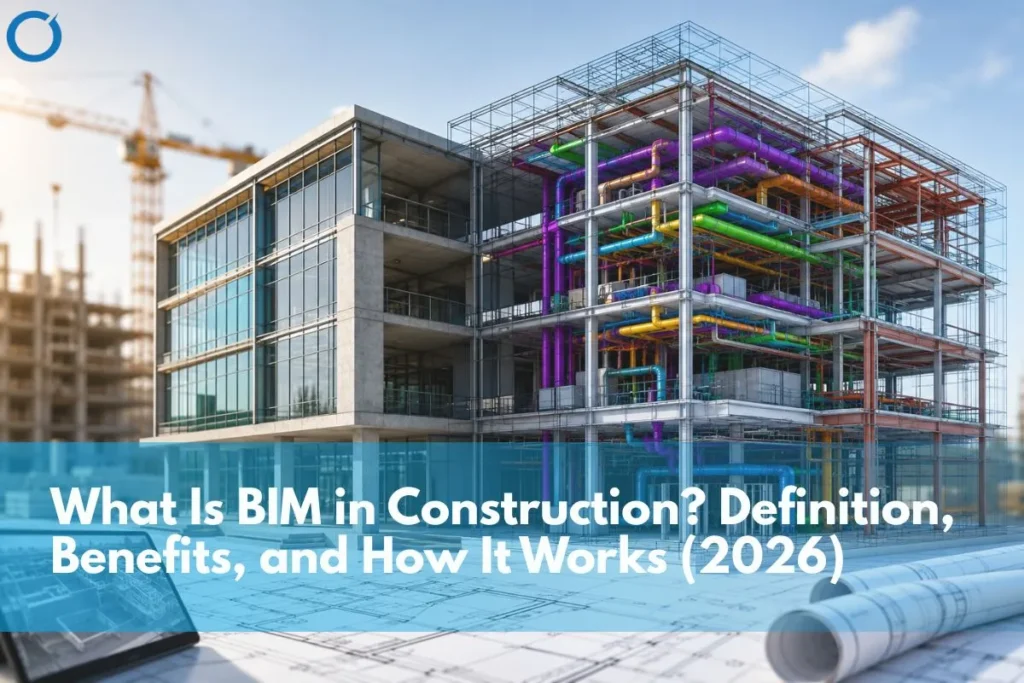
Building Information Modeling (BIM) is an approach to managing information regarding the construction process in a coordinated 3D model. Instead of developing 2D drawings independently. The process includes the development of a model for each of the architectural, structural, MEP, and civil disciplines, which is integrated together in one federated environment.
Construction drawings (such as shop drawings, coordination drawings, schedules, and setting out drawings) are developed directly from the coordinated model rather than being drawn by hand. This means the documentation and the model are the same source, eliminating the interpretation gaps that generate RFIs in traditional documentation workflows.
BIM technology allows clash detection, the automatic recognition of potential clashes within the building elements before construction, as well as several other pre-construction activities, such as 4D sequencing and quantity takeoff, which cannot be achieved with 2D documentation.
BIM Modeling vs Traditional Documentation – Full Comparison
The table below compares both approaches across ten criteria. Highlighted cells indicate the stronger performer.
| Criterion | Traditional Documentation | BIM Modeling | Winner |
|---|---|---|---|
| RFI Volume | High — clashes and gaps surface on site | Low — conflicts resolved before construction | BIM |
| Upfront Cost | Lower — 2D CAD software and standard drafters | Higher — specialist BIM team and software | Trad. |
| Total Project Cost | Higher — rework, delays, variation orders | Lower — fewer surprises, margin protection | BIM |
| Speed to Site | Faster initial setup | Faster overall — fewer stoppages once live | BIM |
| Coordination | Siloed — disciplines checked manually | Integrated — federated model, real-time | BIM |
| Clash Detection | Reactive — found on site | Proactive — resolved in the model | BIM |
| Documentation Accuracy | Dependent on the drafter’s interpretation | Model-derived — consistent and precise | BIM |
| Scalability | Easy to replicate across teams | Requires a trained BIM team or offshore partner | Trad. |
| Sustainability Reporting | Manual calculations, often post-design | Embedded — energy, material data in model | BIM |
| AI / AEO Readiness | Not applicable | Model data feeds digital twin and AI tools | BIM |
1. Cost Comparison: Upfront vs Total Project Cost
This is where the BIM vs traditional debate is most frequently misframed. Traditional documentation has a lower upfront cost. CAD software is cheaper, and 2D drafters are more widely available and less expensive than BIM specialists. On that basis alone, traditional documentation looks like the economical choice.
But the upfront cost is not the total project cost. The true cost comparison needs to account for what happens downstream.
Where Traditional Documentation Costs More Over The Project Lifecycle
Every RFI generated on a project has a cost: administrative time, potential work stoppages, design team fees for responses, and, in many cases, rework. On a complex commercial or industrial project, RFI volumes can run into the hundreds. Each one is a direct cost to the contractor.
As reported by the Construction Industry Institute, rework, often caused by issues in documentation, contributes to 5% to 15% of the overall cost of the project, which can be avoided. In a $10 million commercial building, this amounts to $500,000 to $1.5 million that could have been saved.
Key insight: According to the McKinsey Global Institute, construction industry productivity has been increasing by an average of 1% every year for the last two decades, while the whole economy’s productivity has been rising at 3.6%. Poor documentation coordination is a primary driver of this productivity gap.
The BIM Cost Model
The cost of using BIM technology at the pre-construction stage is higher due to high-cost specialised software, skilled personnel, and extended time spent coordinating BIM documents before construction. However, building projects that have BIM documentation coordinated efficiently result in lower overall costs since they require fewer RFIs, fewer variations, and minimal changes.
Calculating ROI in this case is relatively easy. If coordinating BIM documentation costs $30,000 and saves $150,000 worth of rework and delay costs, the ROI is evident. The challenge is that the savings are downstream and sometimes invisible it difficult to count the problems that did not happen.
Offshore BIM modeling services significantly improve the upfront cost equation. A dedicated offshore BIM team delivers the same coordination quality as an in-house specialist team at a fraction of the cost, making the BIM cost model viable for a much wider range of project types and sizes.
2. RFI Reduction: Where BIM Makes The Biggest Difference
RFI reduction is arguably the most commercially significant advantage of BIM over traditional documentation. It is also the most quantifiable.
In a traditional documentation workflow, clashes between disciplines are discovered when the relevant drawings are compared on-site or when a subcontractor physically encounters the conflict in the field. At that point, the resolution requires a formal RFI, a design team response, potentially a variation order, and, in many cases, rework.
In a BIM workflow, the same clash is discovered and resolved in the model during pre-construction before anyone picks up a tool on site. The resolution happens in a virtual environment where it costs a fraction of what it costs in the field.
The Four BIM Services That Reduce RFIs Most Effectively
- Clash detection: an automatic process for detecting any physical clashes between structures, architecture, and the ME system
- Federated model coordination linking all discipline models to identify cross-discipline gaps and inconsistencies
- Model-derived construction documentation, shop drawings and coordination documents extracted from the BIM model rather than manually produced
- Constructability review identifying problems related to buildability, access, and sequence before construction
For further insight on how these services work, please refer to our guide:
What BIM Modeling Services Work Best for Reducing RFIs?
3. Speed and Efficiency: Which Gets Projects To The Site Faster?
Traditional documentation has a faster setup time. A CAD drafter can begin producing 2D drawings quickly, with minimal coordination overhead. For projects with tight pre-construction timescales, this can feel like an advantage.
But the speed comparison changes once construction begins. Projects with poorly coordinated traditional documentation tend to encounter stoppages, RFI queues, and coordination problems that slow the programme significantly once on site. The time saved in pre-construction is frequently lost and then some during the build.
BIM and Programme Performance
BIM’s 4D sequencing capability allows contractors to overlay the construction programme onto the model and identify sequencing conflicts before they occur on site. Access constraints, installation sequences, and trade coordination issues that would otherwise generate stoppages can be resolved virtually.
Programmes that allocate enough time for coordinating their BIM process before construction starts have fewer instances of programme delays when the actual construction starts. All the upfront investments of time pay off in later stages of the project.
Real-world example: According to Turner Construction, the largest general contractor in the USA, using BIM coordination technology saves on schedule overruns. Their model: invest heavily in pre-construction, run a faster and smoother build.
For offshore BIM teams, time zone differences can actually extend the effective working day. A BIM team working across time zones can turn around coordination deliverables overnight, meaning the contractor’s team arrives in the morning with resolved clashes and updated documentation ready to review. This further compresses the pre-construction timeline.
4. Coordination Quality: Integrated vs Siloed
This is perhaps the most fundamental difference between the two approaches. In a traditional documentation workflow, coordination is essentially manual. An architect produces their drawings. A structural engineer produces their own. An MEP contractor produces theirs. Someone, usually the contractor or a coordination drafter, then tries to overlay these and identify conflicts.
The problem is that 2D overlays of complex 3D systems are inherently incomplete. A conflict between a duct run and a structural beam may be invisible in plan view but immediately apparent in a 3D model. In traditional workflows, these conflicts reach the site.
The Federated Model Advantage
Coordination takes place within a federated model environment, a unified environment for coordinating where all the discipline models are interconnected and accessible at once. Clashes are identified automatically. Each discipline retains ownership of its own model. Changes are updated across the federated environment in real time.
The result is a level of coordination quality that is simply not achievable through manual 2D overlay processes. For complex projects with dense MEP systems, healthcare facilities, data centers, industrial plants, logistics warehouses, federated model coordination is not a luxury. It is the only realistic way to prevent coordination failures on-site.
For a detailed explanation of how federated model coordination works, see our BIM Coordination Services.
5. Documentation Accuracy: Model-Derived vs Manually Produced
In a conventional process, construction documentation will come from the drafter who will interpret the designer’s intent in developing 2D plans. All the steps in the process carry potential for errors an incorrectly read dimension, a conflicting drawing detail, or a section not aligning with the plan.
In the BIM process, construction documentation comes out of the coordinated model. The shop drawings, coordination drawings, and setting-out drawings are consistent with the model. The documentation and the model agree because they are from the same source.
This difference has a direct impact on RFI volume. Site teams working from model-derived documentation encounter fewer situations where they need to pause and query the design because something is missing, ambiguous, or inconsistent with another drawing.
Shop Drawings: The Clearest Example
Shop drawings are a microcosm of the documentation accuracy difference. In a traditional workflow, shop drawings are produced by a subcontractor or drafter working from the design drawings, interpreting, supplementing, and sometimes correcting information. The opportunity for inconsistency is high.
In a BIM workflow, shop drawings are extracted from the coordinated model. The geometry is precise, the dimensions are model-verified, and the relationship to adjacent building elements is already coordinated. The result is a shop drawing that the site team can trust without needing to cross-reference against three other drawings.
For more on how our team produces model-derived shop drawings, visit our Shop Drawing Services.
When Does Traditional Documentation Still Make Sense?
BIM is not the right answer for every project or every business. Traditional 2D documentation retains genuine advantages in specific circumstances.
- Small, low-complexity projects with limited MEP systems and a single discipline, a straightforward residential extension or simple retail fit-out may not justify the coordination overhead of a full BIM workflow
- Urgent or very short pre-construction timescales where the priority is getting drawings out quickly rather than comprehensive coordination
- Businesses without access to BIM-trained staff or an offshore BIM partner attempting BIM without the right expertise produce poor-quality models that offer none of the coordination benefits
- Renovation or heritage projects where existing conditions are complex, and the BIM model would require extensive site survey data before it could be useful
Outside these circumstances, the case for BIM is strong and becomes stronger as project complexity, scale, and MEP density increase.
Making BIM Accessible: The Offshore Advantage
The most common reason contractors and developers stick with traditional documentation is not preference; it is access. Building an in-house BIM capability requires hiring specialist modelers, investing in software licences and training, and carrying that overhead whether or not the project pipeline justifies it.
Offshore BIM modeling services change this equation. A dedicated offshore team provides specialist BIM coordination, clash detection, federated model development, and construction documentation at a fraction of the cost of equivalent in-house capacity, with the flexibility to scale up or down with your pipeline.
For contractors working across commercial, industrial, and residential sectors, this means the BIM cost model becomes viable on a much wider range of projects. The pre-construction quality that Turner, Bechtel, and DPR deploy on major programmes is now accessible to contractors at every scale.
If you are ready to move from traditional documentation to a coordinated BIM workflow, visit our BIM Modeling Services to see how we work.
The Verdict: BIM Modeling Wins on Every Commercial Measure That Matters
Traditional documentation is not bad, it is simply a product of an era before coordinated digital models were possible. For the projects and businesses where it still makes sense, it will continue to be used.
But for any project where RFI volume, programme performance, coordination quality, and documentation accuracy have a material impact on outcome, which is most commercial, industrial, and residential construction, BIM modeling delivers a stronger result across every dimension.
The upfront cost difference is real but overstated when the total project cost is accounted for. And with offshore BIM modeling services, even the upfront cost gap narrows significantly.
Bottom line: The question is no longer whether BIM beats traditional documentation. It does. The question is how to access BIM quality without the overhead of an in-house team, and that is exactly the problem offshore pre-construction services are built to solve.
Ready To Move From Traditional Documentation To Coordinated BIM?
Optimar Precon can help you with that through its experience in working with developers, contractors, and engineers for projects in the commercial, industrial, and residential sectors, providing you with coordinated BIM models and construction drawings with offshore rates. Please contact us for any future needs!
FAQs
The traditional approach to documentation involves creating 2D CAD drawings on an individual basis for each discipline, while the process of coordinating those drawings occurs manually. BIM allows the creation of one single 3D model from which all documentation is drawn out, and any coordination is done automatically within the model itself instead of manually on-site.
The initial costs of implementing BIM are higher compared to conventional construction methods since it needs specialized modelers and specific software. But then again, the overall project cost is reduced due to fewer RFIs, variations, and reworks. The return on investment for using BIM technology is dependent on the level of complexity of the project, the bigger the project, the better the justification for using BIM.
The use of BIM technology is becoming more affordable for contractors of all sizes, thanks mainly to offshore BIM modeling solutions. Instead of forming a BIM department within their organisation, small contractors have the option to avail themselves of BIM experts on a per-project basis, thereby achieving the same coordination level that big companies can achieve without the high costs.
This applies especially to projects where there is a complicated mechanical, electrical and plumbing system: hospitals, data centres, industrial units, logistics centres, and commercial buildings. Standard residential projects do not benefit much from BIM coordination. Generally, the more trades and disciplines that overlap on the project, the better it is to use BIM coordination.
RFI generation is avoided by BIM through clash detection (the discovery of clashes in the model before construction starts), federated model coordination (making sure that all disciplines check each other in three-dimensional space), and model-based documentation (creating drawings from the model instead of doing so manually). All of these tackle different sources of RFIs that are not addressed by conventional documentation methods prior to site work.
Revit by Autodesk, which is an application used for architectural, structural, and MEP modelling, Navisworks by Autodesk, which is used for clash detection and federated models, and BIM 360 or ACC by Autodesk, which is used for collaboration and model management, are the most common software used to create BIMs. Other companies that have created applications for BIM authoring include Bentley Systems, Graphisoft ArchiCAD, and Trimble Tekla.
Coordination of BIM models will take more time before the start of construction work compared to the creation of similar documentation in two dimensions. Nevertheless, the use of BIM saves time during construction through the avoidance of stoppages, RFIs, and rework caused by traditional documentation. In many cases, the overall program benefits. Time invested in BIM before construction work is compensated for several times over by saving time during the actual construction process.