- What is Scan to BIM and Why It Matters in 2026
- Top Scan to BIM Challenges in 2026
- How to Overcome Scan to BIM Challenges
- Why Companies Are Outsourcing Scan to BIM Services in 2026
- How Optimar Precon Helps Overcome Scan to BIM Challenges
- Key Takeaways for Construction Professionals
- Ready to Improve Your Scan to BIM Workflow?
- FAQs
In short, the biggest scan to BIM challenges in 2026 are poor point cloud data quality from inadequate scanning, processing performance issues with large datasets, modeling complexity when interpreting irregular or deteriorated geometry, lack of standardization across LOD and naming conventions, coordination gaps between surveyors and BIM modelers, and high cost when projects are not scoped efficiently. Most of these challenges are preventable with proper scan planning, defined project standards, and experienced BIM professionals working from structured workflows.
Scan to BIM challenges in 2026 continue to impact project timelines, cost accuracy, and coordination across construction projects. While laser scanning and BIM technologies have evolved significantly, converting point cloud data into intelligent BIM models still presents practical hurdles for contractors, architects, and engineers.
From data inconsistencies to modeling inaccuracies, these challenges can delay decision-making and increase project risk. Understanding these issues and how to solve them is critical for construction teams aiming to improve efficiency and deliver high-quality outcomes.
What is Scan to BIM and Why It Matters in 2026
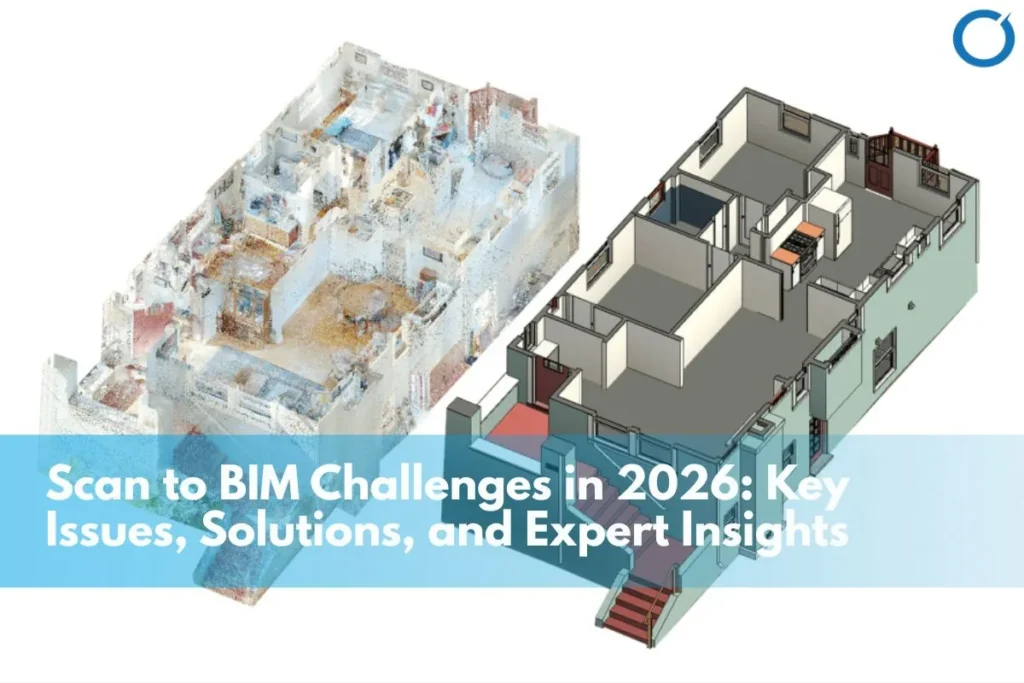
Scan to BIM is the process of capturing real-world conditions using laser scanning technology and converting that data into accurate 3D BIM models. These models are developed using advanced building information modeling services, which help project teams visualize and manage construction data more effectively.
In 2026, Scan to BIM plays a major role in:
- Renovation and refurbishment projects
- Digital twin development
- Facility lifecycle management
- Clash detection and coordination
- Accurate documentation of as-built conditions
However, the process is not always straightforward, especially when dealing with complex structures or outdated buildings.
Top Scan to BIM Challenges in 2026
Poor Quality Point Cloud Data
The success of any Scan to BIM project depends heavily on the quality of point cloud data. Inaccurate or incomplete scans can result in errors during modeling, especially when converting raw data into structured how scan to BIM works.
Common issues include:
- Missing scan coverage
- Low-resolution scans
- Environmental interference (lighting, reflective surfaces)
- Misaligned scan positions
Even minor inaccuracies at this stage can lead to major rework during modeling.
Handling Large Data Sets
Scan to BIM projects often involve massive point cloud files that are difficult to process efficiently. Without proper tools and workflows, teams struggle with performance issues and slow modeling progress, which is why many rely on optimized workflows supported by Revit modeling services to handle complex datasets more effectively.
Challenges include:
- Slow system performance
- Difficulty in managing large datasets
- Software limitations
- Increased processing time
Complexity in Converting Point Clouds to BIM Models
Transforming point cloud data into accurate BIM models remains one of the most complex stages in the process. Many teams rely on structured workflows such as CAD to BIM Services to convert raw scan data into usable models, supported by advanced Revit 3d modeling techniques to ensure precision and consistency.
Key difficulties:
- Identifying elements from point cloud data
- Modeling irregular geometries
- Interpreting unclear structural details
- Maintaining design intent
This process still requires skilled BIM professionals rather than relying on automation alone.
Lack of Standardization
Different projects often follow different modeling standards, which creates inconsistencies in output and coordination. To address this issue, teams rely on structured workflows supported by BIM Coordination Services, ensuring alignment in Level of Detail (LOD), naming conventions, and overall project requirements.
Problems include:
- Varying Levels of Detail (LOD)
- Different modeling conventions
- Inconsistent naming structures
- Misaligned project requirements
Without clear standards, collaboration becomes difficult across teams. See our guide on what is BIM coordination
Coordination Issues Between Teams
Scan to BIM projects require close collaboration between surveyors, BIM modelers, architects, and contractors. To improve coordination and reduce rework, teams often rely on MEP coordination services along with advanced Clash Detection Services to identify conflicts early and streamline communication across disciplines.
Common coordination issues:
- Miscommunication of requirements
- Delays in data sharing
- Inconsistent expectations
- Rework due to misalignment
This often results in project delays and cost overruns. See our guide on what is clash detection in BIM
High Cost and Time Constraints
Scan to BIM projects can become expensive if not managed efficiently.
Cost-related challenges:
- Skilled labor requirements
- Software licensing costs
- Rework due to inaccuracies
- Extended project timelines
Balancing accuracy and cost is a key challenge for project managers.
Difficulty in Capturing Complex Structures
Older buildings and complex structures are difficult to model accurately due to irregular geometries, hidden elements, and incomplete documentation. To address these challenges, teams use precise workflows supported by as-built BIM services to capture real-world conditions with higher accuracy.
Issues include:
- Irregular shapes
- Hidden elements
- Structural deformations
- Incomplete documentation
These factors make modeling more time-consuming and less predictable.
How to Overcome Scan to BIM Challenges
Invest in High-Quality Scanning
Ensure proper scanning techniques:
- Use high-resolution laser scanners
- Plan scan positions carefully
- Avoid environmental disruptions
- Perform quality checks on-site
Better input always leads to better output.
Use Advanced BIM Software and Tools
Handling complex scan data requires the right set of tools and workflows. Teams improve efficiency by implementing Revit modeling along with integrated workflows such as virtual design and construction Services, enabling better coordination and faster project execution.
Leverage tools like:
- Autodesk Revit
- Navisworks
- BIM 360
- Recap Pro
These tools help streamline modeling and improve collaboration.
Define Clear Project Standards
Set clear guidelines for:
- Level of Detail (LOD)
- Naming conventions
- Modeling scope
- Deliverables
This reduces confusion and ensures consistency across teams.
Work with Experienced BIM Professionals
Scan to BIM is not just a technical process it requires expertise.
Experienced teams can:
- Interpret complex scan data
- Reduce modeling errors
- Improve turnaround time
- Maintain accuracy
This is where outsourcing becomes a strategic advantage.
Optimize Data Management
Use structured workflows:
- Segment large datasets
- Use cloud-based collaboration
- Implement data compression techniques
- Maintain version control
Efficient data handling improves speed and accuracy.
Why Companies Are Outsourcing Scan to BIM Services in 2026
Construction companies are increasingly outsourcing Scan to BIM projects to improve efficiency, reduce operational costs, and access skilled expertise. By integrating workflows with construction estimating services, teams can improve cost planning, enhance project accuracy, and make better decisions during early project stages.
Outsourcing also helps businesses scale faster, handle large volumes of work, and maintain consistency across multiple projects without increasing internal overhead.
Key reasons include:
- Access to skilled BIM professionals
- Faster turnaround times
- Reduced operational costs
- Scalability for large projects
- Improved accuracy and consistency
Offshore teams in India provide a strong balance of technical expertise and cost efficiency, making them a preferred choice for global construction firms. See our guide on construction takeoff and estimation
How Optimar Precon Helps Overcome Scan to BIM Challenges
Optimar Precon supports contractors, architects, and engineers with end-to-end solutions powered by advanced BIM Services, accurate Point Cloud to BIM Services, and reliable scan to BIM services, helping teams improve coordination, reduce rework, and deliver projects with confidence.
Our approach includes:
- Accurate point cloud to BIM services conversion
- Support for multiple LOD requirements
- Integration with project workflows
- Use of advanced BIM tools
- Dedicated team aligned with your project
We act as an extension of your team, helping you reduce rework, improve coordination, and deliver projects with confidence.
Key Takeaways for Construction Professionals
- Scan to BIM is essential for modern construction workflows
- Data quality directly impacts model accuracy
- Skilled professionals are critical for successful execution
- Standardization improves collaboration
- Outsourcing can reduce costs and improve efficiency
Ready to Improve Your Scan to BIM Workflow?
Scan to BIM challenges can slow down your projects, but with the right strategy and expert support, they can be effectively managed. Whether you are working on renovation, retrofit, or large-scale infrastructure projects, having a reliable BIM partner makes all the difference.
If you’re looking to improve accuracy, reduce rework, and speed up delivery, it’s time to work with a team that understands both technology and construction workflows.
Get a Quote or Talk to a BIM Expert at Optimar Precon and take control of your next project.
FAQs
The biggest challenges include poor scan data quality, handling large datasets, modeling complexity, and lack of standardization across projects.
Accuracy improves with high-quality scanning, experienced BIM professionals, proper workflows, and clear project standards.
No, while automation tools exist, human expertise is still essential for interpreting point cloud data and creating accurate BIM models.
Companies outsource to reduce costs, access skilled professionals, and improve turnaround time without compromising quality.
Construction, architecture, engineering, facility management, and infrastructure sectors benefit the most from Scan to BIM solutions.