
- What Are MEP BIM Services?
- Why MEP BIM Coordination Matters on Complex Projects
- MEP BIM LOD Requirements: What Level of Detail Do You Actually Need?
- How Do MEP BIM Coordination Processes Work?
- How to Choose an MEP BIM Service Provider
- MEP BIM Services for Specific Project Types
- MEP BIM Services from Optimar Precon
- FAQs
The short answer: The MEP BIM services include modeling and coordination of mechanical, electrical, and plumbing systems in Building Information Modeling. In other words, an MEP BIM specialist will model each discipline system in Revit to certain levels of detail (HVAC, electricity distribution, plumbing, and fire protection) and then federate these models in Navisworks to find and solve all possible clashes between MEP systems and with the architectural and structural models. On projects that involve commercial buildings, healthcare facilities, and data centers, MEP systems represent 30-40% of construction costs and cause the majority of coordination problems. To avoid delays, rework, and RFIs during construction, the proper MEP BIM is essential.
Among all scopes of work in the building industry, mechanical, electrical, and plumbing scopes of work require maximum coordination due to their overlapping and interlocking with other scopes of work and each other. If they are not coordinated properly before the installation phase, they cause many problems on site.
MEP BIM services exist to solve this problem digitally before it becomes a physical one. This guide will detail what is involved within MEP BIM services, what the contractor/developer can anticipate from an MEP BIM service provider, how to determine their ability based on project requirements, and what makes a good MEP BIM provider over a modeling service provider.
What Are MEP BIM Services?
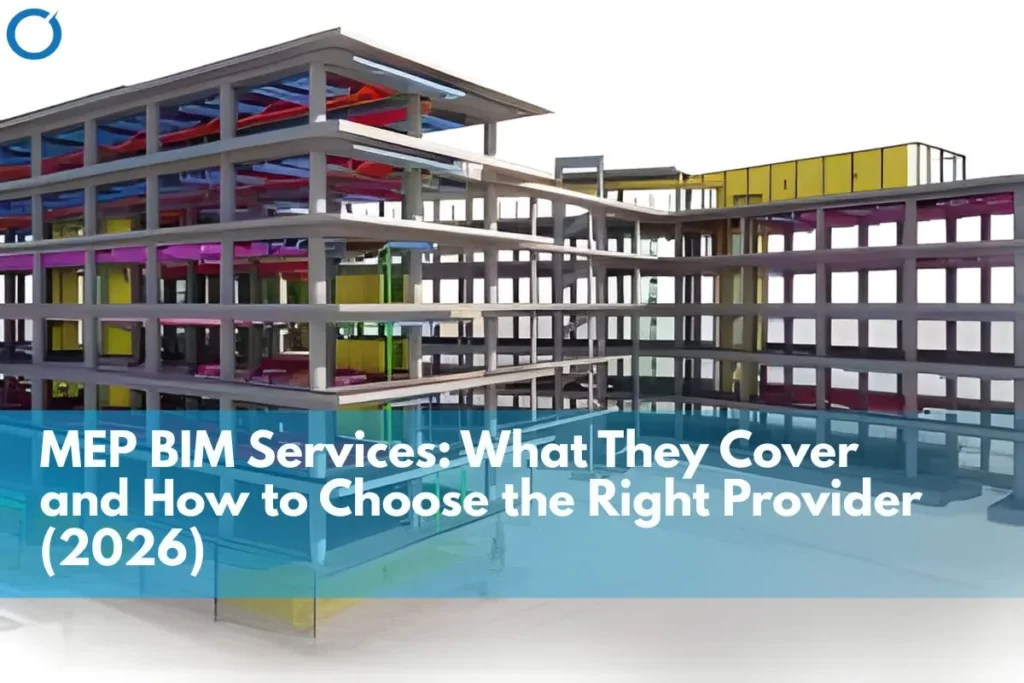
MEP BIM services involve the creation and coordination of three-dimensional Building Information Models for mechanical, electrical, and plumbing systems and, increasingly, fire protection systems, referred to collectively as MEPF.
Each discipline is modeled separately by specialist technicians working in Autodesk Revit. The discipline models are then federated in Navisworks and assembled into a single coordinated model that includes the architectural and structural elements, and clash detection is run to identify and resolve conflicts between systems.
The scope of MEP BIM services typically covers:
- Mechanical BIM – HVAC, such as AHUs, ducts, VAV boxes, diffusers, fan coil units, chilled water pipes, etc.
- Electrical BIM – electrical distribution systems starting from the main switchboard, via distribution boards down to final circuits, cable management, emergency services, etc.
- Plumbing BIM – Hot and cold water piping systems, drainage, soil and waste systems, sanitary fittings, water treatment systems, etc.
- Fire protection BIM – Automatic Sprinklers and firefighting systems, fire detection and alarm systems integrated with other services.
- Clash detection services and coordination – systematic identification and resolution of conflicts between all discipline models and the structural model
- Shop drawings – fabrication-ready drawings produced from LOD 400 models for MEP subcontractor use
- As-built documentation – LOD 500 models recording verified field conditions for handover and facility management
Why MEP BIM Coordination Matters on Complex Projects
On a standard commercial building, MEP systems occupy ceiling voids that are often 300- 600 mm deep. Within that space, structural beams, primary ductwork, secondary ductwork, cable trays, sprinkler mains, domestic water pipework, drain pipework, and lighting must all be routed without conflict, and all must be accessible for maintenance after installation.
Without BIM coordination services, trades route systems independently based on 2D drawings. Conflicts are discovered on site when one trade’s installation physically obstructs another. Resolving these conflicts on-site costs 10-15 times more than resolving them digitally before construction begins. To understand this impact in more detail, read our guide on how MEP BIM services reduce rework and construction delays.
| What MEP BIM Covers | Without MEP BIM | With MEP BIM |
|---|---|---|
| System coordination | Manual review – conflicts found on site | Federated model clash detection before construction |
| Routing efficiency | Estimated from 2D drawings – often incorrect | Optimized routing with clearance verification at LOD 350 |
| RFI volume | High – site teams constantly raising design queries | Low – conflicts resolved digitally before work starts |
| Prefabrication support | Limited – geometry not accurate enough | Full support – LOD 400 models drive fabrication drawings |
| Cost control | Late-stage variations from coordination failures | Early conflict resolution – fewer change orders |
| Handover documentation | As-built drawings compiled from site markups | LOD 500 as-built BIM model with embedded asset data |
On high-density projects, data centers, hospitals, laboratories, and pharmaceutical facilities, MEP coordination services are not optional. System density is so high that uncoordinated installation is structurally impossible. MEP BIM at LOD 350 or LOD 400 is the baseline requirement.
MEP BIM LOD Requirements: What Level of Detail Do You Actually Need?
The Level of Detail specifies the amount of information contained in a particular BIM model and its usability for further processes. For MEP services, LOD is the most important specification to get right before engaging a provider because the wrong LOD means either a model too thin to coordinate from, or unnecessary cost modeling detail that is never used.
| LOD Level | What the Model Contains | Primary Use |
|---|---|---|
| LOD 300 | Specific geometry, accurate dimensions, location, orientation | Design coordination and documentation |
| LOD 350 | LOD 300 plus interface and connection information between systems | MEP coordination, clearance verification, fabrication planning |
| LOD 400 | Fabrication-ready detail-specific components, connections, installation sequences | Shop drawings, prefabrication, installation guidance |
| LOD 500 | Verified as-built conditions, field-verified geometry and data | Facility management, asset data handover, lifecycle management |
In most commercial project coordination cases, LOD 350 is an ideal level of development to begin with. It offers sufficient detail for clearance verification, system interface coordination, and feasibility testing without the expenses associated with full-fledged fabrication-level detailing at LOD 400.
LOD 400 is applicable where MEP systems have been fabricated away from the site using information directly drawn from the BIM model. LOD 500 is required for handover to a facility management system or digital twin environment.
Identify the LOD requirement for every discipline and every phase of the project within the BIM Execution Plan before the start of any modeling process. LOD mismatch between what is specified and what is delivered is the leading cause of MEP BIM coordination failure.
How Do MEP BIM Coordination Processes Work?
It will be easier to make expectations clear and brief the right way after learning about the processes involved.
Stage 1: Design intent modeling
The first step involves developing design intent models by MEP engineers or design consultants at either LOD 200 or LOD 300, establishing the routes of systems and where the equipment will go.
Stage 2: Coordination modeling
It is then that the MEP BIM modeling company utilizes the design intent model and pushes it to the level of detail agreed upon, usually LOD 350 for coordination. This will involve the precise routing of all mechanical, electrical, plumbing, and fire protection systems within the given spatial envelope.
Stage 3: Model federation and clash detection
All of the disciplines’ architecture, structure, mechanical, electrical, plumbing, and fire protection are coordinated under Navisworks into one coherent model. Clash detection is done systematically, revealing hard clashes (intersection), soft clashes (clearance), and workflow clashes (sequence). Clash reports are issued to discipline teams for resolution. See our guide on Clash Detection in BIM
Stage 4: Coordination meetings and resolution
Coordination meetings bring discipline teams together to review clash reports and agree resolutions. The MEP BIM provider updates models to reflect agreed changes and reruns clash detection to confirm resolutions. This cycle continues until the model is clash-free.
Stage 5: Shop drawings and fabrication support
For projects involving prefabricated MEP assemblies, the LOD 350 coordination model is developed to LOD 400 fabrication-ready detail, including specific components, connections, and installation sequences. Shop drawing services are produced directly from the model for MEP subcontractor use.
Stage 6: As-built documentation
After installation is complete, site teams verify the model against field conditions. The model is updated through As-built BIM Services to LOD 500 verified as-built status and issued for handover. This becomes the data source for facility management, maintenance planning, and eventual renovation or decommissioning.
How to Choose an MEP BIM Service Provider
With the process understood, evaluating providers becomes straightforward. If you are comparing multiple BIM partners, you can also review our guide on BIM modeling service providers. Five criteria separate strong MEP BIM providers from basic modeling services:
1. LOD capability evidenced, not just claimed
Most providers claim LOD 100–500 capability. Request sample deliverables at LOD 350 for a project type similar to yours: commercial, healthcare, data centre, or industrial. A coordination model for a hospital MEPF installation looks very different from a residential plumbing model. Seeing actual deliverables at the LOD you need is more useful than any capability statement.
2. Coordination process, not just modeling
Have the provider explain how they do clash detection, how frequently coordination meetings occur, how their reports are set up, how they track their resolution process, and how their coordination model is kept intact throughout the cycle. A provider that can explain a process-driven approach to their coordination model is entirely different from someone who only does clash detection after modeling.
3. Software stack and workflow integration
Autodesk Revit MEP supports Revit Modeling Services, while Navisworks Manage supports model federation and Clash Detection Services. The third application is Autodesk Construction Cloud or BIM 360 for model management and coordination. Ask the provider about the software versions currently being used by them, along with their naming conventions and CDE structure. These operational details determine whether the model will integrate cleanly with your project team.
4. Sector experience in your project type
MEP coordination on a data center where rack densities drive extreme electrical and cooling load concentrations requires completely different expertise from MEP coordination services on a residential development. Ask for three completed project examples in your sector. If the provider cannot demonstrate sector-specific experience, the learning curve on your project will cost you time.
5. Communication structure and turnaround
For offshore MEP BIM providers, the time zone difference becomes an operational advantage when teams structure communication well. If the US or UK team submits work at the end of the business day, the offshore team can return updates the following morning. Ask how the provider communicates design changes, manages RFI response times, and assigns a dedicated coordinator to your account. Providers that route all communication through a generic inbox create coordination risk on complex projects. Providers who route all communication through a generic inbox are at a coordination risk on complex projects.
MEP BIM Services for Specific Project Types
Data Centers
Data center MEP coordination is among the most demanding scopes of Data Center Preconstruction Services in the construction industry. High-density server infrastructure drives extreme electrical load concentrations, complex cooling system routing, and strict clearance requirements around raised floor zones and overhead cable management. MEP BIM at LOD 350 minimum is standard practice on all but the smallest data center projects. Clash detection cycles are intensive; a typical hyperscale facility may run 5-8 coordination cycles before achieving a clash-free federated model.
Healthcare
MEP coordination in hospital projects comes with tight infection control standards, complicated medical gases systems, and HTM and FGI regulations in the UK and USA respectively. MEP BIM professionals who are undertaking a healthcare project require knowledge of these standards together with the fundamentals of coordination. Accessibility for maintenance purposes is very important; the systems must be routable for maintenance even after the installation process is complete.
Commercial High-Rise
Multi-storey commercial buildings present vertical coordination challenges: riser shafts, plant room layouts, and inter-floor connections between mechanical zones. MEP BIM at LOD 350 supports efficient riser design and plant room optimization, which directly reduces the structural zone allocation required for services, a significant spatial and cost saving on high-rise developments.
Industrial and Manufacturing
Industrial MEP includes process pipework, compressed air, specialist electrical systems, and heavy mechanical plant that are not present in commercial building projects. Providers need process engineering knowledge alongside BIM coordination capability. The LOD requirements are typically higher because installation tolerances are tighter and the consequences of coordination errors are more severe.
MEP BIM Services from Optimar Precon
Optimar Precon provides MEP BIM modeling and coordination services for contractors and developers in the USA and UK, delivered from delivery centres in New Delhi and Dallas with UK coordination support from Chertsey, England.
Our MEP BIM services cover:
- Mechanical BIM – HVAC ductwork, pipework, plant and equipment modeling in Revit MEP
- Electrical BIM – power distribution, cable tray, containment, lighting and emergency systems
- Plumbing BIM – supply, drainage, sanitary, and fire protection system modeling
- Clash detection and coordination – systematic clash detection in Navisworks with coordination meeting support
- Shop drawings – fabrication-ready drawings at LOD 400 for MEP subcontractors
- As-built documentation – LOD 500 verified models for handover and facility management
- Integration with Quantity Takeoff Services and Construction Estimating Services – quantity extraction from BIM models for cost planning. For a detailed explanation of takeoff fundamentals, read what is quantity takeoff in construction.
We work to LOD 100-500 across all MEP disciplines, using current versions of Autodesk Revit, Navisworks, and BIM 360. Our coordination workflows follow ISO 19650 information management standards for UK projects and project-specific BIM Execution Plan requirements for USA projects.
If you are looking for MEP BIM services support on your next project, get in touch to discuss your scope and LOD requirements.
FAQs
MEP BIM modeling refers to the creation of 3D models of mechanical, electrical, and plumbing systems using Revit software by positioning equipment, piping, and ductwork and adding information related to those systems at a certain Level of Detail. On the contrary, MEP BIM coordination refers to the act of analyzing the 3D models for any discrepancies and performing clash detection on the model using Navisworks software.
MEP BIM software used in the industry includes Autodesk Revit MEP for discipline-specific modeling, Navisworks Manage for clash detection and model integration, and Autodesk Construction Cloud or BIM 360 for model management and reviews. MEP BIM providers use AutoCAD to prepare 2D documentation and shop drawings. Some providers also use Dynamo to automate workflows and support parametric modeling tasks. Verify the compatibility of the software versions used by your MEP BIM provider to ensure interoperability within your project team’s existing software.
For most commercial coordination projects, LOD 350 is the appropriate specification. LOD 350 adds interface and connection information between systems, including ductwork connections to air handling units, pipework connections to mechanical plant, and cable tray connections to distribution boards. This level of detail helps project teams verify installation feasibility and spatial clearances. LOD 300 is sufficient for design coordination but not for prefabrication or detailed installation planning. Project teams should use LOD 400 when they plan to fabricate MEP systems off-site, because the model can generate fabrication drawings.
The timeline depends on the project size, the complexity of the MEP systems, and the number of coordination meetings required. For example, a moderately sized commercial building between 5,000 sqm and 15,000 sqm may take 3–6 weeks for the first phase of an LOD 350 MEP coordination model. Data centers and hospitals with high MEP density take longer. The most significant driver of timeline is the quality and completeness of the design intent models provided; incomplete or inconsistent input drawings extend the coordination timeline significantly.
Yes, offshore MEP BIM coordination services have been a proven method for US and UK contractors for quite some time now. MEP coordination services from BIM outsourcing teams based in India have been rendering quality service for large projects internationally for over 20 years. What key elements make offshore MEP coordination successful? Others include the LOD level as outlined in the BIM Execution Plan, the timing of the meetings, the revision process, and a coordinator assigned by both sides. Another benefit of outsourcing the work to India is the time difference, which helps complete the tasks within normal working hours.