- Why BIM Continues to Transform Construction
- Trend 1: Digital Twin Integration with BIM
- Trend 2: AI-Assisted BIM Modeling
- Trend 3: Cloud-Based BIM Collaboration
- Trend 4: Increased Use of 4D and 5D BIM
- Trend 5: BIM for Prefabrication and Modular Construction
- Trend 6: Growing Demand for BIM Coordination Expertise
- Why Many Construction Companies Are Outsourcing BIM Services
- How Structured BIM Services Improve Project Outcomes
- Preparing Your Construction Projects for the Future of BIM
- Supporting Construction Teams with Reliable BIM Expertise
- FAQs
In short, The six most important BIM trends in 2026 are: digital twin integration with BIM models for operational monitoring; AI-assisted clash detection and design optimization; cloud-based BIM collaboration platforms enabling real-time multi-team coordination; increased adoption of 4D BIM for construction sequencing and 5D BIM for cost integration; BIM-driven prefabrication requiring highly accurate coordinated models; and growing demand for specialist BIM coordination expertise as project complexity increases.
The construction industry is constantly changing. The complexity and duration of projects are increasing, and the level of precision required from digital project documentation is rising. Building Information Modeling (BIM) is now an integral part of the technology stack used in the modern construction industry.
In the past, contractors, architects, and engineering companies could not afford to ignore building information modeling trends in 2026. Companies that are utilizing the right building information modeling technology are becoming more efficient and productive.
However, many construction companies are now realizing that managing building information modeling internally is not easy. Companies are realizing that they need specialized skills and expertise in building information modeling and coordination across multiple projects.
In this article, we are going to discuss the top building information modeling trends in the construction industry in 2026.
Why BIM Continues to Transform Construction
Before delving deeper into new BIM trends, it is vital to understand the reasons why BIM has come to be an essential aspect of the construction team. Many construction companies now rely on professional BIM Services to create structured digital models that support better coordination and project planning.
Traditional 2D drawing techniques have been a barrier to communication among designers, engineers, and contractors. Any change to a set of drawings can easily cause conflicts with another set of drawings. This has led to coordination errors, installation conflicts, and delays in the construction process.
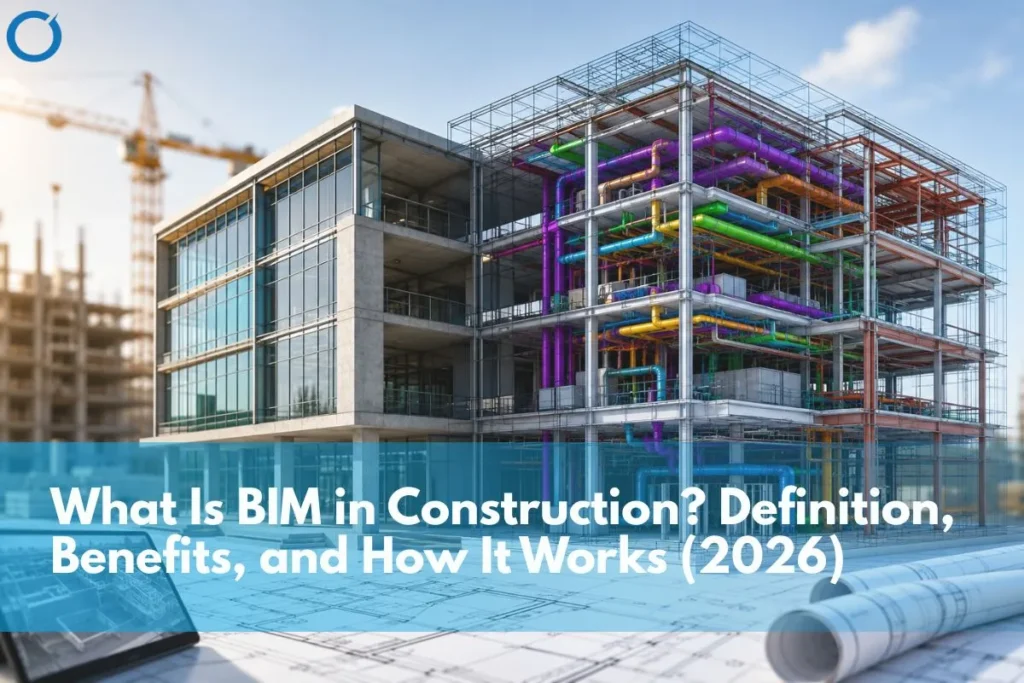
However, BIM has transformed the way construction takes place. BIM has enabled the creation of coordinated digital models of the entire building. The models include the architecture, structure, and MEP of the building within a single platform. The construction can be visualized even before the commencement of the construction process.
With BIM workflows, construction teams can:
- Identify clashes between systems early
- improve installation planning
- reduce project rework
- maintain accurate construction documentation
- support better collaboration between project stakeholders
Given the benefits of using BIM, the adoption of this technology is growing in commercial, infrastructure, and industrial construction projects.
Now, let’s look at the trends in BIM technology that will influence the construction industry in 2026.
Trend 1: Digital Twin Integration with BIM
The most significant change in the AEC industry is the integration of digital twin technology and BIM models.
A digital twin is a dynamic digital representation of a building or infrastructure project. Although BIM provides data during the construction and design phases of a project, digital twins provide data during the operational phase.
When BIM is connected to sensors and data from the building, construction teams and managers can monitor:
- Equipment performance
- Energy usage
- Maintenance needs
- Operational efficiency
For construction companies, BIM models act as a foundation for digital twins in construction environments, facilitating construction as well as management of buildings.
This trend is creating a need for structured BIM models, ensuring accurate information as well as coordination of systems at the commencement of a project.
Trend 2: AI-Assisted BIM Modeling
Artificial Intelligence is slowly entering the BIM industry in different ways.
AI-assisted technologies can analyze BIM design models, recognizing potential coordination problems. These systems help teams identify errors that might otherwise appear during construction.
AI is also improving:
- Automated clash detection
- Design optimization
- Construction sequencing analysis
- Cost forecasting using BIM data
Although these tools improve the BIM process, they need good BIM models to function. Therefore, poorly coordinated models will not allow the AI tools to function well.
As a result, many companies are now seeking ways to improve BIM models and coordination standards before integrating AI tools. See our guide on what is clash detection in BIM
Trend 3: Cloud-Based BIM Collaboration
It is not uncommon to find multiple teams involved in a construction project, with team members located in various places. Therefore, BIM cloud technology allows these teams to collaborate in real-time.
Instead of having to share models, the team can use a shared BIM platform where they can collaborate and manage coordinated project data created through professional BIM Modeling Services.
Cloud collaboration platforms support:
- Real-time model access
- Coordination meetings
- Model reviews
- Issue tracking
- Centralized project documentation
This is an ongoing trend that is improving collaboration between architects, engineers, contractors, and subcontractors. It is also allowing teams to work on larger and more complex projects in a transparent manner.
Nevertheless, collaboration is still dependent on BIM models.
Trend 4: Increased Use of 4D and 5D BIM
Conventional BIM models mainly concentrate on 3D geometry. However, modern BIM practices also consider other dimensions.
4D BIM: This BIM model incorporates the time factor into BIM models. This enables the visualization of the project’s sequence.
5D BIM: This BIM model enables the integration of cost information into BIM models.
These BIM models assist contractors:
- Plan construction phases more accurately
- Manage procurement timelines
- Control project costs
- Reduce delays caused by coordination issues
As the construction time is reduced, these BIM capabilities are becoming more and more useful for the construction of projects.
Trend 5: BIM for Prefabrication and Modular Construction
Construction techniques such as prefabrication and modular construction are increasingly popular in the industry.
Traditionally, the systems were assembled directly on site. However, nowadays, the components are fabricated off-site.
This approach requires extremely accurate BIM models.
Prefabricated systems rely on precise dimensions and coordinated routing of building systems. Even small modeling errors can create installation problems during assembly.
BIM supports prefabrication by providing:
- Detailed fabrication models
- Coordinated MEP routing
- Accurate system dimensions
- Installation planning before site work begins
For contractors working with prefabricated components, BIM modeling has become an essential part of the project workflow.
Trend 6: Growing Demand for BIM Coordination Expertise
As projects become more complex, the coordination of various building systems becomes essential.
All mechanical, electrical, plumbing, and structural systems must be accommodated within the available space in the buildings. If not properly coordinated, conflicts may arise during the construction process.
This has created a growing demand for specialized BIM coordination services that guarantee the coordination of various building disciplines.
Proper BIM coordination allows for:
- Detect clashes between systems
- Resolve routing conflicts
- Optimize building space usage
- Maintain accurate construction documentation
These coordination workflows have now been established as best practice for many large construction projects. See our guide: BIM coordination explained
Why Many Construction Companies Are Outsourcing BIM Services
Although BIM technology has been evolving, managing BIM workflows has been a challenge for many companies.
Construction companies face several challenges:
- Limited in-house BIM resources
- Multiple projects requiring modeling support
- Tight project deadlines
- Specialized coordination expertise requirements
Because of these challenges, many firms prefer to outsource the BIM modeling services.
Outsourcing BIM services allows firms to:
- Scale BIM resources based on project demand
- Access experienced BIM specialists
- Maintain consistent modeling standards
- Reduce internal staffing pressure
- Improve project turnaround times
Rather than developing in-house BIM teams that might be idle between projects, firms can have the BIM support they need.
How Structured BIM Services Improve Project Outcomes
Construction firms that adopt a structured BIM approach to their projects often experience enhanced project results.
Design conflicts can be avoided early on through coordinated BIM models, thus minimizing costly rework during the construction phase.
Digital coordination can also facilitate effective communication among the various stakeholders involved in the project.
Through the adoption of BIM models, the following can be achieved:
- Review system layouts before installation
- Improve construction planning
- Reduce project risks
- Deliver more accurate documentation
For construction firms and contractors who are handling multiple projects, the availability of experienced BIM support can be very beneficial.
Preparing Your Construction Projects for the Future of BIM
The construction industry is constantly changing, and the use of digital technology is becoming the norm. Construction firms that are able to grasp the changing trends in BIM will be able to manage complex projects and produce quality construction projects.
The implementation of BIM technology, such as digital twins, cloud technology, and modeling, requires a structured BIM implementation.
Most construction firms are enhancing their Building Information Modeling service delivery by hiring experienced BIM support.
Supporting Construction Teams with Reliable BIM Expertise
At Optimar Precon, we assist contractors, engineers, and construction companies with our structured BIM services that are adapted to the reality of the projects.
We help construction companies with accurate BIM models that assist them with coordination, planning, and construction.
We provide support across multiple BIM workflows, including:
- BIM modeling services
- common challenges in MEP BIM modeling
- CAD to BIM conversion
- clash detection workflows
- BIM documentation and project coordination
With our extensive experience in assisting various construction projects, our teams can help you achieve better digital coordination in your construction projects.
If your construction projects need reliable BIM support, our experts are ready to help your team.
FAQs
The most important trends in the field of BIM are the integration of digital twins, the use of artificial intelligence in BIM, cloud-based collaboration, the use of 4D and 5D BIM, and prefabrication using BIM.
It is becoming essential for construction companies because BIM allows for the coordination of projects, minimizes design conflicts, and assists construction teams in accurately planning installations before the start of construction work on the site.
Using BIM, construction teams are able to identify clashes in the system before the start of the construction work, thus reducing errors that could have occurred during the construction work.
The difference between the two is that BIM is used for the design and construction of buildings, whereas digital twins are the integration of the performance of buildings with BIM.
Many firms are choosing to outsource BIM services because it allows them access to experienced BIM modeling specialists.
Get Your Instant Quote