- How CAD Services Have Evolved Over Time
- Key Trends Shaping the Future of CAD Services
- How CAD Supports Modern Construction Workflows
- Challenges in CAD Services and How They Are Being Solved
- Role of AI and Automation in the Future of CAD Services
- When Should You Upgrade Your CAD Workflow
- Why CAD Services Are Critical for Project Success
- Best Practices for Implementing Modern CAD Workflows
- How Optimar Precon Supports CAD and Drafting Needs
- Build Future-Ready CAD Workflows for Better Project Outcomes
- FAQs
In short, seven main trends define the future of CAD services in 2026. They include integration with BIM processes, increasing popularity of 3D modeling and visualization, use of artificial intelligence and automation in drafting, rising demands for shop drawings and fabrication drawings, as-built documentation for facility management, a connection between construction estimation and take-off, and increased outsourcing of CAD work to offshore locations.
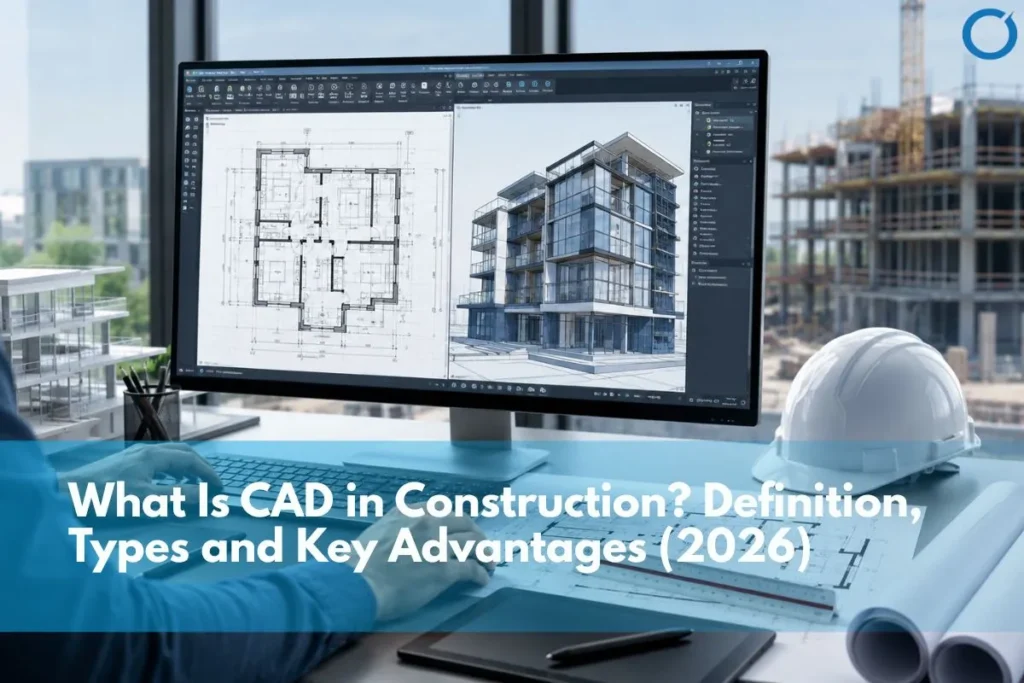
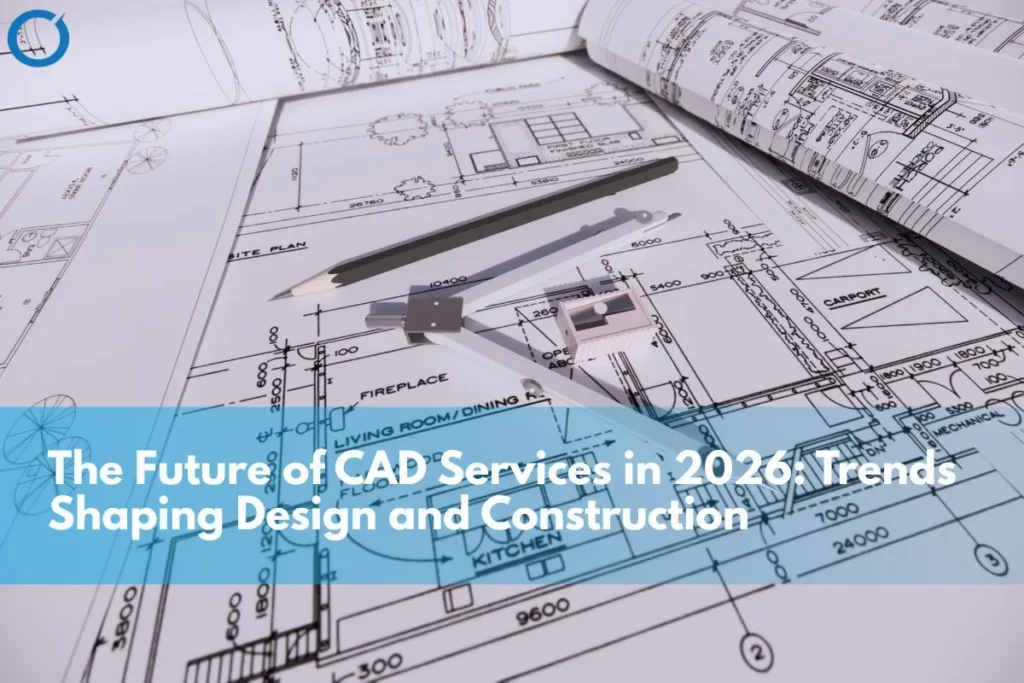
The future of CAD services in 2026 is rapidly evolving as construction projects demand higher precision, faster turnaround, and seamless coordination across disciplines. CAD is no longer just a drafting tool, it has become a critical component of modern digital construction workflows.
As digital construction continues to evolve, CAD is becoming a bridge between traditional drafting and advanced modeling workflows. Its integration with BIM, estimation, and execution processes is redefining how construction projects are planned and delivered.
Today, companies rely on advanced CAD drafting services combined with BIM Services to improve design accuracy, reduce rework, and enhance project efficiency. As technology advances, CAD continues to play a vital role in bridging design, planning, and execution.
How CAD Services Have Evolved Over Time
CAD services have transformed significantly over the past decade.
Earlier CAD workflows focused on:
- 2D drafting and documentation
- Manual design updates
- Limited collaboration
In 2026, CAD workflows now include:
- 3D modeling and visualization
- Integration with BIM environments
- Real-time collaboration across teams
- Automated drafting and detailing
This evolution has made CAD an integral part of end-to-end project delivery.
Key Trends Shaping the Future of CAD Services
1. Integration of CAD with BIM Workflows
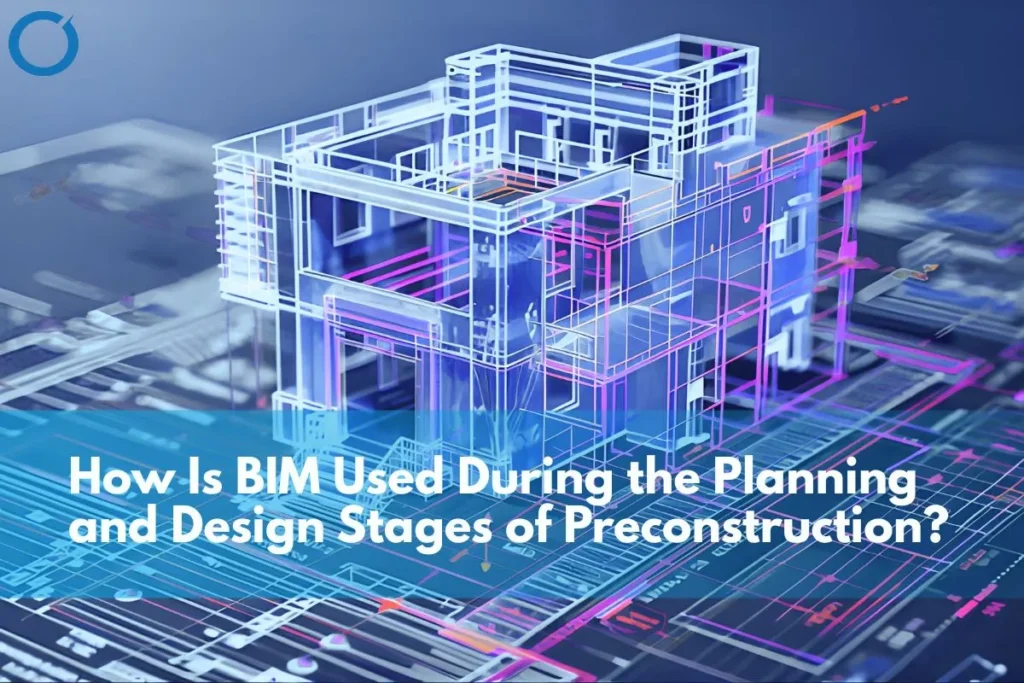
One of the biggest trends in 2026 is the integration of CAD with BIM.
Through CAD to BIM Services, companies can convert traditional drawings into intelligent 3D models, improving coordination and project visualization.
Benefits include:
- Better design accuracy
- Improved coordination
- Reduced design conflicts
- Enhanced collaboration
2. Rise of 3D CAD Modeling and Visualization
3D modeling is becoming the standard across projects.
Using 3D CAD Drawing Services, teams can:
- Visualize designs more effectively
- Identify issues early
- Improve client presentations
This shift is reducing dependency on traditional 2D workflows.
3. Automation in CAD Drafting
Automation is transforming CAD processes by reducing manual effort and improving efficiency.
Key automation benefits:
- Faster drafting and revisions
- Reduced human errors
- Consistent output quality
- Improved productivity
Automation tools are enabling teams to focus more on design and less on repetitive tasks.
4. Increased Demand for Shop and Fabrication Drawings
Detailed drawings are becoming critical for accurate construction execution.
Using shop drawing services and fabrication drawing services, contractors can:
- Improve on-site accuracy
- Reduce installation errors
- Enhance coordination with contractors
5. CAD for As-Built and Documentation Workflows
As-built documentation is gaining importance for project handover and facility management.
Through as-built drawing services, teams can:
- Document final construction accurately
- Support maintenance and operations
- Improve long-term asset management
6. Integration with Construction Takeoff and Estimation
CAD is now closely linked with estimation workflows.
By combining CAD with quantity takeoff services, companies can:
- Extract accurate quantities
- Improve cost estimation
- Reduce material waste
This integration improves financial planning and project efficiency.
For a full explanation of how this works in practice, see our guide on: what is quantity takeoff in construction
7. Growing Role of Offshore CAD Services
In 2026, many companies are outsourcing CAD services to improve scalability and reduce costs.
Key advantages include:
- Access to skilled professionals
- Faster turnaround times
- Cost-effective solutions
- Ability to scale resources
Offshore teams are becoming an extension of in-house design teams.
For a practical guide to what CAD services include and how offshore teams deliver them, see: What are CAD services
How CAD Supports Modern Construction Workflows
CAD is no longer isolated—it works alongside BIM, estimation, and execution workflows. By integrating with advanced BIM modeling services, CAD helps improve coordination, accuracy, and overall project efficiency.
Key roles include:
- Supporting design development
- Enabling coordination across disciplines
- Providing accurate construction documentation
- Assisting in project planning and execution
This makes CAD a foundational element in modern construction. When aligned with workflows like construction estimating services, it also supports better cost planning and decision-making.
Challenges in CAD Services and How They Are Being Solved
Despite advancements, CAD workflows still face challenges.
Common challenges:
- Managing large volumes of drawings
- Maintaining consistency across teams
- Handling frequent design revisions
- Coordination between disciplines
Solutions in 2026:
- Integration with BIM workflows
- Use of automation tools
- Standardized drafting processes
- Outsourcing to experienced teams
Role of AI and Automation in the Future of CAD Services
In 2026, artificial intelligence and automation are playing a significant role in transforming CAD workflows. What once required hours of manual drafting can now be completed faster with intelligent tools that assist in design generation, error detection, and standardization.
Modern CAD environments are increasingly integrated with automation features that help:
- Generate repetitive drawing elements automatically
- Detect inconsistencies and errors in real time
- Improve drafting speed and accuracy
- Maintain standardized drawing outputs across projects
AI-powered CAD tools are also enabling predictive design improvements by analyzing previous project data. This allows teams to make better design decisions and reduce the chances of errors during later stages of construction.
As automation continues to evolve, CAD services are becoming more efficient, scalable, and reliable, allowing teams to focus on critical design and coordination tasks rather than repetitive drafting work. These workflows also complement services like CAD Conversion Services, enabling faster transformation of legacy drawings into usable formats.
When Should You Upgrade Your CAD Workflow
Many companies continue using outdated CAD processes, which can limit efficiency.
You should upgrade when:
- Projects are becoming more complex
- Coordination issues are increasing
- Turnaround time is slowing down
- You need better integration with BIM
Modern CAD workflows enable better accuracy, speed, and collaboration.
Why CAD Services Are Critical for Project Success
In 2026, CAD services are essential for:
- Accurate design documentation
- Smooth coordination across teams
- Efficient project execution
- Reduced rework and delays
Companies that invest in advanced CAD workflows gain a significant competitive advantage, especially when aligned with construction estimating services for better planning and cost control.
Best Practices for Implementing Modern CAD Workflows
To fully leverage the benefits of CAD services in 2026, companies need to adopt structured and optimized workflows. Simply using CAD software is no longer enough, how it is implemented plays a crucial role in project success.
Best practices include:
- Standardizing drawing templates and layers
- Maintaining consistency across all project drawings
- Integrating CAD with BIM Services and estimation workflows
- Using automation tools to improve efficiency
- Ensuring proper coordination between disciplines
It is also important to align CAD processes with project requirements and team capabilities. Companies that invest in training, process improvement, and technology adoption can significantly enhance productivity and accuracy.
By following these best practices, construction teams can reduce errors, improve collaboration, and deliver projects more efficiently.
How Optimar Precon Supports CAD and Drafting Needs
Optimar Precon helps contractors, architects, and engineers streamline their design workflows with reliable and scalable solutions.
Our expertise includes:
- Professional CAD drafting services
- Accurate architectural CAD drawings services
- Detailed structural CAD drawings services
- High-quality MEP CAD drawing services
- Seamless integration with BIM Services
We help you improve accuracy, reduce rework, and deliver projects efficiently.
Build Future-Ready CAD Workflows for Better Project Outcomes
The future of CAD services is driven by automation, integration, and scalability.
Companies that adopt modern CAD workflows will:
- Improve project efficiency
- Reduce operational costs
- Enhance coordination
- Deliver projects faster
If you are looking to upgrade your CAD workflows and improve project performance, working with experienced professionals can make a significant difference.
Get a Quote or Talk to an Expert at Optimar Precon to optimize your CAD workflows.
FAQs
Ans1. The future of CAD services will be characterized by the gradual shift from independent CAD software to integral parts of digital construction processes. The main drivers include automated CAD services powered by AI, which will save time on drafting; integration with BIM models to detect errors; cloud-based systems that allow remote team members to share a single set of drawings; and rising interest in offshore CAD services that deliver specialized skills at lower cost. The worldwide market size for CAD services is expected to reach $22.5 billion by 2034 from an estimated $12.0 billion in 2024. (Fortune Business Insights, 2026)es.
Ans2. CAD creates drawing documents of 2D/3D geometric representations of buildings. In BIM, the creation of intelligent models in which all elements have properties such as costing and interrelation information helps coordinate, resolve clashes, and manage the building’s lifecycle. CAD and BIM are not competitive but rather complementary: the creation of drawings through CAD is sometimes the first step to creating a BIM model, and in fact, it is the main construction document on BIM-coordinated projects.
Ans3. The reasons companies outsource their CAD needs include a 40-70% reduction in overhead costs, access to specialized expertise to develop various outputs such as shop drawings and MEP schematics, scalable manpower to meet project demands, and quick bids. While offshore CAD firms produce output of the same quality as onshore firms, it is the competence of the CAD team and the quality assurance process that make the difference, not the location.
Ans4. Construction, architecture, engineering, manufacturing, and more.
Ans5. By providing accurate drawings, improving coordination, and reducing rework.