
- What Is BIM Coordination?
- The BIM Coordination Process – 8 Steps
- The Federated Model – The Foundation Of BIM Coordination
- Clash Detection – The Core Activity Of BIM Coordination
- Who Is Involved In BIM Coordination – Roles and Responsibilities
- The BIM Coordinator – The Role That Drives Coordination Quality
- The Role Of BIM Coordination In Pre-Construction Planning
- BIM Coordination and MEP – The Highest-Value Application
- BIM Coordination Standards – BEP, LOD, and ISO 19650
- Offshore BIM Coordination – Quality Without The Overhead
- Need End-To-End BIM Coordination for Your Next Project?
- FAQs
In Short: The process of BIM coordination involves bringing together the discipline-specific BIM models (architectural, structural, and MEP) into one federated model, identifying and solving all the issues before starting construction, and creating construction documents based on the coordinated and conflict-free model. This concept plays an essential role in construction because it avoids coordination problems that cause RFI, rework, and delay in the program through virtual solutions before construction starts. It is headed by a BIM coordinator and follows an 8-step process based on the BIM Execution Plan.
The construction process fails in the exact same ways time after time. There’s a duct that hits a steel beam. There’s a conflict between a drain line and a cable tray. The two trades are booked to do the same work in the same zone at the same time. The access path that was clearly shown in the drawings is now blocked by the steel structure.
This is all lack of coordination, and all of these things can be avoided. They aren’t due to any flaw in the design; rather, they result from the failure to coordinate the information gathered during the designing process by the various disciplines involved, including architects, structural engineers, and mechanical and electrical contractors.
This is precisely why BIM coordination was created. BIM coordination is the process of gathering all the information, examining it systematically, solving any conflicts that may arise, and creating construction documentation for an entirely coordinated design. If it is carried out effectively, the outcome will be a project which arrives at the job site in the form of construction documentation ready to build from.
What Is BIM Coordination?
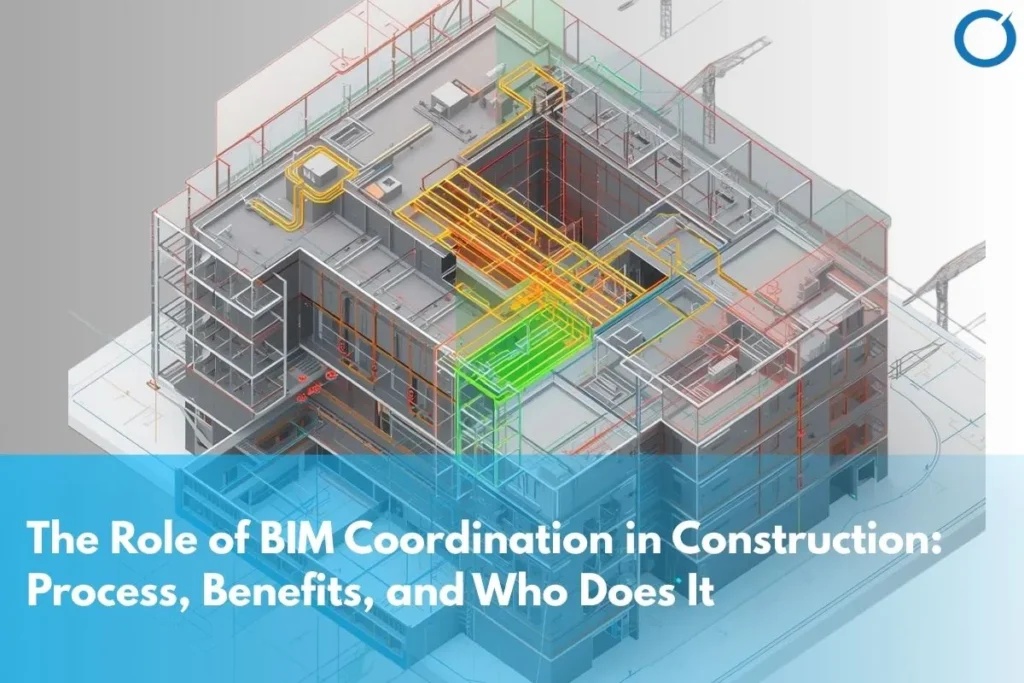
BIM coordination brings individual BIM models from multiple project participants into one coordinated federated model and helps teams resolve clashes before construction documentation begins.
Sometimes, it refers to any form of collaboration involving BIM models. However, BIM coordination requires a particular methodology, software tools, and deliverables. BIM coordination does more than exchange models between disciplines. It brings teams together to develop an interference-free federated model that supports reliable construction drawings.
Key distinction: BIM coordination does not mean BIM modeling. BIM modeling services focus on creating 3D models for each discipline. Coordination combines those models, resolves the conflicts between them, and delivers construction documentation. Modeling is an input to coordination. Coordination is the process that makes the models usable for construction.
The BIM Execution Plan (BEP) manages BIM coordination. All stakeholders sign off on this project plan, which defines who models each element, at what Level of Detail (LOD), by when, using which software, and according to which standards. Without the BEP, there will be no coordination, or it will be erratic. With the right BEP, everyone knows what to do, and all deliverables have specifications.
The BIM Coordination Process – 8 Steps
BIM coordination follows a defined sequence of activities from initial planning through to construction documentation delivery. The table below maps each step, the tools used, and the output delivered.
| Step | Activity | Tools | Output |
|---|---|---|---|
| 1 | BEP development | BIM Execution Plan template | Agreed model structure, LOD requirements, deliverable schedule, software standards, and responsibilities for all parties |
| 2 | Discipline model production | Revit, ArchiCAD, Tekla | Models for each architecture, structure, and MEP system were individually created to the predetermined LOD level for each discipline. |
| 3 | Federated model assembly | Navisworks, BIM 360 / ACC | All discipline models are linked into a single coordinated environment, viewable by the full project team |
| 4 | Clash detection runs | Navisworks Clash Detective, Solibri | Automated clash report identifying all hard, soft, and clearance conflicts by location, type, and severity |
| 5 | Clash triage and assignment | BIM Track, Newforma, BIM 360 Issues | Each clash is reviewed, categorized, and assigned to the responsible discipline for resolution |
| 6 | Resolution and model update | Revit, Tekla, ArchiCAD | Discipline models updated to resolve assigned clashes. Re-run confirms clearance |
| 7 | Construction documentation | Navisworks, Revit | Shop drawings, coordination drawings, and setting-out information extracted from a coordinated, clash-free model |
| 8 | 4D sequencing (if specified) | Navisworks Timeliner, Synchro | The construction sequence is validated spatially against the programme before any trade mobilises |
The Federated Model – The Foundation Of BIM Coordination
The federated model is the environment in which BIM coordination takes place. The resultant model is not amalgamated; rather, it is a coordinated combination of independent discipline models brought together into a single environment.
The architect keeps updating the architectural model. The structural engineer maintains theirs. The MEP contractor maintains theirs. The BIM coordinator integrates all of these models into one federated model through Navisworks, BIM 360, or similar software. Anytime there is an update to the model by any discipline, it will be integrated into the federated model.
Such an approach allows for each discipline to retain ownership of its particular model while facilitating cross-discipline analysis needed for coordination. It is the main factor that ensures that BIM coordination can be scaled up to fit large projects involving many stakeholders.
What Happens In The Federated Model
- Clash detection – automated identification of physical conflicts between elements from different disciplines
- Visual review – the full project team can view all disciplines simultaneously in 3D and identify issues that automated detection may not capture
- Constructability review – installation sequences, access routes, and workspace requirements checked against the coordinated geometry
- 4D sequencing – the construction programme linked to model elements to validate the build sequence spatially
- Construction documentation services – shop drawings, coordination drawings, and setting-out extracted from the resolved model
Clash Detection – The Core Activity Of BIM Coordination
Clash detection services use automated checks to identify physical conflicts between elements from different discipline models within the federated environment. This is the fundamental analysis involved in BIM coordination and the main tool used to prevent any coordination problems from happening on the job site.
Coordination teams need to resolve four types of clashes: hard clashes, where two components occupy the same physical space; soft clashes, where components sit too close together; workflow clashes, where trade schedules conflict; and clearance clashes, where the design does not leave enough room for maintenance access or compliance.
Why LOD 350 is important to clash detection: Clash detection, especially regarding clearance and soft clashes, needs models to be at the LOD 350 level, not the LOD 300 level. At LOD 300, we see the ductwork but not the jacketing or hangers. LOD 350 includes these elements, making clearance conflicts visible. The majority of on-site coordination problems are clearance clashes that went unnoticed at LOD 300.
To learn about clash detection types, software, processes, and cost benefits, please refer to our dedicated guide: What is clash detection in BIM?
Who Is Involved In BIM Coordination – Roles and Responsibilities
All project parties share responsibility for BIM coordination, but each party follows a defined role within the coordination process. Below is a chart of the roles and their responsibilities.
| Role | Responsibilities in BIM coordination | Primary tools |
|---|---|---|
| BIM Manager | Responsible for the BIM Execution Plan, establishes standards, oversees the coordination process, and ensures that everyone adheres to the established protocol | Revit, Navisworks, BIM 360 / ACC, ISO 19650 framework |
| BIM Coordinator | Builds up the federated model, performs clash detection, handles the clash log, assigns issues, and manages their resolution | Navisworks Clash Detective, BIM Track, Newforma |
| Discipline Modeller | Provides the model of the discipline (architectural, structural or MEP) at the LOD agreed and modifies the model in light of clash resolution | Revit MEP, ArchiCAD, Tekla Structures, AutoCAD MEP |
| Principal Contractor | Reviews the coordination model for constructability and programme alignment. Approves the federated model before construction documentation is issued | Navisworks, BIM 360, Synchro (for 4D) |
| Specialist Subcontractor | Generates BIM shop drawing services outputs from the coordinated LOD 400 model for manufacturing and installation purposes Can generate speciality models (such as structural steel, curtain wall). | Revit, Tekla, specialist fabrication software |
| Client / Owner | Reviews the coordinated model for compliance with the Employer’s Information Requirements (EIR). Takes delivery of the LOD 500 as-built model at project completion | BIM 360, ACC, Solibri (for compliance checking) |
The BIM Coordinator – The Role That Drives Coordination Quality
The BIM Coordinator serves as the focal point for the coordination process. The success of the BIM Coordinator will determine if the coordination process yields a clash-free model or a coordinated model that misses crucial clashes.
An efficient BIM Coordinator has construction experience beyond BIM software knowledge. They can assess the severity and resolution options for each clash, communicate effectively with discipline teams, manage the issue log to closure, and make constructability judgements about the coordinated design. These are construction skills as much as digital skills.
This is why the quality of the BIM Coordinator, not just the quality of the software, is the most important factor in coordination outcomes. A poor coordinator with good software will miss the clashes that matter. A skilled coordinator with standard tools will catch them.
The Role Of BIM Coordination In Pre-Construction Planning
BIM coordination sits at the heart of pre-construction planning. Its role is to resolve, before construction begins, the coordination problems that would otherwise emerge as RFIs, rework, and programme stoppages during the build.
The commercial logic is straightforward. A coordination conflict costs significantly more to resolve on-site than in the model. The Construction Industry Institute (CII) consistently finds rework accounts for 5–15% of total project costs. BIM coordination helps project teams reduce this figure by resolving the conflicts that cause rework before any physical work begins.
BIM Coordination and RFI Reduction
Every clash the team resolves in the federated model prevents a potential RFI from reaching the site. On a complex commercial or industrial project with thorough BIM coordination, the RFI volume reduction is substantial. For a detailed breakdown of which BIM coordination services reduce RFIs most effectively, see our guide: What BIM modeling services work best for reducing RFIs?
BIM Coordination and Programme Performance
BIM coordination improves programme performance through two mechanisms. First, fewer coordination failures on site means fewer unplanned stoppages that disrupt the programme. Furthermore, teams can add 4D sequencing to the coordination process to validate the construction sequence spatially before work begins. This helps prevent sequence-related issues that could disrupt the programme.
See What is 4D BIM sequencing? for an extensive explanation on 4D sequencing and its coordination processes.
BIM Coordination and MEP – The Highest-Value Application
The highest-value application of BIM coordination on commercial and industrial projects is MEP coordination, the integration of mechanical, electrical, and plumbing systems into the federated model and their coordination against structural and architectural elements. MEP systems are the most spatially demanding components of any building, and MEP-related clashes are the most common and costly category of coordination conflict on commercial projects. For a full breakdown, see our guide on BIM modeling for MEP coordination.
MEP coordination at LOD 350 prevents most costly site conflicts by checking connections, clearances, and installation interfaces before construction begins. A coordination workflow that stops at LOD 300 will miss the clearance clashes that generate the most expensive rework. On a complex MEP project, teams can resolve hundreds of additional conflicts when they coordinate at LOD 350 instead of stopping at LOD 300.
BIM Coordination Standards – BEP, LOD, and ISO 19650
The BIM Execution Plan (BEP)
The BEP is the governing document for BIM coordination on a project. It defines the coordination scope, LOD requirements per element type, software standards, file naming conventions, model review schedule, and the roles and responsibilities of each party. A well-structured BEP is the difference between a coordination workflow that delivers reliable results and one that produces models of uncertain quality.
The BIM Manager typically produces the BEP at the start of the project, and all parties agree on it before modeling begins. It references the BIMForum LOD Specification for US projects and ISO 19650 for UK and international projects.
LOD Requirements for Coordination
The LOD level specified in the BEP determines the quality of clash detection that is achievable. LOD 300 supports initial coordination and major clash identification. Full MEP coordination requires LOD 350, including clearance checks and installation interface conflict reviews. LOD 400 supports fabrication. For a full explanation of what each LOD level includes and when to use it, see our guide: BIM LOD levels explained.
ISO 19650
The ISO 19650 standard refers to the international standard for information management in BIM projects. This includes the ways of information creation, distribution, and management throughout the project lifespan, as well as the allocation of duties in a BIM project. For UK and international projects, contract documents increasingly require ISO 19650 compliance, and UK government-procured projects mandate it. For US projects, the BIMForum LOD Specification and AIA BIM documents are the relevant references.
Offshore BIM Coordination – Quality Without The Overhead
Building in-house BIM coordination capability requires specialist BIM coordinators, software licences (Navisworks, Revit, BIM 360), and enough project volume to keep that capability fully utilized. For many contractors and developers, this is not commercially viable.
Offshore BIM coordination services provide a practical alternative. A dedicated offshore team runs the full coordination workflow, including BEP development, federated model assembly, clash detection, triage, resolution management, and construction documentation at a fraction of the cost of equivalent in-house capacity. The quality of BIM coordination depends on the expertise of the team and the rigour of the process, not the physical location of the specialists.
For contractors looking for a dedicated BIM coordination partner, visit our BIM Coordination Services. And for a guide to choosing the right provider, see: How to choose the right BIM modeling service provider.
Need End-To-End BIM Coordination for Your Next Project?
Optimar Precon offers you our BIM coordination service, which involves creating a federated model, clash detection, MEP coordination, and documentation for construction purposes for your firm, whether you are an engineer, contractor, developer, or architect. We offer you our offshore BIM coordination services that cost a fraction of what you will incur in hiring in-house professionals. Please get in touch with us regarding your upcoming project.
FAQs
BIM coordination involves merging all the individual BIM models of each discipline – architectural, structural, and mechanical, electrical, plumbing – into one integrated environment, detecting any clashes among them, resolving them, and generating construction documents from the integrated model. Its purpose is to avoid issues of coordination, clashes, misunderstandings, and sequencing that can cause problems on-site in the form of Requests for Information, rework, and project delays.
BIM modeling is the production of 3D models by individual disciplines, architectural, structural, or MEP, to specified LOD levels. BIM coordination is the process of combining those models into a federated environment, running clash detection to identify conflicts, managing their resolution, and extracting construction documentation from the coordinated model. Modeling produces the inputs. Coordination produces the outputs that construction teams can rely on.
A federated BIM model brings separate discipline models, including architectural, structural, and MEP models, into one coordinated viewable environment without merging them into a single file. Each discipline retains ownership of its own model. Any changes a discipline makes appear in the federated environment. Teams use the federated model to run clash detection and produce coordinated construction documentation.
The BIM Coordinator creates the federated model from discipline models, runs automatic clash detection, reviews the clashes, assigns each issue to the relevant discipline, tracks resolution until the team delivers a clash-free model, and documents the full coordination process. This is also the role of the BIM Coordinator to manage the BIM Execution Plan and facilitate the meeting between models.
The BIM Execution Plan (BEP) is the controlling document in relation to the BIM coordination process in any particular project. The document outlines the level of detail required by each project milestone and for each element type, the type of software, file formats, model review plan, names, and responsibilities of each contributor to the model. Project teams should develop a carefully crafted BEP before they begin modeling the project.
Effective BIM coordination, particularly for MEP systems, requires models at LOD 350. LOD 300 models are accurate geometrically but do not include connections, interfaces, or support clearances. This means LOD 300 coordination misses clearance clashes, insufficient space for insulation, hangers, or maintenance access, which are among the most common and costly conflicts discovered on site. LOD 350 includes these elements, making it the minimum standard for reliable coordination on complex projects.
BIM coordination reduces construction costs primarily by preventing rework. The Construction Industry Institute (CII) consistently finds rework accounts for 5–15% of total project costs. BIM coordination reduces rework because teams resolve coordination issues in the model before construction, at a much lower cost than fixing them on-site. Other areas that benefit include RFIs due to minimized costs and reduced impact on the program, fewer variation orders, and fewer program interruptions through unforeseen stoppages.