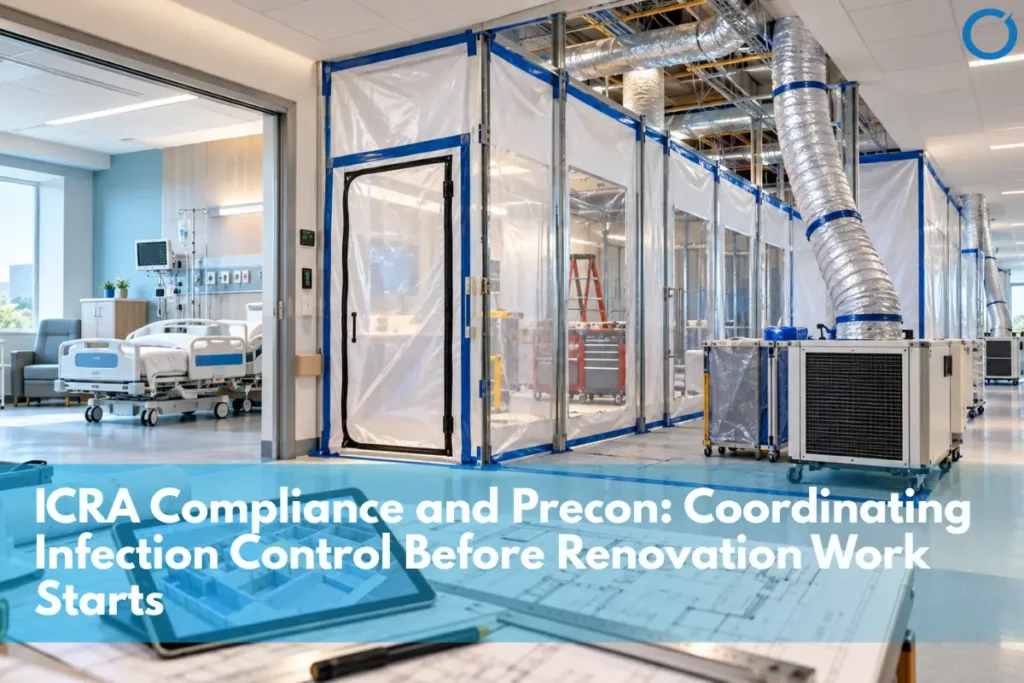
The Infection Control Risk Assessment (ICRA), on the other hand, is the process through which an infection control facility evaluates what level of infection control measures will be needed for the construction project. This evaluation involves matching the type of construction work with the patient population within the hospital. The outcome becomes the barrier and air filtration requirements of the project, which become scope, cost, and schedule for the precon team. It is not paperwork to sort out after award.
An ICRA crosses the type of construction activity (Types A through D) with the patient risk group in the affected area (low through highest) to produce a class of precautions, Class I through IV in the original matrix, with ASHE’s 2022 ICRA 2.0 adding a fifth tier. Work of Class III and IV requires formal approval for infection control prior to beginning construction. ICRA is part of the FGI Guidelines, which are referenced by most state licensing boards, and the Joint Commission demands pre-construction risk assessment from accredited institutions. Precon requires knowledge of class, barrier construction, air handling, cleaning, lead times, and costs, which depend on the class.
How an ICRA Gets Classified
The process is a matrix, not a judgment call. Four inputs produce the answer:
- Step 1: Define the activity classification. Activities are classified as Type A (inspection and minimal activity) to Type D (long duration and healthcare construction activity) based on the invasiveness of the activity and the amount of dust created.
- Step 2: Define the patient risk category. Affected areas are categorized from lowest to highest risk category. In case of multiple risk categories, the higher category controls.
- Step 3: Interpret the matrix. Activity type and patient risk category intersect to provide a classification of precautions. A Type A activity in a lowest risk area will be classified as Class I, while a Type D activity will be Class IV regardless of the risk category of the affected area.
- Step 4: Obtain permission where necessary. Class III and Class IV activities require permission for infection control prior to the start of construction.
| Activity Type | What It Covers | How It Lands on the Matrix |
|---|---|---|
| Type A | Inspection and non-invasive activity | Lowest impact. Class I when the affected area is low risk. |
| Type B | Small-scale, short-duration work | Class steps up as the patient risk group rises. |
| Type C | Activity that generates moderate to high levels of dust | Higher classes as risk rises, with Class III or IV in the highest-risk areas. |
| Type D | Major duration and construction activity | Class IV regardless of the area’s patient risk group. |
Facilities produce their own matrices, and hence the language used for each of the classes will be unique to each individual hospital. The structure remains constant, which is activity type, patient risk category, and then the class produced.
Why ICRA Isn’t Optional
The facilities create their own matrices, and thus the language that will be used for each of the classes will be specific to each individual hospital. The format stays the same, which is activity type, risk to patient, and then the class generated.
- FGI Guidelines. The Guidelines by the Facility Guidelines Institute on design and construction necessitate that there should be an ICRA in order to achieve an integrated planning, design, construction, and commissioning process. The ICRA comes through when state health departments incorporate FGI in their construction codes.
- The Joint Commission. Its Environment of Care standards call for a pre-construction risk assessment on air quality, infection control, utilities, noise, and vibration. However, it does not provide a tool, and ICRA is the known method to fulfill the requirement.
- Facility ownership. The owner is responsible for conducting the ICRA, using a multidisciplinary team that includes infection prevention, facilities engineering, and the contractor’s representative.
- Documentation. Documentation of a risk assessment is supposed to be done even in the case of minimal risk, since the documentation will prove that the guidelines have been followed.
What the Class Means for Precon Scope
The class an ICRA assigns isn’t a compliance footnote. It is the scope of work the contractor must address through Construction Estimating Services and project scheduling, and the higher the class, the more that scope grows.
- Containment. Higher classes require critical barriers or a control-cube method completed before work begins.
- Barrier construction. Temporary barriers need to be fire-resistant in nature and can be composed of either non-combustible or limited combustible materials such as gypsum boards.
- Air handling. Sealing the ventilation systems, HEPA filtration, and exhaust control systems are increased with the classes, which means that the mechanical system needs to be considered in relation to the work environment.
- Cleaning and verification. The higher the classes, the more frequent cleaning is required, as well as an inspection conducted by safety and infection control departments.
- Permit lead time. Class III and IV approval is a schedule dependency, not a formality that can be handled on day one.
- Monitoring during work. FGI Guidelines call for ongoing monitoring to verify that infection control measures are holding, which means someone has to be assigned and priced to do the checking.
Where Precon Gaps Show Up
The overwhelming majority of ICRA surprises stem from one common factor – the classification was determined after pricing the work. When a contractor prices the job as general interior work and later finds out that it is in fact Class IV, he is dealing with barriers, air handling, and cleaning that were never factored into the number.
- The classification isn’t requested before bidding. It should arrive with the bid documents for each work area, not after award.
- Barriers are priced as temporary plastic when, in fact, a rated partition needs to be installed.
- The mechanical engineer does not consider HVAC isolation; therefore, sealed vents and exhaust ductwork need to be done on site. These problems also show why BIM coordination in construction matters when temporary barriers, HVAC systems, utilities, and occupied spaces interact during renovation.
- The phasing plan does not consider that debris and traffic routes may pass through the patients’ area.
- Separate individuals determine the scope of the ILSM and ICRA scopes; hence some barriers and egress may get missed.
Newer Wrinkles Worth Knowing
The ICRA framework keeps evolving, and a facility may be working from any of these:
- ICRA 2.0. ASHE’s 2022 revision refined the activity-type and risk-group definitions and added a fifth precaution class, so a facility may use the original four-class matrix or the updated tool.
- Interim Life Safety Measures. The Joint Commission requires an ILSM assessment for construction projects, meant to be coordinated with the ICRA because barrier materials and egress changes affect both.
- Water management. ICRA has traditionally focused on airborne dust and pathogens. Tools such as the WMC-ICRA extend the same matrix logic to waterborne pathogens like Legionella during construction.
Turning the Classification Into Drawn Scope
A synchronized 3D model ensures that both the ICRA team and the contractor see the same image in terms of the location of barriers, which air handlers and ducting systems are serving the construction area, and how construction traffic flow relates to patient flow. This is the importance of MEP BIM services at this stage, as it transforms a theoretical class assignment into an actionable scope definition prior to work commencement, and it becomes highly important especially in the context of renovations involving other trades accessing the walls too, such as zone valve retrofitting resulting from medical gas installation.
IP professionals are not construction experts, and construction professionals are not IP experts. A synchronized 3D model provides both sides with something tangible to approve. BIM Coordination Services give infection prevention, design, and construction teams one coordinated model for reviewing these interfaces before work begins.
Questions to Ask Before You Bid
Five questions, answered before pricing starts, close most of the gaps above:
- Which patient risk group applies to each work area, and who determined it?
- Is the facility using the original four-class matrix or ASHE’s ICRA 2.0?
- Has infection-control approval been requested, and what is the lead time for the class this work will carry?
- Who verifies barrier integrity and cleaning, how often, and is that cost in the bid?
- Is an ILSM assessment running alongside the ICRA, and who owns the barrier and egress decisions that affect both?
Planning a Healthcare Renovation?
Optimar Precon prices ICRA precautions as defined scope , from barriers to air handling to cleaning, before the bid goes out. Contact us to discuss your project.
FAQs
ICRA is built into the FGI Guidelines, which many states adopt into health facility codes, and the Joint Commission requires a pre-construction risk assessment from accredited organizations. The Joint Commission doesn’t prescribe a specific tool, but ICRA is the recognized method.
The property owner is accountable, coordinating with the multidisciplinary team comprising of infection prevention and facilities engineers, along with the contractor’s representative.
Class IV is the highest class level within the original matrix and the one with the most stringent controls, including an exhaust system and inspections after the completion of the project. Both require infection control clearance and critical barriers or a control-cube approach before commencing work.
Any construction or renovation project which may affect patient care areas needs a documented risk assessment. Most of the small projects are classified either as Type A or B and are usually of a lower class but need classification anyway.
Yes, traditionally. Dust and infectious agents in the air, like mold spores, were of prime importance; however, today’s technology allows extending the same process to waterborne agents, for example, Legionella.