
- Role of P&ID Drawings in Engineering and Construction
- Challenges in Managing P&ID Drafting In-House
- Why Engineering Firms Are Outsourcing P&ID Drafting Services
- Integration with BIM and Digital Engineering Workflows
- Control Logic and Instrumentation Representation in P&IDs
- Quality Control and Validation in P&ID Drafting
- Impact on Project Coordination and Execution
- Managing Revisions and As-Built Documentation
- When Should You Outsource P&ID Drafting
- Key Considerations When Choosing a P&ID Drafting Partner
- How Optimar Precon Supports P&ID Drafting Services
- What This Means for Engineering Firms in 2026
- FAQs
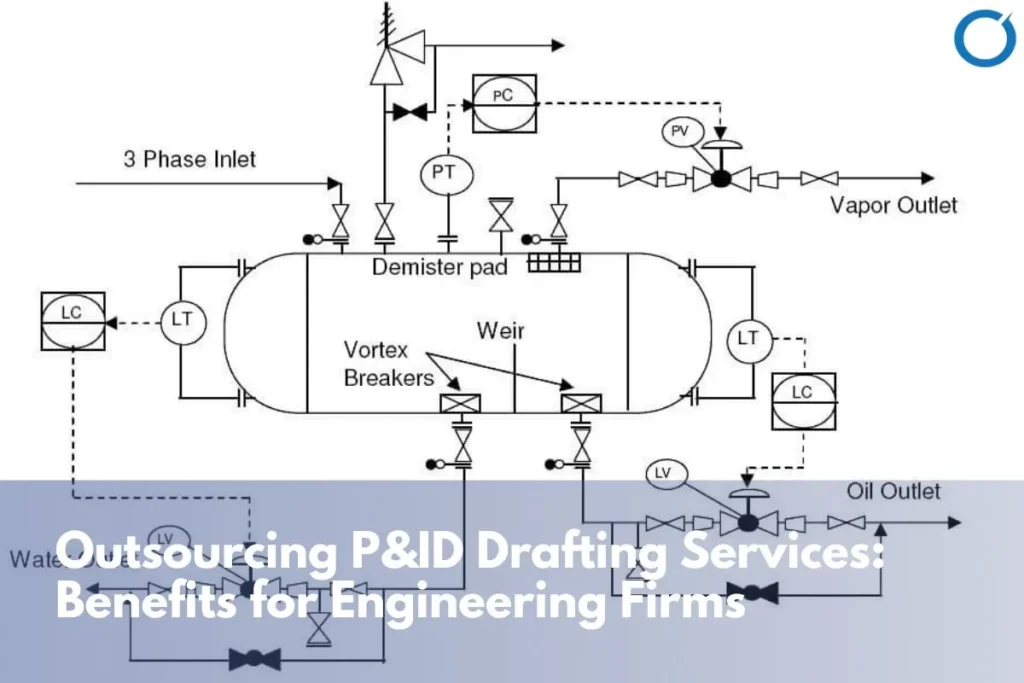
P&ID drafting services are fundamental to engineering, process design, and industrial construction projects. These drawings define the relationship between piping systems, instrumentation, control logic, and process equipment, making them essential for design coordination, construction execution, and plant operations.
As engineering projects become more complex and data-driven, maintaining accurate and consistent P&ID documentation internally has become increasingly challenging. This is why many firms are choosing to outsource P&ID drafting services to improve efficiency, maintain quality, and scale their operations without increasing overhead.
P&ID drafting in modern projects involves detailed representation of process flow, line numbering, instrument tagging, and control loop integration, ensuring that all systems are aligned with engineering standards and operational requirements.
Role of P&ID Drawings in Engineering and Construction
P&ID drawings act as execution-level documents that guide multiple stakeholders across the project lifecycle.
Core Functions of P&IDs
- Define process flow, system logic, and interconnections
- Identify piping routes, valves, instruments, and control systems
- Support coordination between process, mechanical, and instrumentation teams using CAD drafting services
- Serve as reference for construction, commissioning, and maintenance
These drawings also define control philosophies, interlocks, and shutdown sequences, which are critical for process safety and system reliability during operation.
Unlike conceptual diagrams, P&IDs provide detailed and structured information required for installation and operational accuracy.
Even minor inconsistencies in these drawings can lead to:
- Installation conflicts
- System inefficiencies
- Safety risks and compliance issues
Challenges in Managing P&ID Drafting In-House
Engineering firms often face operational and technical challenges when handling P&ID drafting internally.
Key Challenges
1. Limited Skilled Resources
Finding experienced professionals who understand process engineering, instrumentation, and drafting standards can be difficult.
2. High Workload Variability
Project demands fluctuate, making it inefficient to maintain large in-house drafting teams at all times.
3. Coordination Gaps
P&ID development requires collaboration across multiple disciplines. Lack of coordination can lead to inconsistencies across MEP CAD drawings and engineering documentation.
4. Revision Management Issues
Frequent design updates require continuous revisions, which can be difficult to manage without structured workflows.
5. Standardization Challenges
Ensuring consistency in symbols, tagging, and documentation across projects is often a major concern.
Inconsistent tagging conventions, missing line specifications, and lack of coordination between process and instrumentation layers can lead to discrepancies between design documentation and actual installation.
These challenges directly impact project timelines, quality, and overall execution efficiency.
Why Engineering Firms Are Outsourcing P&ID Drafting Services
Outsourcing has evolved into a strategic approach for managing engineering documentation.
Key Benefits of Outsourcing
Access to Specialized Expertise
Outsourcing partners provide professionals with experience in:
- Process engineering drawings
- P&ID symbols and standards
- Industrial plant documentation
These capabilities are often supported by advanced CAD drawing services and structured drafting workflows.
This ensures technically accurate and industry-compliant drawings.
Scalability Based on Project Requirements
Outsourcing allows firms to:
- Scale resources up or down
- Handle multiple projects simultaneously
- Manage peak workloads efficiently
This flexibility is critical for large and multi-phase projects.
Faster Turnaround Times
Dedicated drafting teams and structured workflows enable:
- Quicker drawing preparation
- Faster revision cycles
- Improved project timelines
Parallel execution across multiple tasks significantly reduces delays.
Cost Optimization
Outsourcing reduces:
- Hiring and training costs
- Infrastructure and software expenses
- Long-term resource commitments
At the same time, firms benefit from high-quality deliverables without increasing operational costs.
Improved Accuracy and Consistency
Outsourcing partners follow standardized processes, ensuring:
- Consistent use of symbols and tagging systems
- Alignment with industry standards (ISA, ISO)
- Reduced risk of documentation errors
This leads to clear and reliable engineering documentation supported by construction documentation services and structured drafting workflows.
Integration with BIM and Digital Engineering Workflows
Modern engineering projects are increasingly dependent on integrated digital workflows.
How Outsourced P&ID Services Support BIM
- Alignment between P&ID drawings and 3D BIM models
- Improved coordination between process and design teams
- Early detection of inconsistencies between schematic and physical layouts
- Better visualization of complex systems
Integration of P&IDs with BIM environments enables alignment between schematic diagrams and 3D models, particularly for equipment layout, piping routes, and system clearances.
This integration ensures that P&IDs function as part of a coordinated engineering ecosystem rather than standalone documents.
Control Logic and Instrumentation Representation in P&IDs
P&ID drawings also capture control loops, instrumentation signals, and process interdependencies. This includes transmitters, controllers, and actuators, which are essential for maintaining process stability and automation.
These systems are often integrated with MEP BIM services to ensure coordinated modeling of piping, instrumentation, and mechanical systems within a unified environment.
Accurate representation of these elements ensures proper system integration during commissioning and operation, reducing risks associated with system failure and performance inefficiencies.
Quality Control and Validation in P&ID Drafting
In engineering projects, the accuracy of P&ID drawings directly impacts construction quality, system performance, and operational safety. This makes quality control and validation processes a critical part of P&ID drafting workflows.
Outsourced P&ID drafting services typically follow structured review mechanisms to ensure that every drawing aligns with project requirements and industry standards. These processes include:
- Cross-disciplinary validation between process, mechanical, and instrumentation systems
- Verification of tagging, line numbers, and equipment identification
- Standardization of symbols based on ISA and ISO guidelines
- Consistency checks across multiple drawings and revisions
Validation workflows often include cross-checking against process datasheets, equipment specifications, and line lists to ensure complete alignment across engineering documentation.
Without proper validation, even minor discrepancies can result in:
- Incorrect installation of components
- Delays during commissioning
- Increased cost due to rework
Advanced drafting workflows also include multi-level quality checks, where drawings are reviewed at different stages before final submission. This ensures that all updates are accurately reflected and aligned with design intent, especially for final deliverables such as as-built drawing services.
To ensure error-free and standardized documentation, professional P&ID drafting services can help streamline validation and improve drawing accuracy across your projects.
Establishing a structured quality control approach ensures that P&ID drawings are not only technically correct but also reliable for execution and long-term operations.
Impact on Project Coordination and Execution
Accurate P&ID drafting directly influences how smoothly a project is executed.
Key Improvements
- Reduced conflicts during installation
- Better communication between engineering disciplines
- Improved constructability of systems
- Enhanced efficiency during commissioning
When P&IDs are properly developed and coordinated, they reduce the need for rework and improve overall project performance.
Managing Revisions and As-Built Documentation
One of the most critical aspects of P&ID drafting is managing revisions throughout the project lifecycle.
Challenges in Revision Management
- Frequent design changes
- Lack of version control
- Misalignment between updated drawings and actual installation
These challenges often lead to inconsistencies across downstream deliverables, particularly in shop drawing services and fabrication-level outputs.
How Outsourcing Helps
- Structured revision tracking systems
- Regular updates aligned with project changes
- Accurate as-built documentation after project completion
This ensures that final drawings accurately reflect installed systems.
When Should You Outsource P&ID Drafting
Outsourcing becomes essential in the following scenarios:
- Large-scale industrial and infrastructure projects
- Projects with tight deadlines and frequent design updates
- Lack of in-house drafting expertise
- Need for standardized documentation across multiple projects
- Requirement for BIM integration and coordination
Key Considerations When Choosing a P&ID Drafting Partner
Selecting the right partner is critical for successful outsourcing.
What to Evaluate
- Experience in process and industrial projects
- Knowledge of industry standards and symbols
- Ability to coordinate with multiple engineering disciplines
- Quality control processes and review systems
- Communication and turnaround capabilities
A reliable partner ensures accuracy, consistency, and seamless collaboration.
How Optimar Precon Supports P&ID Drafting Services
Optimar Precon provides specialized P&ID drafting support aligned with industry requirements and project complexity.
Our Capabilities Include
- CAD-based P&ID drafting using standardized symbols and conventions
- Coordination with process, mechanical, and instrumentation teams
- Integration with BIM services for improved accuracy
- Revision management and as-built documentation
Our approach focuses on delivering technically accurate, coordinated, and execution-ready drawings that support project success.
What This Means for Engineering Firms in 2026
As projects become more complex and timelines more demanding, outsourcing P&ID drafting is becoming a strategic necessity.
Engineering firms that adopt outsourcing can:
- Improve efficiency and productivity
- Maintain high-quality documentation
- Reduce operational costs
- Scale resources based on project demand
Outsourcing enables firms to focus on core engineering and project delivery while ensuring reliable drafting support.
If you are looking to outsource P&ID drafting services, Optimar Precon can provide scalable and technically aligned solutions tailored to your project requirements.
FAQs
These services involve creating detailed piping and instrumentation diagrams used in engineering and industrial projects.
Outsourcing helps improve accuracy, reduce costs, and scale resources efficiently.
They provide detailed system information used for installation, coordination, and operation.
Can outsourced teams follow industry standards?
Yes, outsourcing provides scalability and supports complex, multi-phase projects.


