- This Isn't Just a Cost Question
- The In-House Model: What It's Built For
- The Fully Offshore Model: What It's Built For
- The Hybrid Model: Why Most Data Center Developers End Up Here
- In-House vs. Offshore vs. Hybrid: The Real Differences
- Signs You've Outgrown Your Current Structure
- A Decision Framework: Which Structure Fits Your Project
- Not All Solutions Are Appropriate for Everyone; The Right Approach Should Fit the Task at Hand
- FAQs
Most developers scoping a data center precon team frame the in-house vs. offshore vs. hybrid decision as a cost question, because that’s how it’s usually pitched. Cost is a real factor, but it’s not the one that determines whether a structure actually works on a data center project specifically; redundancy complexity, bid-cycle timing, and how much design authority needs to stay in-house all matter more once the project is MEP-dense and moving on a hyperscaler’s timeline rather than a standard commercial schedule.
The right precon team structure for a data center project depends on four factors: pipeline volume, whether work remains steady or occasional, MEP and redundancy complexity, how compressed the bid timeline is, and how much design authority the in-house team needs to retain.
Fully in-house teams work best for developers with steady, high-volume pipelines and established data center experience. An offshore-only team works most effectively when the required capabilities are unavailable in-house.
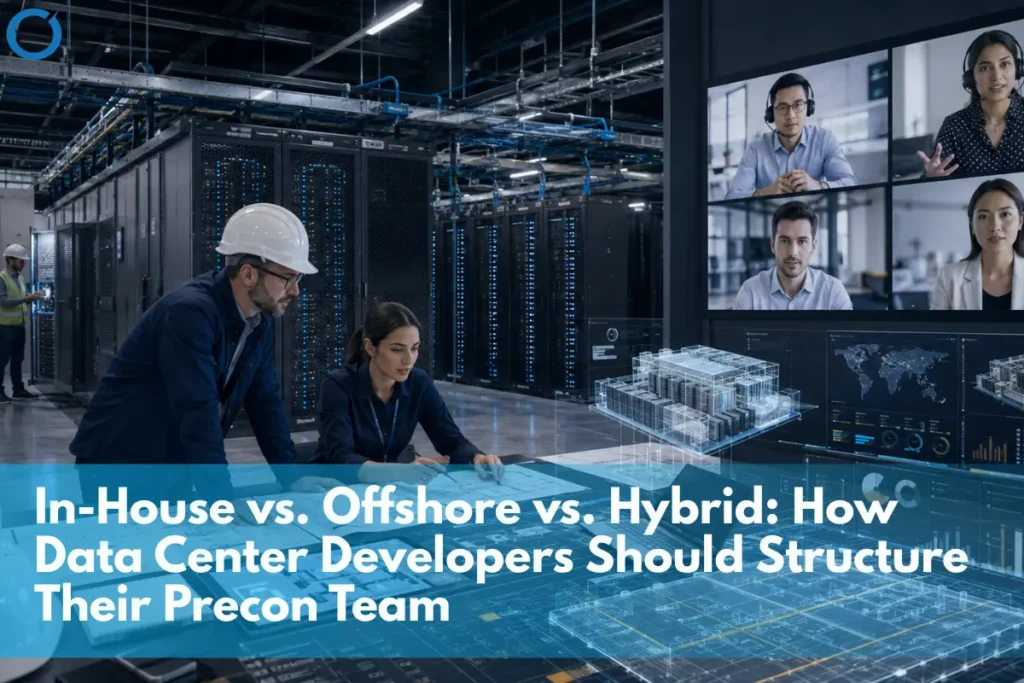
Most data center designers prefer a hybrid structure. The in-house team manages design decisions and approvals, while the offshore or delivery partner handles BIM coordination, CAD drawings, and volume estimating.
This Isn’t Just a Cost Question
Cost differences between in-house and offshore staffing are real and well documented; our own breakdown in How Much Does Construction Estimating Cost in 2026? covers the salary and rate comparison in detail. This post assumes that comparison as background rather than repeating it, and focuses instead on a question the cost comparison doesn’t answer: which structure actually fits a specific data center project’s complexity and timeline, regardless of price.
The In-House Model: What It’s Built For
With an entirely in-house pre-con team, the BIM coordination, estimating, and CAD drafting will all be under direct control of the company, which means that all the internal knowledge stays with the company. This is ideal for the developers that have a consistent and high-volume pipeline of data centers.
- Works well when pipeline volume is steady enough to keep the team fully utilized year-round, and the team already has prior data center-specific coordination experience.
- Breaks down when volume is inconsistent; carrying a large in-house team through a slow quarter is expensive with no offsetting benefit.
- Breaks down when a project’s complexity exceeds what the team has priced before, such as a first AI data center or 2N+1 build.
The Fully Offshore Model: What It’s Built For
A fully offshore structure hands BIM coordination, CAD, and estimating to a dedicated external team entirely, which suits developers without an existing in-house precon function or with occasional, non-recurring data center project volume.
- Works well when a developer has no existing in-house precon function to build on, or data center volume is occasional rather than a recurring pipeline.
- This structure works well when the external team has genuine data center coordination experience rather than only a general commercial BIM background. Developers should evaluate that experience carefully when choosing a data center preconstruction partner.
- The main risk is design authority: a fully offshore structure with no in-house technical oversight can produce a coordinated model and priced estimate that are internally consistent but disconnected from decisions only the developer’s own team has full context on redundancy tier commitments, site-specific constraints, or client relationship history.
The Hybrid Model: Why Most Data Center Developers End Up Here
A hybrid structure keeps design authority, final QA, and client-facing decisions in-house while a dedicated offshore or nearshore team manages model development, clash detection, takeoffs, and construction estimating services. Most data center developers adopt this structure after completing one or two projects because it solves the main weaknesses of the other models. It avoids carrying full in-house headcount through inconsistent workloads without removing technical oversight from the people who understand the project’s specific requirements.
A typical division of responsibility in a hybrid structure looks like this:
- In-house retains design authority, redundancy tier decisions, client relationship management, and final sign-off before anything goes to bid or permit.
- The partner team handles BIM model development, clash detection passes, CAD drafting, and first-pass estimating that the in-house team then reviews.
- The two parties set out the review milestones from the outset, so that the partner team is not working in a vacuum and is only reviewed once at the end of the process.
In-House vs. Offshore vs. Hybrid: The Real Differences
| Factor | In-House | Fully Offshore | Hybrid |
|---|---|---|---|
| Design authority | Full, retained internally by default | Held by the partner unless actively reviewed | Retained in-house; partner executes under it |
| Cost structure | Fixed cost regardless of monthly volume | Variable, scales with actual workload | Mixed: smaller fixed core plus variable partner cost |
| Scalability | Slow hiring and layoffs lag pipeline changes | Fast partner capacity flexes with demand | Moderate: partner flexes while the core team stays stable |
| Speed on data center-specific work | Depends entirely on the team’s prior experience | Fast when the partner has direct data center experience | Fast: combines partner speed with in-house judgment |
| Best fit | Steady, high-volume pipeline with existing depth | Occasional volume with no established in-house precon function | Most data center developers, regardless of volume |
Signs You’ve Outgrown Your Current Structure
Several tendencies may appear before the developer decides to undergo structural transformation:
- Bids are being declined or postponed because the internal group is overloaded, rather than there are no attractive projects.
- A fully offshore team’s output is technically clean but keeps missing project-specific context that has to be corrected after the fact.
- The same coordination mistakes recur across projects because nobody in the current structure has genuine data center-specific experience to catch them early.
These capacity and oversight gaps often create the same data center preconstruction mistakes that delay coordination, force estimates to be rebuilt, and allow project-specific requirements to reach the construction phase unresolved.
A Decision Framework: Which Structure Fits Your Project
- Pipeline volume – steady and high favors in-house or a large dedicated partner team; occasional favors a flexible offshore or hybrid arrangement.
- Redundancy and MEP complexity – a first AI or 2N+1 project favors a partner with direct experience over building that knowledge internally from scratch. Review how N+1, 2N, and 2N+1 redundancy levels affect data center costs before deciding which team needs to control estimating and coordination.
- Bid timeline compression – hyperscaler-driven timelines favor whichever structure can turn around coordination passes fastest, which is often a dedicated partner team already running a repeatable process.
- Design authority requirements – projects with complex client relationships or evolving redundancy commitments favor keeping final sign-off in-house regardless of who handles the coordination volume.
Structuring a Precon Team for a Data Center Project?
Optimar Precon works as the dedicated partner layer in a hybrid structure , handling BIM coordination, CAD, and estimating volume while your team retains design authority and final approval. Contact us to discuss your project scope.
Not All Solutions Are Appropriate for Everyone; The Right Approach Should Fit the Task at Hand
There is no universal answer regarding which approach is more appropriate in-house, offshore, or a combination of both. The choice depends on factors such as the number of projects in the pipeline, project complexity, time pressures, and the level of control over the design process required by the developer. It’s hard to imagine data center developers not using hybrid approaches, but it’s the details that matter.
The developers who get the most value from any of these three structures tend to be the ones who chose deliberately rather than by default; they looked at their actual pipeline, their team’s experience with redundancy-driven complexity, and their actual bid timelines before committing, rather than assuming whichever structure worked on their last commercial project would translate directly to a data center build.
Contact us to discuss the preconstruction team structure that best fits your data center pipeline and project requirements.
FAQs
Not always; a developer with steady, high volume, and deep existing in-house data center experience may not need a hybrid structure at all. Hybrid tends to be the right fit for developers whose volume or complexity has outgrown a fully in-house model but who still need design authority to stay close to the project.
The design authority, redundancy levels, and final sign-off tend to remain within the in-house team, whereas the partner team is in charge of developing the BIM model, clash detection pass, CAD drawings, and initial estimation that the in-house team then checks prior to bidding or permitting.
It typically costs more than a fully offshore structure but less than a fully in-house one, since it still carries some in-house headcount alongside the partner team’s cost. The tradeoff is retained design authority and oversight, not the lowest possible cost.
The main risk is a disconnect between the coordinated model or estimate and the project-specific context, redundancy-tier decisions, site constraints, or client relationship history that only the developer’s own team fully holds, if no in-house technical oversight reviews the offshore team’s output before it’s used.
It’s possible, but disruptive shifting structures mid-project means transferring context and standards to a new team partway through, which is why the structure is worth deciding deliberately at the start of precon rather than defaulting into one and adjusting later.
Ask for sample deliverables from an actual data center project, not a general capability statement, specifically how they’ve handled redundancy-tier-driven quantity changes or high-density MEP coordination. General commercial BIM experience doesn’t automatically transfer to data center-specific complexity.