In reality, most construction businesses get this question wrong. “What do estimating services cost me?” This should actually be asked as: “Am I paying too much for my current estimates?”
The fact of the matter is that construction estimating prices differ greatly, from $0.10 per square foot in residential takeoff services up to and above $5,000 in complicated commercial bids. It all comes down to who, how, and what you are estimating.
In this guide, we uncover the real costs associated with estimating, what contractors can’t afford to overlook, and why more and more US construction businesses are considering alternative staffing models for estimating.
Quick Answer
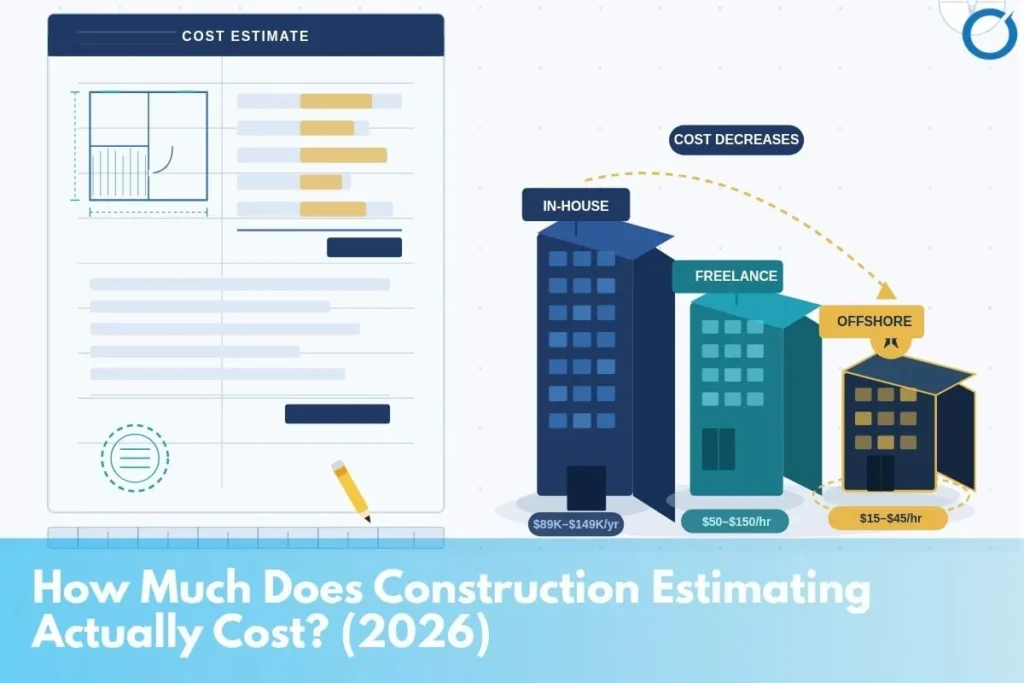
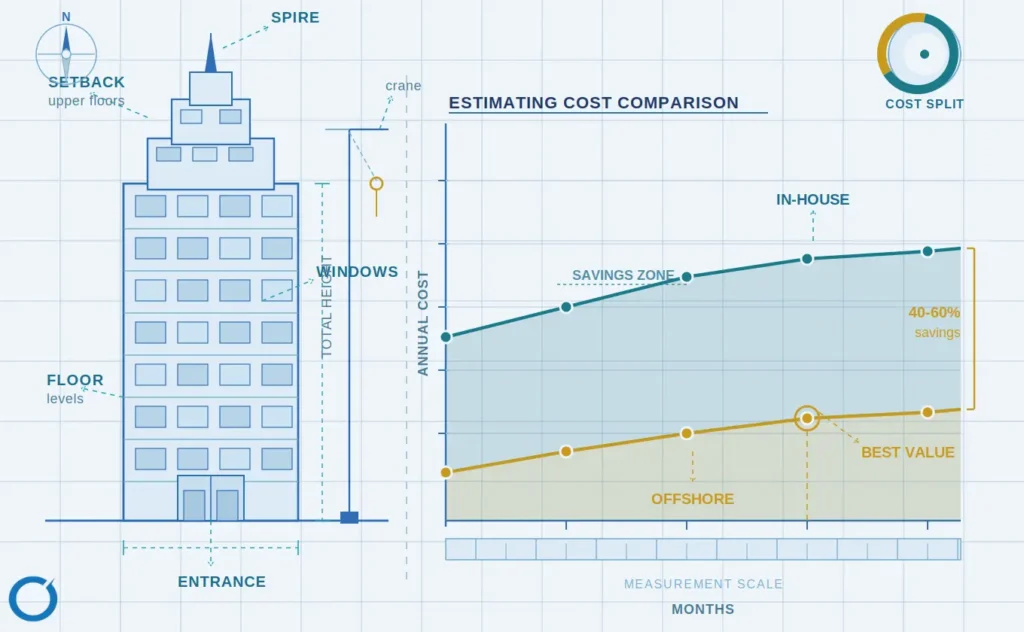
An in-house estimator costs between $65,000 and $120,000 per year (inclusive of overheads). Freelance estimators’ fees range from $50 – $150 per hour. Outsourced construction estimating services run $15-$45/hr. For a typical mid-size commercial contractor, outsourcing saves 40- 60% annually.
The 3 Ways Contractors Handle Estimating and What Each Actually Costs
To begin, it is important to explain the three methods. The majority of contractors operate on one of those three models, and it is the cost factor that determines their choice in many cases.
1. In-House Estimate Team
You have a dedicated estimator or a team of estimators working for you; they work at your office, understand your business, and manage bid preparation internally. This is the traditional alternative to hiring a Dedicated Construction Estimator through an offshore model.
The actual cost per estimator per year in the US:
| Cost Item | Low End | High End |
|---|---|---|
| Base salary | $65,000 | $105,000 |
| Benefits & payroll tax (~25%) | $16,250 | $26,250 |
| Software licenses (Bluebeam, Planswift etc.) | $1,200 | $3,500 |
| Training & CPD | $800 | $2,000 |
| Office overhead allocation | $6,000 | $12,000 |
| Total annual cost per estimator | $89,250 | $148,750 |
Most mid-size commercial contractors carry two to four estimators. That puts your annual estimating spend between $178,500 and $595,000 before you factor in turnover, recruitment, or the cost of estimating errors.
2. Freelance / Independent Estimators
This model requires less commitment. You hire per project, per bid, or on retainer for Bid Estimating Services when your internal team does not have enough capacity. Good for contractors with irregular bid volumes.
Typical US freelance estimating rates in 2026:
| Service Type | Rate Range | Notes |
|---|---|---|
| General commercial estimate | $50-$100/hr | Varies heavily by state and complexity |
| MEP estimate | $75-$150/hr | Higher due to specialist knowledge |
| Residential takeoff | $200-$800 flat | Per plan set |
| Complete bid package (commercial) | $1,500-$5,000+ | Depending on project size |
| Retainer arrangement | $3,000-$8,000/month | For consistent workload |
Specialist trades such as mechanical, electrical, and plumbing usually cost more because MEP Estimating Services require trade-specific knowledge, coordination understanding, and detailed scope review.
The hidden problem with freelancers: availability. Good independent estimators are busy during bid season exactly when you need them most. Turnaround times stretch, and you have little control over quality consistency across projects.
3. Offshore Estimating Services
A dedicated team, working exclusively on your estimates, at a fraction of in-house cost. This is the model a growing number of US contractors are moving toward, particularly for commercial, industrial, and multi-family residential work.
What offshore estimating services cost in 2026:
| Service Model | Typical Cost | What You Get |
|---|---|---|
| Per-project estimate | $300-$1,200 | Full estimate for one bid package |
| Dedicated estimator (part-time) | $1,500-$2,500/month | Set hours per week, your tools, your templates |
| Dedicated estimator (full-time) | $2,800-$4,500/month | Full-time output, managed team |
| Hourly (as-needed) | $15-$45/hr | Flexible, no retainer required |
A dedicated team, working exclusively on your estimates, at a fraction of in-house cost, and if you’re thinking about scaling your bid capacity at the same time, read how offshore preconstruction teams help contractors scale faster.
Cost Comparison at a Glance
In terms of the salary of a full-time in-house estimator, you will have to pay around $89,000 to $149,000 per annum. An offshore Dedicated Construction Estimator may cost somewhere between $34,000 and $54,000 annually, depending on experience, scope, and engagement model. In other words, you will be saving $55,000-$95,000 each year for additional resources.
What Affects the Price? 5 Factors That Move the Number
No two estimates cost the same. Here’s what drives the price up or down:
- Scope: Size and complexity of the project. A 10,000 square foot warehouse is easier to estimate than a 200,000 square foot mixed-use development project. Big, complex projects will always require more hours of Construction Cost Estimate Services, irrespective of whom you hire.
- Discipline: Trades involved. A full MEP estimate requires specialist knowledge in mechanical, electrical, and plumbing systems. Structural steel is another specialist area. General civil takeoffs are faster and cheaper.
- Documentation: Drawing quality and completeness. Clear and properly dimensioned CAD drawings lead to quicker and more precise estimates. Partial drawings or PDFs will only prolong the process and may cause mistakes.
- Speed: Turnaround time required. Tight bid deadlines cost more. If you need a full commercial estimate in 48 hours, expect to pay a premium, particularly with freelancers.
- Detail: Level of detail required. A budgetary estimate for early-stage pricing is different from a full bid-level estimate. Detailed Quantity Takeoff Services with supplier pricing take longer than high-level square-foot costing.
The Hidden Costs Most Contractors Don’t Count
The salary or service fee is the visible cost. The hidden costs are where in-house estimating gets expensive fast.
Estimating errors and missed items
An in-house estimator who underestimates a job by $80,000 costs far more than their annual salary, which is why understanding the importance of accurate take-offs and estimations goes beyond just picking the right software. Estimation error is the leading cause of margin erosion on construction projects, and it compounds: one bad estimate can wipe out profit from three good jobs.
Bid volume limits
An in-house staff works within limited resources. At the peak of tender seasons, bids are always late, shortcuts are taken, or your best employees are exhausted. Either way, you lose out on potential. Neither is good.
Recruitment and turnover
There’s a shortage of good estimators. An average period for hiring a seasoned estimator in the United States ranges from six to ten weeks. Every vacancy costs you bids. And when you finally hire, onboarding takes another 4-8 weeks before they’re fully productive.
Software and technology
The cost of data for BlueBeam Revu, PlanSwift, Procore, and RSMeans subscriptions is $3,000-$8,000 per estimator per year. If offshore estimators are working for you, these costs can be included in the service fee.
How to Know Which Model Is Right for Your Business
Unfortunately, there is no easy answer. However, consider this simple model:
| Your Situation | Best Model |
|---|---|
| Consistent bid volume, 20+ jobs/year, complex multi-trade projects | In-house team |
| Irregular bid volume, seasonal peaks, straightforward project types | Offshore service or freelance hybrid |
| Growing contractor in Texas, Florida, or California with limited capital, need to win more bids faster | Offshore dedicated estimator |
| Large GC with established team but overflow during peak season | Offshore as overflow capacity |
| Small contractor, 5–15 bids/year, tight margins | Per-project offshore estimating |
The right estimating model doesn’t just affect your costs; it directly affects how often you win. See how accurate pre-construction preparation can improve your bid success rate.
The hybrid approach is currently growing at a rapid pace and entails having a smaller team of professionals who are part of your organization deal with your clients as well as the bidding process, whereas the rest of the process is taken care of by the offshore professionals.
Need Construction Estimating Services in the USA?
Optimar Precon provides dedicated offshore estimating teams for US contractors: MEP, structural steel, earthwork, roofing, concrete, drywall, electrical, and plumbing. Faster turnaround than in-house, at a fraction of the cost. Visit our US Construction Estimating Services page to learn more or request a quote.
What Changes When You Stop Treating Estimating as Overhead
Construction estimating services is one of the highest-leverage functions in any contracting business. Get it wrong, and you bleed margin. Get it right, and you win more bids at better prices.
The cost of estimating whatever model you use is not the number to optimize. The number to optimize is accuracy. But when you can get equivalent or better accuracy at 40-60% lower cost by shifting to an offshore model, the business case is hard to ignore.
The contractors gaining ground right now are the ones who stopped treating estimating as a fixed overhead and started treating it as a scalable function. That shift starts with understanding what you’re actually paying and what you could be paying instead. If you’re ready to make that shift, contact us and we’ll walk you through what offshore estimating looks like for your project type.
FAQs
For a typical mid-size commercial project ($2M-$10M construction value), budget $800-$2,500 for a full estimate if using a service. In-house costs are harder to isolate per project, but most contractors spend 1-2% of their annual bid volume on estimating staff and tools combined.
Yes, provided you choose a service with experience in your project types and trades. The quality of the source drawings matters more than who does the takeoff. Offshore estimating teams using the same tools (Bluebeam, PlanSwift, RSMeans) produce estimates that are equivalent in accuracy to in-house work.
A straightforward residential takeoff takes 4-8 hours. A full commercial estimate for a mid-size project typically takes 3-5 business days. Complex multi-trade industrial projects can take 7-10 days. Rush turnarounds are possible but cost more.
A complete estimating service typically includes: what is a quantity takeoff by trade, material pricing (using RSMeans or current supplier quotes), labour hour calculations, subcontractor allowances, and a summary sheet in your preferred format. Some services also include bid analysis and value engineering suggestions.
Yes. Offshore Construction Estimating professionals have experience in working according to the standards set by the US (IBC, OSHA, state-specific), US-specific pricing databases (RSMeans), and US contractor, General Contractors, and developer documentation.