
- What is a bill of quantities?
- Who prepares a BOQ, and when?
- What does a BOQ contain?
- What is the format of a BOQ?
- What are the types of BOQ?
- How are BOQs prepared in the UK?
- How does US practice compare?
- How does a BOQ differ from a takeoff, BOM, estimate and SOV?
- How is a BOQ prepared?
- What are the most common BOQ mistakes?
- FAQs
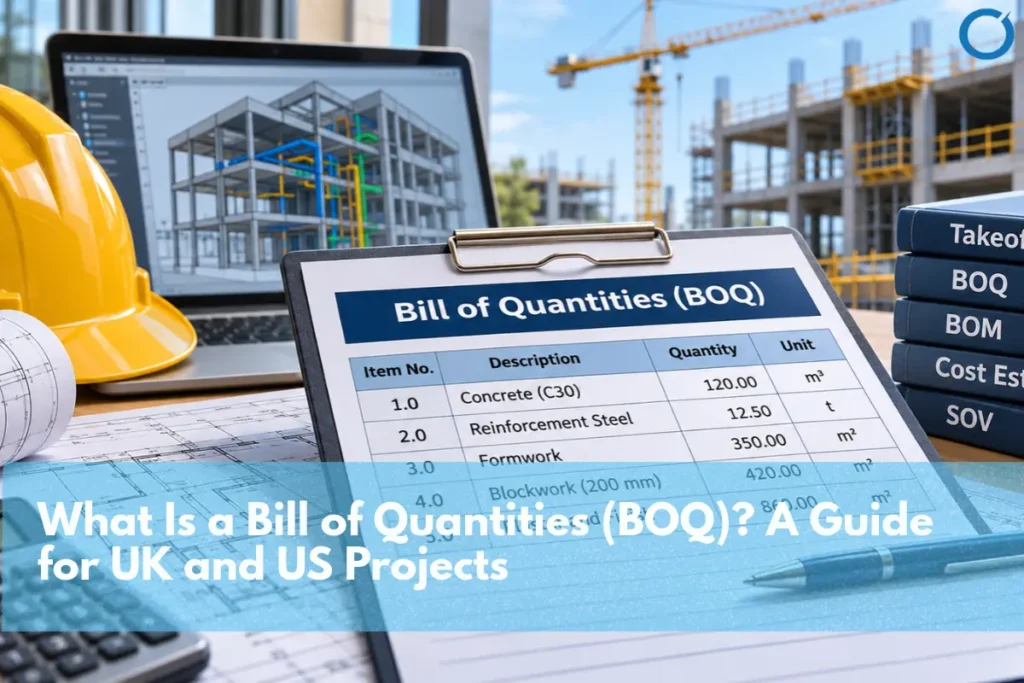
A bill of quantities (BOQ) is a document that lists every item of work in a construction project, with a description, quantity, and unit of measurement for each. It is usually prepared by the client’s quantity surveyor and issued unpriced to tendering contractors, who add their rates. In the UK, BOQs are measured to the RICS NRM2 rules and used under “With Quantities” contracts such as the JCT Standard Building Contract With Quantities. The US has no national equivalent: the closest documents are unit-price bid schedules on public works.
Two contractors given the same drawings can produce very different prices, simply because they measured the work differently. A bill of quantities removes that problem. Each one prices the identical goods in identical quantities described in identical ways.
The following pages outline what the bill of quantities is, its contents, differences between UK and US procedures, comparison to the takeoff, bill of materials, and estimate, as well as the process of preparing one.
What is a bill of quantities?
The bill of quantities gives a detailed account of all work required for a project. It assigns each item a reference number, description, quantity, and unit of measurement, such as cubic meters of concrete, square meters of blockwork, or the number of doors of a specific type.
This is a commercial document rather than an inventory of materials. Once it is priced and agreed upon, it serves four purposes:
- Tendering: each contractor prices the identical items, allowing direct comparisons.
- Contract sum: the priced bill of quantities forms part of the contract and amounts to the total contract sum.
- Interim payments: completed work is valued against the BOQ quantities and rates.
- Variations: changes are valued using the BOQ rates where the work is similar.
Who prepares a BOQ, and when?
In UK traditional procurement, the client’s quantity surveyor (QS) prepares the BOQ once the design is substantially complete. It is issued unpriced with the tender documents. Contractors price it, and the winning priced BOQ forms part of the contract.
Not every project uses one. Whether there is a client BOQ depends on the procurement route:
| Procurement route | Client BOQ? | What is used instead |
|---|---|---|
| Traditional, with quantities (e.g. JCT SBC With Quantities) | Yes, measured to NRM2 | — |
| Traditional, without quantities | No | Drawings, specification and work schedules; contractors measure their own quantities |
| Design and build | Usually no | Employer’s requirements and the contractor’s proposals |
| Remeasurement (e.g. FIDIC Red Book, civil engineering) | Yes, approximate | Quantities are remeasured as work is done |
| US lump sum | No | Drawings and specifications; each bidder does its own takeoff |
| US unit price (public works) | Yes, as a bid schedule | — |
Where there is no client BOQ, contractors still produce their own quantities through a quantity takeoff services, often structured like a BOQ for pricing.
What does a BOQ contain?
All BOQs have the following format essentially:
- Type of tender and other information: project information, contractual provisions, and bill pricing.
- Preliminary items: cost information that is common to the entire project and not specific to any particular item of work, like site establishment, project management, welfare, scaffolding, temporary works, insurance and site security.
- Measured items: the bulk of the document, which is subdivided into various categories of work, such as excavation, concrete, masonry, roofing, finishes and services.
- Provisional sums: sums reserved for undefined work, which will be adjusted once it is defined.
- Dayworks: rates for labor, plant and materials for work that can’t be measured and is paid by time.
- Summary (collection): totals carried from each section to a total, which becomes the tender sum.
What is the format of a BOQ?
Below is a brief excerpt from an unpriced BOQ for in situ concrete work. The contractor completes the rate and quantity sections.
| Item | Description | Qty | Unit | Rate | Amount |
|---|---|---|---|---|---|
| A | Plain in-situ concrete, C25/30, in foundations, poured against earth | 42 | m³ | ||
| B | Reinforced in-situ concrete, C32/40, in ground floor slab, 200 mm thick | 85 | m³ | ||
| C | Formwork to sides of foundations, height not exceeding 500 mm | 120 | m | ||
| D | Reinforcing bars, high-yield steel, 12 mm diameter, straight and bent | 4.2 | t | ||
| E | Mesh reinforcement, A393, in ground floor slab, 200 mm side laps | 430 | m² | ||
| Carried to collection |
This description will provide enough information to price the component without the need for estimation of material type, position, thickness, and placement. Specifications stay within the specification. The BOQ cross-references it rather than repeating it.
What are the types of BOQ?
| Type | What it is | When it’s used |
|---|---|---|
| Firm BOQ | Quantities measured from a complete design and treated as accurate | Traditional procurement with a finished design |
| Approximate BOQ | Quantities estimated from an incomplete design, then remeasured as work is done | Early tendering, civil engineering, remeasurement contracts |
| Unpriced BOQ | The BOQ as issued to tenderers, with blank rate and amount columns | Tender stage |
| Priced BOQ | The BOQ with the contractor’s rates and amounts filled in | Tender evaluation and the contract itself |
| Work section (trade) BOQ | Items grouped by type of work, such as concrete, masonry and finishes | Most common format; matches how contractors buy and subcontract |
| Elemental BOQ | Items grouped by building element, such as substructure, frame, roof and services | Useful for cost planning and comparing projects |
How are BOQs prepared in the UK?
BOQs for construction in the UK are measured using the Royal Institution of Chartered Surveyors (RICS) New Rules of Measurement, Volume 2 (NRM2). Construction Estimating Services UK can apply NRM2 measurement rules when preparing quantities, BOQs, and tender pricing for UK building projects. The implementation of NRM2 occurred in January 2013, superseding the old NRM version, SMM7. This guides how each activity should be measured and described.
The NRM suite has three parts:
- NRM1: order of cost estimating and cost planning, used before a BOQ exists.
- NRM2: detailed measurement for building works, used to prepare the BOQ.
- NRM3: Cost estimation and planning for building maintenance.
Civil engineering projects usually use CESMM4, the Civil Engineering Standard Method of Measurement, for valuation instead of NRM2.
Which JCT contracts use a BOQ? Only the “With Quantities” versions. Under the JCT Standard Building Contract With Quantities, the priced BOQ forms part of the contract documents, and the parties use its rates to value variations. The “Without Quantities” and Design and Build contracts do not use a client BOQ, so contractors measure their own quantities.
Teams increasingly take quantities straight from Revit or IFC models instead of measuring 2D drawings. Construction Takeoff Services UK can extract and verify quantities from drawings and BIM models before teams structure them into an NRM2-compliant BOQ. Model quantities still need to be checked and described to NRM2 before they become a BOQ.
How does US practice compare?
The US has no national equivalent of NRM2, and the formal BOQ is much less common.
- Lump-sum contracts, the most common type in US construction, have no client BOQ. Each bidder does its own takeoff from the drawings and specifications.
- Unit-price contracts, common on public works and highways, use a bid schedule: a list of pay items with estimated quantities, priced per unit. This is the closest US equivalent to a BOQ. Measurement rules come from the “measurement and payment” clauses in each specification section, or from the owner’s standard specifications.
- CSI MasterFormat is often mistaken for a measurement standard. That’s not true. It is a method of number classification that classifies specifications and costing data according to divisions such as 03 Concrete and 09 Finishes. The contractors utilize this classification system in structuring their estimates; however, there are no measurement guidelines involved.
- A schedule of values (SOV) is also referred to as a BOQ; however, it is not a BOQ at all. It is prepared by the contractor after award, and divides the contract amount into line items.
UK and US estimating teams work to different rules. See our UK estimating services for how NRM2-based work is structured.
How does a BOQ differ from a takeoff, BOM, estimate and SOV?
People often confuse these five documents because different teams prepare them at different stages and use them for different purposes.
| Document | What it is | Who prepares it | When |
|---|---|---|---|
| Quantity takeoff | Raw measurements taken from drawings or a model | QS, estimator or takeoff specialist | Before the BOQ or estimate |
| Bill of quantities (BOQ) | Measured work items with descriptions and units, in a standard format | Client’s QS | Tender stage |
| Bill of materials (BOM) | Materials to buy, in purchase units such as bags, sheets or lengths | Contractor or subcontractor | Procurement, after award |
| Cost estimate | Quantities priced with labor, material, plant, overheads, and margin | Contractor’s estimator | Bid stage |
| Schedule of values (SOV) | The contract sum split into line items for payment | Contractor (US) | After award |
To put it briefly: the BOQ uses takeoff quantities to describe the work, the estimator prices them, the contractor uses the BOM to purchase materials, and the SOV organizes payments. Our guide to construction takeoff and estimation explains how measured quantities move from drawings into pricing and bid preparation.
An example is the concrete slab. The BOQ lists 85 m³ of reinforced concrete. The estimate prices that with labor, pumping, waste, and margin. The BOM orders the ready-mix in truckloads and the mesh in sheets.
Material Takeoff Services help convert measured project quantities into material-specific lists that procurement teams can use for purchasing.
How is a BOQ prepared?
- Check the design information. Confirm that drawings and specifications are complete and coordinated. Gaps found now become queries, not variations later.
- Agree on the measurement rules and format. NRM2 for UK building, CESMM4 for civil engineering, or the owner’s bid item rules in the US. Decide between work section and elemental format.
- Take off the quantities. Measure every item from drawings or the model, section by section, and keep the dimension sheets or model extracts as an audit trail.
- Write the item descriptions. Describe each item according to the measurement rules and cross-reference the specification so estimators can price it without guessing.
- Add preliminaries, provisional sums and dayworks. Make sure project-wide costs and undefined work are covered.
- Check and review. An independent check of quantities, descriptions and arithmetic before issue.
- Issue and manage queries. Answer tender queries, and issue addenda if quantities change before tenders return.
What are the most common BOQ mistakes?
- Missing items: work shown on the drawings but not measured. Contractors either add a guess or claim it later as a variation.
- Vague descriptions: items that could be read in various ways, so tender comparisons cannot be fair.
- Preliminaries that are not properly described: site preparation, temporary works, or scaffolding poorly described, then claimed back again.
- Measurement from partial designs: a firm BOQ done from partial drawings, which will require a lot of remeasurement.
- Inconsistency in measurements: sections measured according to various conventions in the same bill.
- No audit trail: quantities not traceable back to the drawings.
Most of these trace back to the takeoff. Accurate, well-documented measurement is the foundation of a reliable BOQ and of the construction estimates built from it.
Need a BOQ prepared to NRM2 or a client format for your next tender? See our BOQ estimation services.
FAQs
It is a list of all the work in a construction project, broken into measured items with quantities and units. Contractors price each item, and the total becomes their tender.
In the UK, usually the client’s quantity surveyor. In the US, the owner or their engineer prepares bid schedules on unit-price public works. On most other projects, contractors measure their own quantities.
No. Only the “With Quantities” versions use a BOQ as a contract document. Without Quantities and Design and Build contracts work without one.
NRM2 is the RICS New Rules of Measurement for detailed measurement of building works. It sets how each type of work is measured and described in a UK BOQ, and replaced SMM7 in January 2013.
No. MasterFormat organizes specifications and cost information into numbered divisions but contains no measurement rules. US measurement rules come from specification sections and owner standards.
A BOQ lists measured work items for pricing and contract use. A BOM lists the materials to buy, in purchase units, for procurement after award.
A BOQ defines what is to be built and in what quantities. An estimate prices it, adding labor, materials, plant, overheads, and margin. A priced BOQ is one form of estimate.
It depends on project size, complexity, and how complete the design is. A small fit-out might take one to two weeks; a large multi-story project can take several weeks or more. Incomplete design adds time and risk.
Yes. Quantities can be extracted from Revit or IFC models, which is faster and easier to update. They still need checking, and descriptions still need to follow the measurement rules.