Data Center MEP Clash Detection(US Hyperscale Fit-Out)
Optimar Precon ran the MEP coordination programme for a Phase 1 hyperscale data center fit out covering two data halls and six electrical rooms. Across an 11 week programme, a federated model review surfaced 9,847 raw hard clashes, which were filtered and grouped into 1,412 valid coordination issues. Of these, 1,268 were resolved inside the model before construction release, and 68 were slab penetration conflicts closed before concrete was placed.
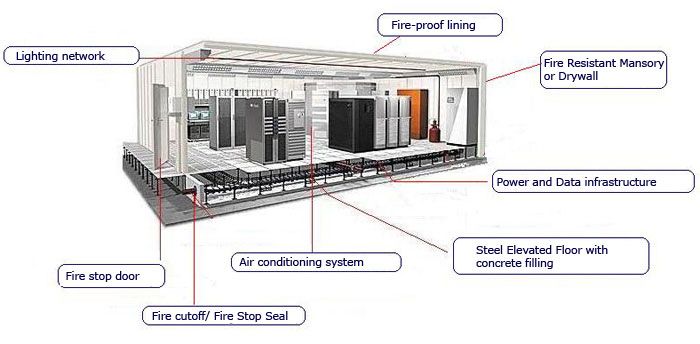
Three coordination sprints, weekly clash cycles, 48 hour issue reporting
MEP Coordination for Two Data Halls and Six Electrical Rooms
The operator was delivering Phase 1 of a multi phase campus. Two data halls totalling 78,000 sq ft of white space were being fitted out concurrently with the six electrical rooms serving them. Mechanical, electrical, plumbing, fire protection and containment packages had each been modelled by separate trade contractors to LOD 350, but no single party held responsibility for federated coordination across all five.

A Single Coordination Authority Across Five Trade Models
Each trade contractor had modelled its own scope competently. The problem was the space between them. The mechanical contractor’s chilled water routing, the electrical contractor’s busway runs, the containment subcontractor’s cable tray levels and the fire protection contractor’s pre action mains were each internally clean and mutually incompatible in the overhead zone.
- ✅ One federated model maintained across all five trade packages
- ✅ A filtered, deduplicated issue register rather than a raw clash dump
- ✅ Weekly coordination cycles that trade contractors could actually action
- ✅ Structural penetration and sleeve conflicts identified before slab pour
- ✅ Design queries escalated with a clear owner and a decision deadline
- ✅ A construction release position naming every unresolved item explicitly

Federated Model Management, Rule Based Clash Testing and Issue Closure Tracking
Through our clash detection services and data center preconstruction services, Optimar Precon acted as the single coordination authority across the trade models while design responsibility remained with the project’s engineers of record.
Model federation
Assemble trade models on a shared coordinate system and validate origin, units, level datums and naming against the project BIM execution plan.
Rule based clash testing
Configure discipline pair clash tests with tolerances appropriate to each combination, then filter and group results into unique, actionable issues instead of reporting raw hit counts.
Coordination sprints
Run weekly cycles: test, group, assign, review in coordination session, verify closure in the following run.
Escalation and release control
Route issues requiring design intervention to the engineer of record with a documented decision deadline, and produce a construction release status listing every open item.
Congestion Was Not Evenly Distributed
Electrical room density
The six electrical rooms occupied a small fraction of the coordinated floor area but concentrated switchgear, UPS modules, PDUs, battery cabinets, containment risers, and the mechanical and fire protection services serving them. Available overhead volume was minimal and access clearance requirements were non negotiable.

Sequence locked structural interfaces
Slab penetrations, sleeves and cast in supports had to be positioned before pour. Any conflict discovered after concrete placement converts from a modelling correction into core drilling through a structural element, with engineering approval, scanning and programme impact attached.
Clearance conflicts that pass a clash test
Hard clash detection finds intersecting geometry. It does not find a cable tray at the correct elevation blocking a switchgear arc flash access zone, or a valve positioned where a battery cabinet door needs to swing. These require rule sets built around maintenance and code clearance, not geometry alone.
Six Electrical Rooms Held 43% of All Coordination Issues
Once raw clashes were grouped into valid issues, distribution showed where coordination effort actually needed to go.
| Issue category | Count |
|---|---|
| Overhead containment vs chilled water piping | 213 |
| Busway routing vs cable tray levels | 187 |
| Pre action fire main vs containment and lighting | 156 |
| Electrical room access and maintenance clearance | 118 |
| Structural penetrations, sleeves and cast in supports | 68 |
| Hanger, support and seismic bracing conflicts | 142 |
| Remaining single trade and miscellaneous issues | 528 |
Coordination priority sequence
Structural interface first
Anything affecting slab, penetration or cast in items was prioritised regardless of severity, because the closure window was fixed by the pour date.
Busway and containment levels second
Agreeing a stacked elevation strategy removed a large share of downstream conflicts before resolving them individually.
Clearance zones third
Arc flash boundaries, cabinet door swings, equipment pull space and maintenance access were modelled as solids and tested as clash geometry.
Everything else fourth
Remaining issues were assigned on a weekly cycle with closure verified in the following clash run.
Three Sprints, Weekly Cycles, One Issue Register
Federated model validated. Full clash test executed. Penetration and cast in conflicts isolated and driven to closure ahead of the pour sequence. Busway and containment elevation strategy agreed across trades.
The 604 electrical room issues worked through in room by room coordination sessions, with clearance zones modelled as testable geometry.
Remaining white space and riser issues resolved. Open items escalated with decision deadlines. Construction release status package issued.
Weekly cycle within each sprint:
144 Issues Required Design Intervention
Not every conflict can be resolved by moving something. Where two systems both had a legitimate claim to the same space, or where a resolution would breach a design parameter, the issue was escalated rather than absorbed.
Each escalation carried the affected trades, the space constraint, the options considered, the reason no coordination level resolution existed, and a decision deadline tied to the construction sequence.
Five Checks Before Any Issue Was Marked Closed
Confirm the conflict resolved rather than displaced into a new one.
Verify maintenance, access and code clearance envelopes remain intact after the move.
Confirm hangers, supports and bracing were relocated with the service, not left orphaned.
Affected trade contractor confirms the resolution is buildable within its scope.
Issue status, owner and closure evidence recorded before the item leaves the active register.
Coordination Closed Before Concrete, Not After
Resolved in model before construction release. 89.8% of all valid coordination issues closed without field intervention.
Resolved before slab pour, including 22 conflicts that would have required core drilling through reinforced slab, with attendant scanning, engineering approval and programme impact.
Estimated field RFIs avoided, applying a conservative one in six conversion assumption to the 1,268 model resolved issues. At an average RFI processing cost of roughly $1,080, this represents approximately $228,000 in avoided RFI administration alone, separate from any construction cost impact.
Estimated trade labour hours avoided, derived from the 68 pre pour penetration resolutions and 142 support and bracing conflicts closed in model.
Spot verified model to field match. Overhead installations checked during construction matched coordinated model positions within project tolerance.
Protected on the containment install sequence. The containment package started on the planned date rather than waiting on penetration resolution.
Before Optimar Precon’s coordination programme
- Five competent trade models with no federated owner
- Raw clash counts in the thousands with no filtering
- No agreed busway and containment elevation strategy
- Penetration conflicts unidentified with the pour date approaching
- Clearance and access conflicts invisible to hard clash testing
- No single issue register or closure evidence
After the 11 week programme
- One federated model maintained across all five packages
- 1,412 valid issues tracked individually to closure
- Stacked elevation strategy agreed and modelled
- 68 penetrations resolved ahead of pour
- Clearance zones modelled as testable geometry
- Construction release issued with every open item named and owned
Maintained across five trade packages on a validated shared coordinate system.
Discipline pair tests with documented tolerances, reusable on subsequent phases.
Grouped, assigned, deduplicated issues with 48 hour turnaround from each clash run.
All 1,412 items with status, owner, resolution and verification record.
Coordinated locations issued to the structural package ahead of pour.
144 design queries with options, constraints and decision deadlines.
Closed items, open items, owners and outstanding decisions at release.
Attendance, decisions and actions from each weekly session.
9,847 raw clashes would have been ignored by trade contractors. 1,412 grouped, assigned issues got actioned.
Structural interface items were worked first because their closure window was fixed by construction, not by severity ranking.
Access and code clearance envelopes were made testable rather than left to visual review.
Design queries carried decision dates tied to the construction sequence, so open items did not drift into the field.
Construction release did not claim zero conflicts. It named every remaining one with an owner.
Commercially sensitive project details have been withheld
The operator’s name, campus identity, project location, capacity roadmap, contract value and commercial terms have not been published.
Coordinating MEP in a Data Center Fit Out?
Send the trade models, BIM execution plan, level datums, pour schedule and construction release date. Our team will review model maturity and confirm an appropriate coordination cycle.