
- What the CRU's New Connection Policy Actually Requires
- Two Distinct Requirements Don't Conflate Them
- Why This Is a New Precon Line Item, Not a Redundancy Tier Decision
- What Changes in Electrical and MEP Precon Scope
- Requirement vs. Precon Impact
- Timeline and Practical Considerations
- The Compliance Requirement Is Now Part of the Precon Scope
- FAQs
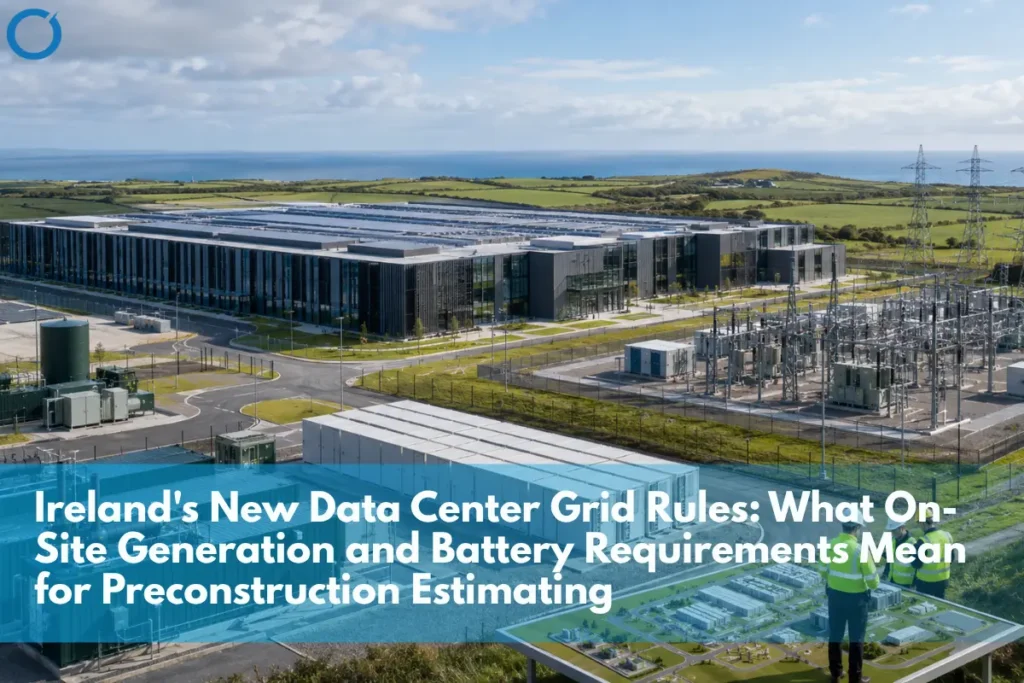
Ireland’s Commission for Regulation of Utilities (CRU) published a new connection policy for data centers in December 2025, and it changes what belongs in electrical and MEP precon scope before a project can even apply for grid connection. New data centers must now provide dispatchable on-site or proximate generation and storage capacity matching their full Maximum Import Capacity (MIC), a requirement that sits alongside, but is genuinely distinct from, the redundancy tier decisions that already drive backup power sizing on a data center project.
Ireland’s CRU Large Energy User Connection Policy, published December 2025, requires new data centres to provide dispatchable on-site or proximate generation and/or storage matching 100% of their requested Maximum Import Capacity before receiving a grid connection offer, separately from a requirement that data centres with MVA or more of capacity meet at least 80% of annual demand through new additional Irish renewable generation. This on-site generation must be separately connected, metered, and participate in the Single Electricity Market; it is a grid-compliance requirement distinct from redundancy-tier backup power sized for reliability, even though both may involve similar generator and battery infrastructure. For precon teams, this means a new electrical scope line item that must be planned and estimated before a connection application can be submitted.
What the CRU’s New Connection Policy Actually Requires
The Large Energy User (LEU) Connection Policy, published by the CRU in December 2025, replaces the 2021 Direction to System Operators and applies to all data center connection applications submitted after its publication date; projects already in the connection queue continue under the previous framework. The policy sets out two distinct obligations that new data center applicants need to satisfy as part of the connection process itself, not as optional sustainability commitments layered on afterward.
This isn’t a minor procedural update. It follows a period where Ireland’s electricity demand from data centers grew from roughly 5% of national consumption in 2015 to around 22% by 2024, prompting the CRU to move from a broader regional approach to connection assessment toward a location-specific, application-by-application evaluation. EirGrid and ESB Networks now have discretion to reject proposed sites that don’t meet the energy supply requirements, which makes this policy a genuine gating factor for project feasibility, not just a design consideration to work around later.
Grid availability and connection capacity have therefore become important data center construction challenges that need to enter site feasibility and preconstruction planning before detailed electrical and MEP design begins.
Two Distinct Requirements Don’t Conflate Them
- On-site or proximate generation matching MIC dispatchable generation or storage capacity equal to 100% of the site’s requested Maximum Import Capacity, separately connected and metered, participating in the Single Electricity Market.
- 80% additional renewable energy requirement applies to data centers with MIC of 1MVA or more, requiring at least 80% of annual electricity demand to be met through new, additional Irish renewable generation, typically via corporate power purchase agreements.
These are separate obligations with separate compliance mechanisms; one is about dispatchable capacity matching import demand for grid stability, the other is about the source of that energy over the course of a year. A project can satisfy one without automatically satisfying the other, and precon scope needs to account for both independently.
Why This Is a New Precon Line Item, Not a Redundancy Tier Decision
It’s easy to assume the onsite generation requirement overlaps with standard backup power planning, but the two serve different purposes. Redundancy tier (N+1, 2N, 2N+1) drives backup generation sized for facility uptime during a grid outage. The CRU’s MIC-matching requirement drives generation sized for grid connection eligibility, participating in the wholesale market rather than sitting idle as pure backup. A facility could technically satisfy its redundancy tier’s backup power sizing without meeting the CRU’s separate MIC-matching requirement, or vice versa; these need to be scoped and estimated as two distinct electrical systems, even where some physical infrastructure might eventually be shared or co-located.
Data Center Estimating Services in Ireland should price grid-compliance generation, backup power, metering, connection infrastructure, and redundancy requirements as distinct cost items rather than combining them under one electrical allowance.
This also directly expands the scope covered in our guide on generator yards and fuel systems, since a compliance-driven generation asset matching full MIC is a substantially larger yard footprint and fuel system than a facility would need for backup power alone.
What Changes in Electrical and MEP Precon Scope
- Separate connection and metering for the generation asset; the onsite/proximate generation requires its own grid connection application, distinct from the data center’s own connection. Electrical Estimating Services can quantify the additional generation equipment, switchgear, metering, controls, cabling, and connection infrastructure created by the new grid-compliance requirement.
- SEM market participation infrastructure equipment and controls need to support participation in the Single Electricity Market, not just standby operation.
- A credible renewable delivery plan before a connection offer: System Operators require a credible plan for the 80% renewable requirement as part of the application itself, not a future commitment.
- Dynamic modelling data in the application: new applicants must provide dynamic models and equipment details as part of grid code compliance, which needs engineering input well before construction begins.
- Tiered process by capacity: data centers under 20MVA apply to ESB Networks; 20MVA or more apply to EirGrid, each with its own published engagement process.
Requirement vs. Precon Impact
| Requirement | What It Means | Precon Impact |
|---|---|---|
| Onsite generation matching MIC | Dispatchable capacity equal to 100% of requested import capacity | New electrical scope distinct from redundancy-driven backup power |
| 80% additional renewable requirement | New Irish renewable generation covering most annual demand | Requires a credible delivery plan documented before application |
| Separate connection for generation asset | Onsite/proximate generation needs its own grid connection | Additional application process and metering scope |
| Capacity-based routing | Under 20MVA to ESB Networks; 20MVA+ to EirGrid | Determines which System Operator process and timeline applies |
Once the grid-compliance scope is defined, Construction Takeoff Services can quantify generation equipment, switchgear, cabling, foundations, fuel infrastructure, and other materials required for the revised electrical scope.
Timeline and Practical Considerations
Grid connection and planning permission run on separate clocks, and both must be satisfied before a data center can connect. A connection offer can be secured while planning is still in progress, but not the reverse. Dublin is currently a heavily constrained location under the published network capacity assessments, which affects site selection as much as it affects electrical scope. A two-year derogation period has been proposed for existing data centers to upgrade their systems to the new grid code requirements, but this does not apply to new applicants, who need to meet the current requirements from the outset.
For wider data center construction planning, this means site selection, grid strategy, electrical infrastructure, MEP coordination, and project budgeting need to develop together rather than as sequential decisions.
Planning Precon for a Data Center Project Under Ireland’s New Grid Rules?
Optimar Precon scopes onsite generation, metering, and grid-compliance electrical infrastructure as distinct line items from redundancy-driven backup power, coordinated from the earliest planning stage. Contact us to discuss your project scope.
The Compliance Requirement Is Now Part of the Precon Scope
Ireland’s new grid connection policy doesn’t just affect a data center’s energy strategy; it adds a specific, estimable line item to precon electrical scope that must be planned before a connection application can be submitted. Treating onsite generation matching MIC as the same thing as redundancy-driven backup power risks under-scoping one or both systems; treating them as genuinely distinct requirements, each with its own connection process and cost structure, is what keeps a data center project’s precon estimate aligned with what the CRU’s policy actually requires.
Treating these two requirements as one scope can become one of the more expensive data center preconstruction mistakes because the project may underestimate equipment quantities, connection infrastructure, site requirements, and electrical cost before submitting its application.
Because this regulatory area continues to evolve, project stakeholders should verify current requirements directly against CRU and System Operator publications before finalizing the preconstruction budget. System Operators only published their full processes in early 2026, continue to refine constrained-area maps, and are still developing the derogation framework for existing facilities, so older summaries may no longer reflect the latest guidance.
FAQs
It applies to new data center connection applications submitted after the policy’s December 2025 publication date; applications already in the connection queue before that date continue under the previous 2021 framework.
No. The CRU requires generation capacity to match Maximum Import Capacity for grid connection eligibility and market participation, while redundancy-tier backup power supports facility uptime during an outage. Project teams should scope these requirements separately, even if they eventually share some infrastructure.
It applies to data centers with a Maximum Import Capacity of 1MVA or more and requires new, additional Irish renewable generation to supply at least 80% of their annual electricity demand, separately from the onsite generation matching requirement.
Data centers requiring under 20MVA apply to ESB Networks as the Distribution System Operator, while those requiring 20MVA or more apply to EirGrid as the Transmission System Operator, each with its own published engagement and connection process.
Government policy explicitly disfavors fully ‘islanded’ developments not connected to the electricity grid and powered mainly by on-site fossil fuel generation. The on-site generation requirement supplements the grid connection and enables participation in the wholesale market rather than replacing the grid connection entirely.
System Operators assess whether a proposed connection falls in a constrained or unconstrained area of the network, and published capacity assessments currently show significant constraints in high-demand areas like Dublin. Location affects both feasibility and the specific requirements that apply, which makes site selection and grid strategy inseparable decisions rather than sequential ones.