- Why Data Center Sustainability Is Different From General Building Sustainability
- Where Precon Decisions Reduce Both Carbon and Cost Simultaneously
- Precon Decision vs. Carbon and Cost Impact
- Why This Has to Happen During Precon, Not After Design Is Locked
- Where This Synergy Gets Missed in Practice
- The Same Decisions Drive Both Outcomes
- FAQs
Data center sustainability often focuses on operational measures such as renewable energy sourcing, post-commissioning cooling efficiency, and workload optimization. However, preconstruction decisions can lock in a large share of embodied carbon before a single system is installed. Choices around redundancy, cooling, equipment, and space planning also directly influence construction cost.
This overlap matters for how ESG-driven developers should actually approach a data center project. Sustainability should not function as a separate workstream layered on top of the value engineering process. Instead, sustainability goals and value engineering decisions should inform the same preconstruction planning process from the outset. The truth is that some of the most leveraged sustainability considerations and some of the most leveraged cost considerations are one and the same, made at the same time by the same people.
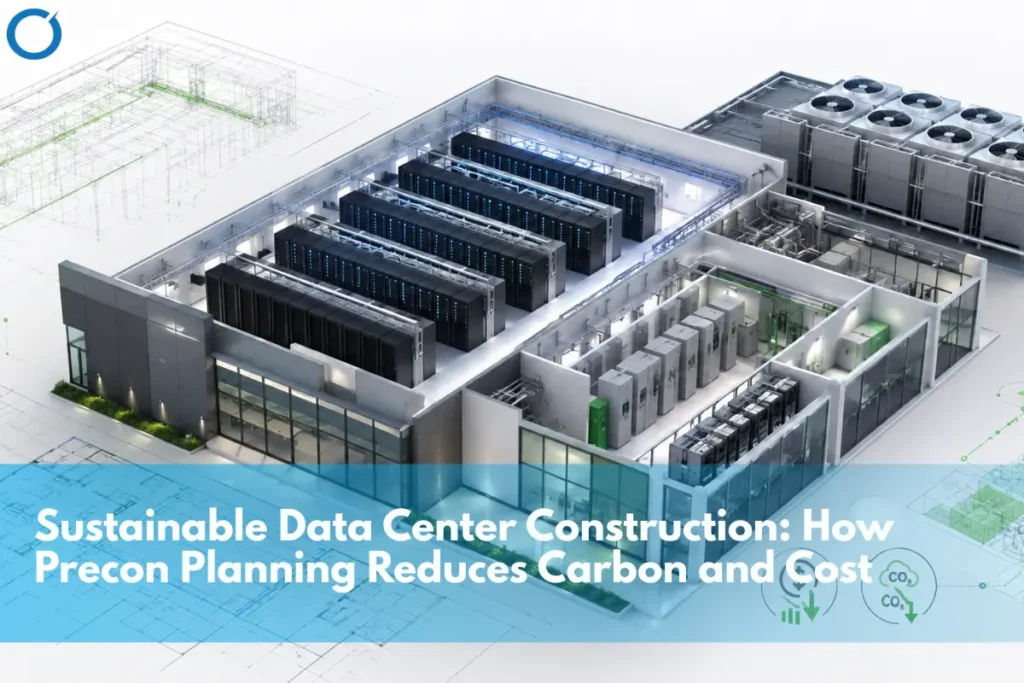
Precon planning reduces both carbon and cost on data center construction because the decisions that determine embodied carbon, redundancy tier sizing, cooling method selection, and how efficiently white space and grey space are allocated are the same decisions that determine construction cost. An over-provisioned redundancy tier doesn’t just cost more; it embeds more manufactured equipment and material into the building than the actual reliability requirement needs. Right-sizing these decisions during precon, rather than defaulting to conservative assumptions, reduces embodied carbon and construction cost simultaneously rather than trading one against the other.
Why Data Center Sustainability Is Different From General Building Sustainability
Discussion surrounding building sustainability usually revolves around energy efficiency, insulation, glass, and HVAC system performance during the life span of a building. However, data centers are different in this aspect due to their higher carbon embedded within them compared to their size, mainly because of their heavy presence of manufactured products such as electrical and mechanical products in generators, UPS, chillers, and switchgear. For cooling infrastructure specifically, Mechanical Estimating Services help quantify equipment, piping, HVAC, labor, and installation costs before the design reaches procurement. This means data center sustainability decisions made during precon, before that equipment is specified and ordered, carry disproportionate weight compared to a standard building project.
These decisions become even more significant in AI data center power and cooling design, where higher rack densities can substantially change electrical distribution, cooling infrastructure, equipment quantities, and preconstruction budgets.
This is also why data center sustainability doesn’t map cleanly onto general green building frameworks built around insulation values and glazing ratios. A data center’s biggest carbon lever rarely comes from the building envelope. Redundancy tiers, cooling methods, and decisions about how much floor area supports infrastructure versus actual server capacity usually have a much greater impact, and teams make these choices during preconstruction rather than through architectural finishes.
Where Precon Decisions Reduce Both Carbon and Cost Simultaneously
- Redundancy tier right-sizing – confirming the actual reliability requirement before defaulting to a higher redundancy tier avoids embedding unnecessary generators, UPS units, and switchgear into the project.
Understanding data center redundancy costs also helps decision-makers see how N+1, 2N, and 2N+1 configurations change generator, UPS, switchgear, cooling, and space requirements. - Cooling method selection matched to actual density – specifying a cooling approach sized for the real anticipated load, rather than over-provisioning for a worst-case assumption, reduces both equipment volume and long-term operational energy use. MEP Estimating Services can quantify the mechanical, electrical, and plumbing cost implications of different cooling capacities and equipment configurations before procurement.
- Efficient white space to grey space allocation – a tighter, better-coordinated ratio reduces total building footprint and the material required to construct it, without sacrificing the redundancy or cooling capacity actually needed.
- BIM Clash Detection Services can reduce material waste by identifying coordination conflicts before construction begins. Every conflict resolved during coordination can avoid unnecessary fabrication, material replacement, and additional labor on site.
Precon Decision vs. Carbon and Cost Impact
| Precon Decision | Carbon Impact | Cost Impact |
|---|---|---|
| Redundancy tier right-sizing | Fewer generators, UPS units, and switchgear manufactured and installed | Lower equipment and installation cost |
| Cooling method matched to actual density | Less over-provisioned equipment; lower long-term operational energy use | Avoids paying for capacity the facility doesn’t need |
| Efficient white/grey space ratio | Smaller total footprint and material volume | Less structure and finishes to construct |
| Early clash detection | Less rework material and waste | Avoided field change and rework cost |
BIM Coordination Services support the same objective by resolving spatial and system conflicts before construction commits additional materials, equipment, and labor to the project.
Why This Has to Happen During Precon, Not After Design Is Locked
Once teams specify and order equipment for a particular redundancy tier or cooling method, they effectively lock in the embodied carbon associated with that equipment. Later value engineering can refine some downstream decisions, but it cannot reverse the carbon impact of equipment that manufacturers have already produced and supplied. The same principle applies to white space and grey space allocation: teams face much higher costs when they try to correct an inefficient footprint after completing the structural design than when they plan the space efficiently from the start.
These decisions also sit behind many broader data center construction challenges because power density, cooling infrastructure, equipment quantities, and MEP coordination all become harder to change after detailed design.
This is precisely where the ESG and cost-control conversations converge rather than compete. A developer asking “can we reduce embodied carbon” and a developer asking “can we reduce cost” during precon are, on a data center project specifically, often asking about the same handful of decisions from two different angles.
Where This Synergy Gets Missed in Practice
- When sustainability and cost teams conduct separate reviews, they can miss opportunities where ESG criteria and value engineering goals overlap. Bringing both perspectives together earlier helps teams identify shared benefits before the project progresses too far.
- Redundancy defaulted to a higher tier for perceived safety without confirming whether the actual reliability requirement justifies it, which embeds cost and carbon that neither team specifically asked for.
- Teams should apply sustainability as a decision-making lens while they still have flexibility to optimize redundancy, cooling, and space, rather than treating it as a checklist after they finalize the design.
Several common data center preconstruction mistakes follow the same pattern, including locking budgets before confirming redundancy, treating white and grey space as one planning zone, and delaying BIM coordination.
Planning a Data Center Project With Sustainability and Cost Goals?
Optimar Precon coordinates redundancy sizing, cooling method selection, and space planning together, so carbon and cost reductions happen at the same decisions, not as competing tradeoffs. Contact us to discuss your project scope.
The Same Decisions Drive Both Outcomes
Sustainable data center construction does not require teams to add a separate initiative on top of standard preconstruction planning. On data center projects, many of the same decisions that reduce construction costs also reduce embodied carbon. Reduction of redundancy to match cooling capability with density, as well as a rational design of white-to-grey space ratio during the pre-con stage, achieve both objectives simultaneously, making a better argument for the proper completion of the tasks than seeing sustainability and cost as conflicting objectives.
Taking the sustainability of a project as a cost center that is competing with other objectives like reliability or schedule ignores such synergy. In particular, on a data center project, the developer who achieves sustainability through proper right-sizing and space allocation is not compromising cost-efficiency but achieving it.
When evaluating a data center preconstruction partner, developers should also assess whether the provider can coordinate redundancy, white and grey space, BIM, MEP systems, and estimating as connected decisions rather than isolated scopes.
FAQs
No, not necessarily. Many of the largest material-related carbon savings, such as right-sizing redundancy tiers and improving space utilization, can also reduce costs because they require less equipment, fewer materials, and less floor area to design and construct.
Carbon embodied in structures arises from the manufacturing and installation of equipment and building materials, while the operational carbon of structures is that which arises from the use of energy throughout the lifetime of the structure. Data centers have higher embodied carbon than regular buildings due to equipment density.
Sustainability can create unnecessary cost or complexity when it becomes a separate objective layered onto a reliability requirement that the project has not properly validated. Right-sizing redundancy to the genuine reliability need, rather than defaulting to a higher tier out of caution, generally serves both goals rather than trading one against the other.
They overlap significantly on data center projects because many value engineering opportunities, such as right-sizing redundancy and matching cooling capacity to actual loads, also reduce embodied carbon. Teams traditionally frame value engineering as a cost exercise, but it can support sustainability goals at the same time.
As early as possible, ideally alongside the initial redundancy tier and cooling method decisions, since those choices determine most of the embodied carbon outcome before detailed design work has even started.
Considered together, or at least considered in conjunction with each other, they are likely to reveal the relationship between the two objectives more easily than when considered separately, as often as not, due to the high-impact decisions that achieve both.