
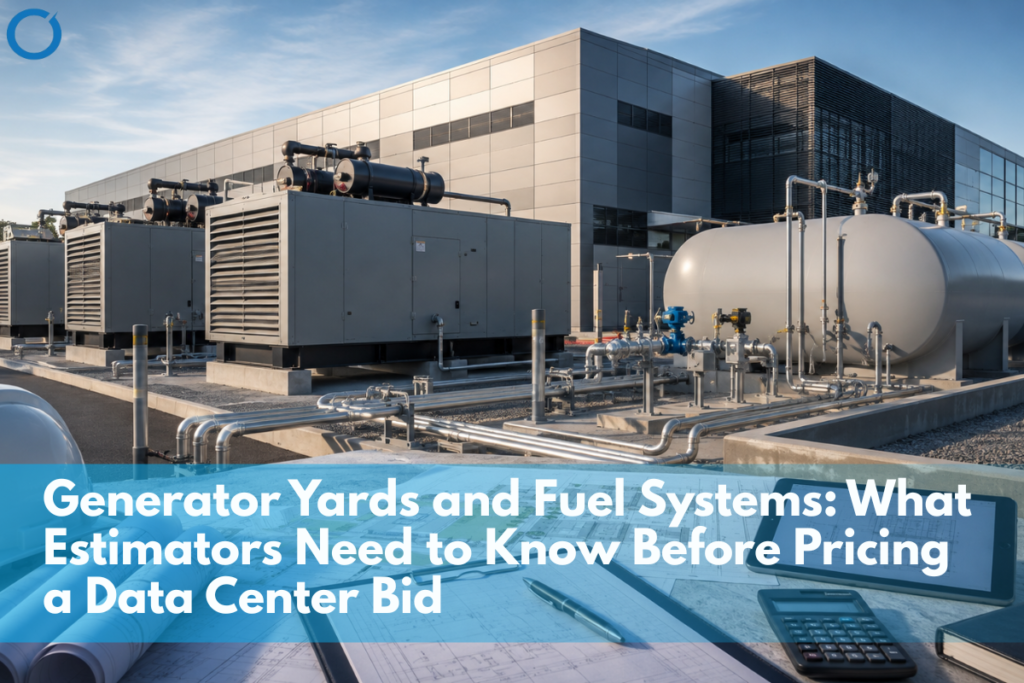
Generator yards and fuel systems get priced off rough assumptions more often than almost any other data center system, mainly because they sit outside the building envelope and get less design attention early on than electrical rooms or chiller plants. That’s exactly why they’re a common source of bid inaccuracy: generator count and fuel storage capacity both depend on decisions that are often still unsettled when an estimate needs to go out.
Because generator yards sit at the edge of the site rather than within the primary building footprint, they’re frequently treated as a secondary scope during early estimating, priced with a placeholder number that’s revisited later once the electrical design catches up. The problem is that “later” often means after the bid has already gone out, at which point the placeholder number is the one the project gets held to.
These early assumptions can also increase the true cost of construction estimating by creating revisions, scope gaps, and repeated pricing work later.
Quick Answer
Estimating a data center generator yard and fuel system accurately requires confirming the redundancy tier first, since generator count and sizing scale directly with N+1, 2N, or 2N+1 requirements. Beyond unit count, cost drivers include acoustic enclosures, structural pad requirements, access clearances for the yard itself, and fuel storage tank capacity based on required runtime hours, fuel type, and environmental permitting requirements for the fuel system. Pricing either system using a generic assumption instead of the project’s actual redundancy tier and runtime requirement often causes estimating errors.
Why Generator Yards Are Harder to Estimate Than They Look
Generator count and sizing scale directly with the facility’s redundancy tier, the same way UPS and switchgear requirements do; an N+1 configuration needs fewer generators than 2N or 2N+1 for the same critical load. Because generator yard design often lags behind electrical room design in the sequence of a project, estimators are frequently asked to price this scope before the redundancy tier is fully locked, which is exactly the condition that produces an inaccurate number.
Specialist Electrical Estimating Services align generator quantities, critical loads, switchgear requirements, and supporting infrastructure with the confirmed redundancy strategy.
The fuel system compounds this uncertainty rather than resolving it. Runtime requirements how many hours the facility needs to run on backup power without refueling are sometimes set by the client’s own operational policy rather than a code minimum, which means the number isn’t always documented anywhere an estimator would think to look for it. Confirming this figure directly, rather than assuming a standard runtime, is often the single highest-leverage question an estimator can ask before pricing the fuel system.
Generator yards and fuel systems should form part of the wider MEP Estimating Services scope because their electrical, mechanical, structural, and site requirements affect the complete project cost plan.
What Drives Generator Yard Costs
- Unit count and sizing – determined by redundancy tier and critical load, not a fixed number regardless of facility size.
- Acoustic enclosures – noise mitigation requirements vary by site location and local regulations, and enclosure cost scales with unit count.
- Structural pad requirements – generator weight and vibration require dedicated structural design, not a generic concrete pad assumption.
- Access and maintenance clearances – yard layout needs to accommodate routine maintenance and eventual generator replacement, which affects total yard footprint.
What Drives Fuel System Costs
- Storage capacity and required runtime – fuel tank sizing is driven by how many hours of runtime the facility needs to guarantee, not a standard tank size.
Accurate Quantity Takeoff Services should calculate tank capacity, fuel piping, containment, supports, fittings, and associated site quantities from the confirmed runtime requirement.
- Fuel type – different fuel types carry different storage, handling, and refueling infrastructure requirements.
- Environmental permitting – fuel storage typically requires environmental compliance review that varies by jurisdiction and can affect both cost and schedule.
- Refueling access – site access for fuel delivery trucks needs to be planned into the yard layout, not assumed to work itself out during construction.
Generator Yard vs. Fuel System: Cost Drivers at a Glance
| System | Primary Cost Driver | Common Estimating Gap |
|---|---|---|
| Generator Yard | Unit count tied to redundancy tier | Priced before redundancy tier is confirmed |
| Fuel System | Storage capacity tied to required runtime hours | Tank sizing assumed instead of calculated from runtime requirement |
Pricing a Data Center Bid With Generator Yard and Fuel System Scope?
Optimar Precon estimates generator yards and fuel systems against confirmed redundancy tiers and runtime requirements rather than generic assumptions. Contact us to discuss your project scope.
Redundancy Tier Is the Number Behind the Number
Every generator yard and fuel system estimating gap on this list traces back to pricing before the inputs that actually determine cost were confirmed. Getting the redundancy tier and required runtime locked before detailed estimating starts is what keeps this scope from being the line item that gets revised once the rest of the electrical design catches up.
FAQs
This depends entirely on the redundancy tier and critical load; there’s no fixed number, since N+1 requires meaningfully fewer units than 2N or 2N+1 configurations supporting the same load.
Fuel storage capacity is based on the required runtime hours the facility needs to guarantee during an outage, combined with generator fuel consumption rates; it’s a calculated requirement, not a standard tank size applied across every project.
Yes, generator weight and operational vibration require dedicated structural pad design rather than a generic concrete slab assumption, which is often underestimated in early-stage pricing.
Requirements vary by jurisdiction, but fuel storage generally requires environmental compliance review, which can affect both project cost and schedule if not accounted for early in the estimating process.
Ideally, the redundancy tier should be confirmed before detailed generator yard estimating, even if the full electrical design isn’t finalized yet, since the redundancy tier alone determines the generator count that drives most of the yard’s cost.
This is often set by the client’s operational policy rather than a fixed code requirement, which means it should be confirmed directly with the client or operator rather than assumed from a standard industry figure.