
- Why AI Workloads Push Rack Density Far Beyond Standard Hyperscale
- What This Means for Electrical Design and Precon Budgets
- What This Means for Cooling Design
- Cooling Methods at a Glance
- Why This Changes BIM Coordination and Clash Detection Requirements
- Budget Implications: Where AI Data Center Costs Diverge from Standard Hyperscale
- The Cooling Method Is a Budget Decision, Not Just an Engineering One
- FAQs
AI data center power and cooling design has moved further from standard hyperscale practice in the last two years than hyperscale moved from enterprise data centers in the decade before it. The conventional rack in a data center uses about 8 to 10kW of electricity per rack. The new AI training racks use up to 40 to 100 kW, while some advanced next-generation racks consume up to 200 kW. This kind of increase does not scale in a linear manner via a pre-con budget; rather, it affects the type of cooling system used, the electrical requirements of that space, and the BIM coordination of the space.
Developers scoping precon for an AI-focused facility who assume it’s just “hyperscale, but more” tend to underbudget both the mechanical system and the coordination effort needed to build it.
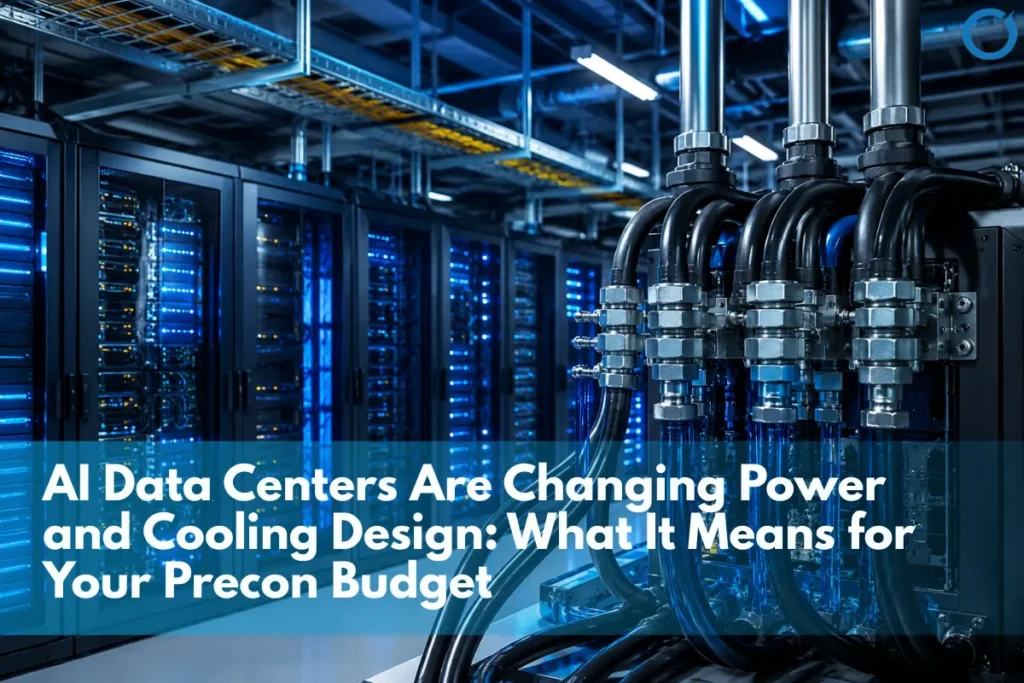
Data centers designed for artificial intelligence applications are altering power and cooling design, since racks for training and inference of artificial intelligence require much more power than typical server racks, which can range anywhere from 40 to 100kW compared to a standard rack requiring about 8-10kW. Beyond 20-50kW per rack, air cooling with containment is no longer feasible. For precon budgets, this means heavier electrical distribution, denser MEP coordination, and cooling infrastructure that most teams haven’t priced at scale before.
Why AI Workloads Push Rack Density Far Beyond Standard Hyperscale
The density increase comes from the GPUs themselves, not from data centers generally getting more crowded. A single AI training rack packed with high-performance GPUs draws several times what a standard enterprise or hyperscale rack needs, which is a different problem than the hyperscale vs. enterprise density difference covered in our facility-types guide. This is a step change within the hyperscale and AI category itself, not just hyperscale being bigger than enterprise.
What This Means for Electrical Design and Precon Budgets
Higher rack density means more power has to be delivered to a smaller footprint, which changes electrical distribution design well beyond simply upsizing conductors. Busway and distribution systems designed for standard hyperscale density often can’t be scaled up proportionally for AI density; the physical space for conductors, panels, and cooling infrastructure all compete for the same limited area. Redundancy tier compounds this further: an AI facility running 2N redundancy at 80kW per rack requires substantially more switchgear and UPS capacity than the same redundancy tier at standard hyperscale density.
What This Means for Cooling Design
Air cooling with hot/cold aisle containment remains workable up to roughly 20-50kW per rack, depending on climate and containment quality. Beyond that range, air alone can’t remove heat fast enough, which is why AI-focused facilities increasingly turn to direct-to-chip liquid cooling or full immersion cooling. Each of these requires different piping, containment, and coordination than a standard chiller and CRAH-based system, a topic covered in more depth in our guide on chiller plant and cooling tower estimating, which applies to standard hyperscale density but needs a further layer of coordination once liquid or immersion cooling enters the picture.
Cooling Methods at a Glance
| Cooling Method | Typical Density Range | Precon Implication |
|---|---|---|
| Air cooling with containment | Up to ~20kW per rack | Closest to standard hyperscale precon scope; well-understood coordination |
| Rear-door heat exchangers | ~20- 50 kW per rack | Bridges standard air cooling and liquid systems; moderate added coordination |
| Direct-to-chip liquid cooling | ~50-100kW+ per rack | Requires piping and CDU coordination; most teams haven’t priced at scale |
| Immersion cooling | Highest densities, 100kW+ | Substantially different structural, piping, and containment coordination |
Why This Changes BIM Coordination and Clash Detection Requirements
Denser electrical distribution and liquid or immersion cooling infrastructure both compete for the same raised floor and overhead space that cabling, structural elements, and fire suppression already occupy. Running BIM coordination and clash detection for an AI data center means modeling piping and containment systems that a standard hyperscale coordination pass wouldn’t include at all, not just running the same process at a larger scale.
Budget Implications: Where AI Data Center Costs Diverge from Standard Hyperscale
Redundancy tier and cooling method compound each other in ways that a standard hyperscale estimate doesn’t need to account for; the same reasoning covered in our guide on N+1, 2N, and 2N+1 redundancy cost impact, except that an AI facility applies that redundancy logic on top of liquid or immersion cooling infrastructure that didn’t exist in the original estimate baseline most teams are working from.
Estimating an AI facility with a standard hyperscale cost baseline and simply scaling up the numbers is one of the more common ways these projects go over budget. The cooling method itself, not just the quantity of equipment, needs to be priced as a distinct line item.
Optimar Precon coordinates and estimates AI data center power and cooling design, including direct-to-chip and immersion cooling infrastructure, before the RFP goes out, not after the budget needs revising. Contact us to discuss your project scope.
The Cooling Method Is a Budget Decision, Not Just an Engineering One
Every AI data center estimate that goes over budget traces back to the same pattern: treating rack density as a bigger version of standard hyperscale instead of a genuinely different design problem. Confirming density and cooling method before detailed estimating starts and pricing the coordination effort that comes with liquid or immersion cooling specifically is what keeps an AI data center budget from being rebuilt once the real infrastructure requirements become clear.
FAQs
AI training and inference workloads run on high-performance GPUs that draw significantly more power than standard server hardware, which is why AI racks commonly reach 40-100kW compared to roughly 8-10kW for a traditional rack.
Air cooling with well-designed containment generally remains workable up to around 20-50kW per rack, depending on climate and containment quality. Beyond that range, direct-to-chip liquid cooling or immersion cooling typically becomes necessary.
The redundancy tier concept (N+1, 2N, 2N+1) still applies, but it has to be priced against AI-level power density and whatever cooling method is selected, since both variables compound the equipment count well beyond what a standard hyperscale redundancy calculation would produce.
It depends on the original electrical and cooling design margin. Facilities built for standard hyperscale density often lack the power distribution capacity and cooling infrastructure needed for AI-level density, making significant retrofit work necessary rather than a simple equipment swap.
The expected rack density and cooling method (air, direct-to-chip liquid, or immersion) need to be confirmed before detailed estimating starts, since both determine electrical distribution scope and cooling infrastructure cost in ways a generic hyperscale cost baseline won’t capture.