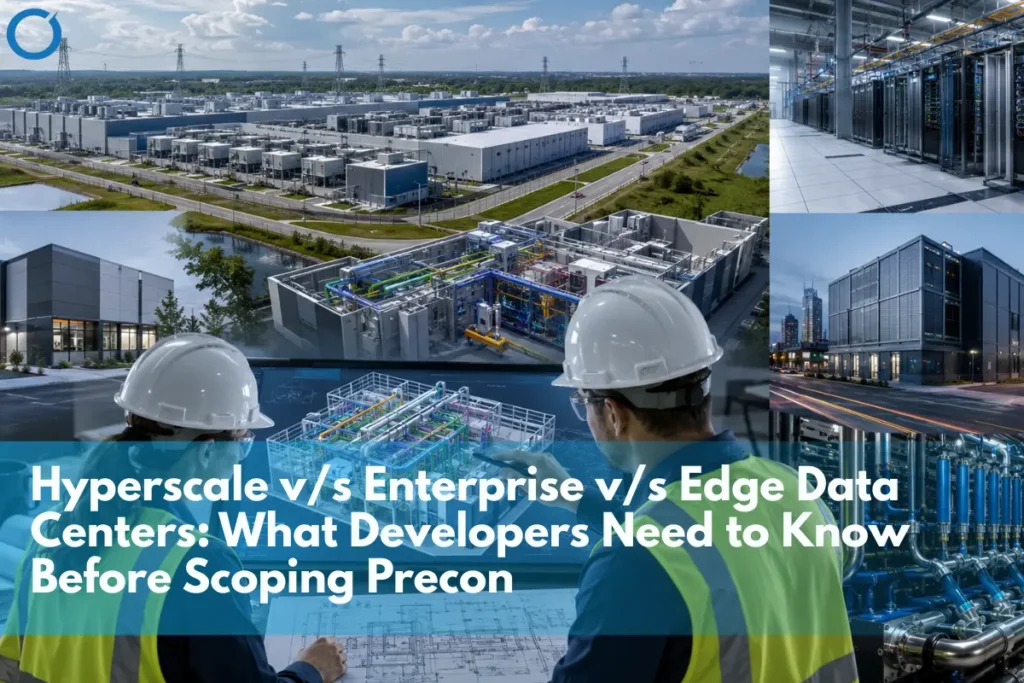
The facility type is not marketing terminology but is the only input that determines the amount of BIM coordination, level of estimating, and redundancy required for the data center before issuing an RFP. A precon scope written for an enterprise data center will badly undersize a hyperscale campus, and a scope built around a hyperscale assumption will waste time and budget on a smaller edge facility. Getting this right before scoping precon is what keeps the RFP matched to the actual project, instead of getting revised once a provider is already engaged.
Quick Answer
Hyperscale data centers require the deepest BIM coordination and highest LOD due to massive scale and density, often exceeding 20–30kW per rack. Enterprise data centers are simpler and owned by a single organization, needing less redundancy complexity. Edge data centers are small, distributed facilities with a lighter precon scope but tighter site constraints. Colocation facilities add multi-tenant metering and separation requirements. AI data centers push density and cooling requirements even higher than those of standard hyperscale data centers, often requiring coordination for liquid cooling. Each type changes the precon scope before an RFP is written, not after.
Why Facility Type Changes Your Precon Scope Before You Even Draft an RFP
This post focuses specifically on what each facility type means for precon scoping for a broader overview of data center construction infrastructure and design generally. That guide covers the full system layers (electrical, cooling, server infrastructure, networking, and building management) that apply across all facility types.
A developer’s RFP and the scope of BIM/estimating developed by a preconstruction partner in response to that RFP should have taken into account whether the actual project belongs to one of those five facility types. Incorrect assessment will result in an overbuilding of the scope of work for the former case and an underbuilding for the latter, and subsequent re-negotiations.
Hyperscale Data Centers
Hyperscale facilities are built by large technology companies at massive scale, often containing hundreds of thousands of servers with rack densities that can exceed 20-30kW, well beyond standard enterprise density. For precon, this means the highest LOD requirements, the most demanding clash detection across electrical, mechanical, and cabling systems competing for the same limited space, and redundancy tiers (2N or 2N+1) that multiply equipment counts significantly. Hyperscalers also compress bid cycles around their own delivery timelines, which places even more pressure on preconstruction turnaround than the project’s technical complexity alone.
Enterprise Data Centers
A single company owns and operates an enterprise data center to support its internal operations, applications, systems, and data storage. Enterprise facilities usually have lower rack densities and simpler redundancy requirements than hyperscale campuses. Many operate at N+1 rather than the 2N or 2N+1 configurations commonly considered for larger mission-critical projects. Our guide to N+1, 2N, and 2N+1 data center redundancy explains how each configuration affects equipment quantities, room sizes, cooling capacity, and construction costs.
Edge Data Centers
Edge facilities are small data centers that are strategically located near customers to minimize latency, unlike other data centers that are built centrally within a single sprawling campus. The scope of precon for edge facilities is less in the absolute sense, owing to their smaller size and less equipment; however, the site constraints are tighter in nature due to their urban setting. Repeatability matters more here than on a single hyperscale project: a developer building multiple edge sites benefits from a standardized precon template more than from bespoke scoping on each site.
Colocation Facilities
Colocation facilities allow multiple tenants to rent space within a shared data center, with the operator managing shared infrastructure like power and cooling. This creates a preconstruction requirement that other facility types do not face: teams must clearly coordinate and document metering, billing separation, and tenant-specific electrical and cooling allocations because multiple tenants draw from shared infrastructure and require fair, accurate cost allocation.
AI Data Centers
AI-focused data centers represent the newest and most demanding category, driven by the power and cooling requirements of GPU-heavy AI training and inference workloads. Density frequently exceeds even standard hyperscale rack loads, which is pushing many projects toward liquid cooling and immersion cooling coordination rather than traditional CRAC/CRAH air cooling alone. Precon scope for AI data centers needs to account for cooling infrastructure that most BIM and estimating teams haven’t priced or coordinated at scale yet, since the building type itself is still relatively new.
These cooling strategies also affect the project takeoff and cost plan. Our guide to chiller plant and cooling tower estimating explains how condenser water piping, pumps, foundations, controls, redundancy, and commissioning affect the total mechanical package.
What This Means for Scoping Your Precon RFP
A few practical takeaways carry across all five facility types when it’s time to define scope:
- Match LOD to facility type: a hyperscale or AI data center needs LOD 350-400 coordination; an enterprise facility may not.
- Confirm redundancy tier before estimating: N+1, 2N, and 2N+1 assumptions can dramatically change UPS, generator, switchgear, cooling, piping, structural, and equipment-room quantities. Starting detailed construction estimating services before confirming the tier may force the project team to rebuild the estimate later.
- Account for compressed timelines on hyperscale and AI projects; bid cycles are often set by the developer’s own commercial pressure, not standard construction timelines.
- Plan for repeatable templates on edge deployments; standardizing precon scope across multiple small sites is more efficient than bespoke scoping each time.
Ireland’s data center market illustrates this range well: hyperscale campuses across West Dublin and the M50 corridor sit alongside enterprise colocation builds, each requiring a different level of BIM coordination for Irish data center projects depending on facility type and scale.
Facility type alone does not guarantee an accurate scope. Contractors should also evaluate the provider’s experience with redundancy planning, high-density MEP systems, BIM coordination, estimating, and compressed bid programmes. Review these factors in our guide on how to choose a data center preconstruction partner.
Scoping Precon for a Data Center Project?
Optimar Precon scopes BIM coordination and estimating around the actual facility type, hyperscale, enterprise, edge, colocation, or AI, before the RFP goes out, not after the proposal needs revising. Contact us to discuss your project scope.
The Facility Type Sets the Scope, Not the Other Way Around
Conflicts between the RFP scope and the project’s actual complexity usually arise because teams treat the facility type as a label rather than a critical input for defining the preconstruction scope. Teams must confirm whether the project is hyperscale, enterprise, edge, colocation, or AI before they write the RFP.
Need help defining the right BIM, estimating, and coordination scope for your data center project? Contact Optimar Precon to discuss your project requirements.
FAQs
Hyperscale facilities need higher LOD, more demanding clash detection, and typically higher redundancy tiers (2N or 2N+1) than enterprise facilities, which usually run at N+1 with lower rack density and simpler MEP coordination requirements.
In absolute scope, yes, edge facilities are smaller with less equipment to coordinate. But site constraints are often tighter, and developers building multiple edge sites benefit more from a standardized, repeatable precon template than from treating each site as a bespoke scope.
AI training and inference workloads push rack density beyond what traditional CRAC/CRAH air cooling can efficiently handle, which is why many AI data center projects require liquid or immersion cooling coordination, a discipline most BIM and estimating teams have priced far less often than standard hyperscale air cooling.
Colocation facilities need metering and billing separation coordinated into the design, since multiple tenants draw from shared power and cooling infrastructure that has to be fairly and accurately apportioned, a documentation requirement that single-tenant hyperscale and enterprise facilities don’t need.
Yes, determine the facility type before issuing the RFP because it defines the required LOD, redundancy assumptions, and level of coordination the preconstruction partner needs to price the project accurately. An RFP without these parameters may generate inaccurate proposals.