
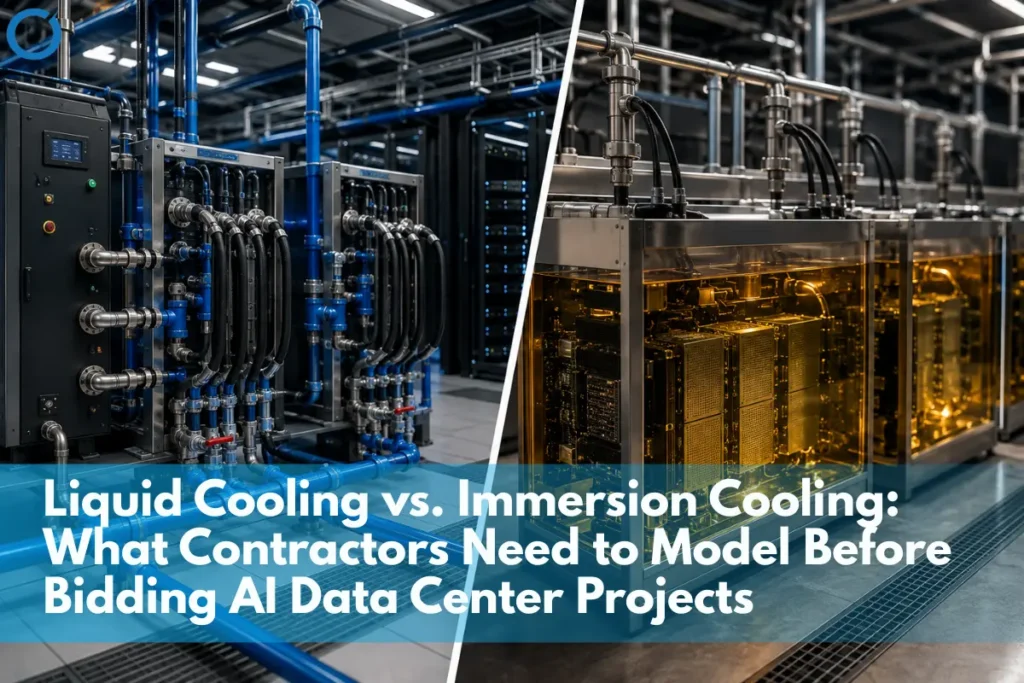
Liquid cooling and immersion cooling get lumped together as “high-density cooling” in a lot of early planning conversations, but they price out completely differently once an estimator actually has to quantify them. Direct-to-chip liquid cooling and full immersion cooling use different equipment, different structural requirements, and different consumables; bidding either one using assumptions borrowed from the other is one of the more avoidable ways an AI data center estimate goes wrong before construction even starts.
The confusion is understandable; both methods get discussed under the same “beyond air cooling” umbrella when a project first moves past standard CRAC/CRAH systems, and early planning conversations often treat the choice between them as a design decision to be finalized later rather than a decision that needs to happen before an accurate bid can be built. By the time an estimator is asked to price the mechanical scope, the specific method needs to already be confirmed, not still under discussion.
Direct-to-chip liquid cooling and immersion cooling require different quantities in a bid. Liquid cooling estimates depend on CDU counts, piping lengths, manifold and quick-disconnect fitting quantities, and per-rack connection points. Immersion cooling estimates depend on tank or enclosure quantities, structural floor loads for the combined weight of the tanks and dielectric fluid, fluid volume as a major cost item, and differently sized pumps and heat exchangers. Applying liquid-cooling assumptions to an immersion-cooling bid, or vice versa, can produce a reasonable-looking estimate based on the wrong equipment and quantity structure.
Direct-to-chip liquid cooling delivers coolant to individual servers through a piped network; the cost structure centers on distribution equipment and piping runs. Immersion cooling submerges entire servers or racks in a dielectric fluid inside a tank or enclosure; the cost structure centers on the tanks themselves, the fluid volume, and the structural capacity to support them. These aren’t variations on the same estimate; they’re different equipment categories with different quantity drivers entirely.
Accurate Mechanical Estimating Services must separate these systems because their equipment, labor, installation and consumable costs follow different quantity structures.
The installation labor profile differs just as much as the equipment list. Liquid cooling installation involves running and connecting piping throughout the white space. Effective BIM Coordination Services help teams route this piping around cable trays, electrical systems and structural elements before installation begins. And commissioning leak detection at each connection point labor that scales with the number of connection points across the facility. Immersion cooling installation is more concentrated: fewer, larger connection points at each tank, but more structural and rigging work to place and secure heavy, fluid-filled enclosures, along with the handling and filling process for the dielectric fluid itself, which often requires specialized handling procedures that a standard mechanical crew may not already have.
Detailed Construction Takeoff Services help estimators measure equipment counts, piping lengths, fittings, fluid volumes and structural requirements before applying labor and material pricing.
What to Quantify for Direct-to-Chip Liquid Cooling
- CDU count – coolant distribution units scale with the number of racks or cooling zones being served, typically with redundant units for N+1 coverage.
- Piping run length and routing – distribution piping from CDUs to manifolds and from manifolds to individual racks, priced by length and fitting complexity.
- Manifold and quick-disconnect fitting counts – each rack connection point needs its own fitting, which scales linearly with rack count rather than being a fixed cost.
- Controls and monitoring integration – comprehensive MEP Estimating Services should include leak detection, flow monitoring, controls, power connections and building management system integration rather than pricing only the cooling pipework.
What to Quantify for Immersion Cooling
- Tank or enclosure unit count – each unit typically replaces multiple traditional racks, which changes the unit-count math compared to a per-rack liquid cooling approach.
- Structural floor loading – the combined weight of tanks, hardware, and dielectric fluid is substantial and needs to be verified against the structural design, not assumed to match standard rack loading.
- Dielectric fluid volume – the fluid itself is a major, quantifiable line-item cost, priced by volume, and is a cost category that doesn’t exist in a piped liquid cooling estimate at all.
- Pump and heat exchanger sizing – immersion systems still need equipment to move heat out of the fluid, sized differently than the CDU-based approach used in direct-to-chip systems.
Liquid Cooling vs. Immersion Cooling: Estimating Cost Drivers
| Cost Driver | Liquid Cooling (Direct-to-Chip) | Immersion Cooling |
|---|---|---|
| Primary equipment | CDUs, manifolds and piping network | Tanks or enclosures, pumps and heat exchangers |
| Scales with | Rack count and cooling zones | Tank or enclosure unit count |
| Major consumable cost | Coolant volume, which is comparatively modest | Dielectric fluid volume, which forms a substantial line item |
| Structural consideration | Piping support and routing clearance | Floor loading for the combined tank and fluid weight |
Bidding Risk Factors Unique to Each Method
Pricing either method without confirming the actual redundancy tier and rack density first compounds the risk further; the same reasoning is covered in more depth in our guide on AI data center power and cooling design, which looks at how density itself drives the underlying equipment counts before either cooling method’s specific quantities get taken off.
The choice between N+1, 2N and 2N+1 can also change CDU, pump, heat-exchanger and supporting equipment quantities. Our guide to data center redundancy costs explains how each tier affects project budgets.
A bid that assumes standard liquid cooling piping labor rates for an immersion project or vice versa will be wrong in a way that doesn’t show up until the equipment quotes come back, often too late to adjust before submission. Getting a preliminary equipment quote from a vendor for the specific cooling method, rather than pricing from a generic per-kW assumption, is the most reliable way to catch this before the bid goes out.
Similar pricing problems arise when estimators size major cooling equipment before confirming capacity and redundancy. Review these chiller plant and cooling tower estimating mistakes before finalizing the wider mechanical cooling budget.
Bidding an AI Data Center Project With Liquid or Immersion Cooling?
Optimar Precon estimates liquid cooling and immersion cooling as distinct equipment and quantity categories rather than variations of a standard mechanical estimate. Contact us to discuss your project scope.
The Cooling Method Determines the Quantity Structure, Not Just the Equipment List
Liquid cooling and immersion cooling aren’t two prices for the same scope; they’re two different quantity structures entirely, with different cost drivers and different risk points. Confirming which method a project actually uses before taking off quantities, rather than assuming one set of assumptions covers both, is what keeps an AI data center bid from being priced against the wrong cooling method’s cost structure.
For estimators who haven’t priced either method before, the safest starting point is treating both as genuinely new equipment categories rather than variations on standard mechanical scope, sourcing real vendor pricing, confirming installation labor assumptions with the crew actually doing the work, and resisting the temptation to scale a familiar air-cooling or generic liquid-cooling number into a bid it was never built to represent.
Cooling-method uncertainty is only one early-stage risk. These data center preconstruction mistakes show how unresolved redundancy, cooling and design assumptions can force teams to rebuild estimates later.
FAQs
Not necessarily; immersion cooling has different cost drivers (fluid volume, structural loading) rather than uniformly higher ones, and the total cost comparison depends heavily on project-specific density and equipment quantities rather than a fixed rule.
Yes, provided they understand both equipment categories specifically, the risk isn’t a lack of general estimating skill; it’s applying one method’s quantity assumptions to the other method’s actual cost structure.
Treating dielectric fluid volume as a minor consumable rather than a major line-item cost is one of the most common immersion cooling estimating mistakes, since it doesn’t have an equivalent-scale cost category in a piped liquid cooling estimate.
Both are affected by redundancy tier, but the way it scales differs; liquid cooling redundancy typically means additional CDU units. In contrast, immersion cooling redundancy often means additional tank or enclosure capacity, which carries a different cost profile.
A preliminary vendor quote for the specific cooling method is strongly preferable to a generic per-kW cost assumption, since liquid and immersion equipment pricing varies widely across vendors and configurations, so a generic assumption carries real risk on a bid that matters.
Yes, liquid cooling labor scales with the number of piping connection points across the facility, while immersion cooling concentrates labor around fewer, larger installations with more rigging and specialized fluid-handling work, which changes the labor cost profile even when total equipment cost is comparable.