
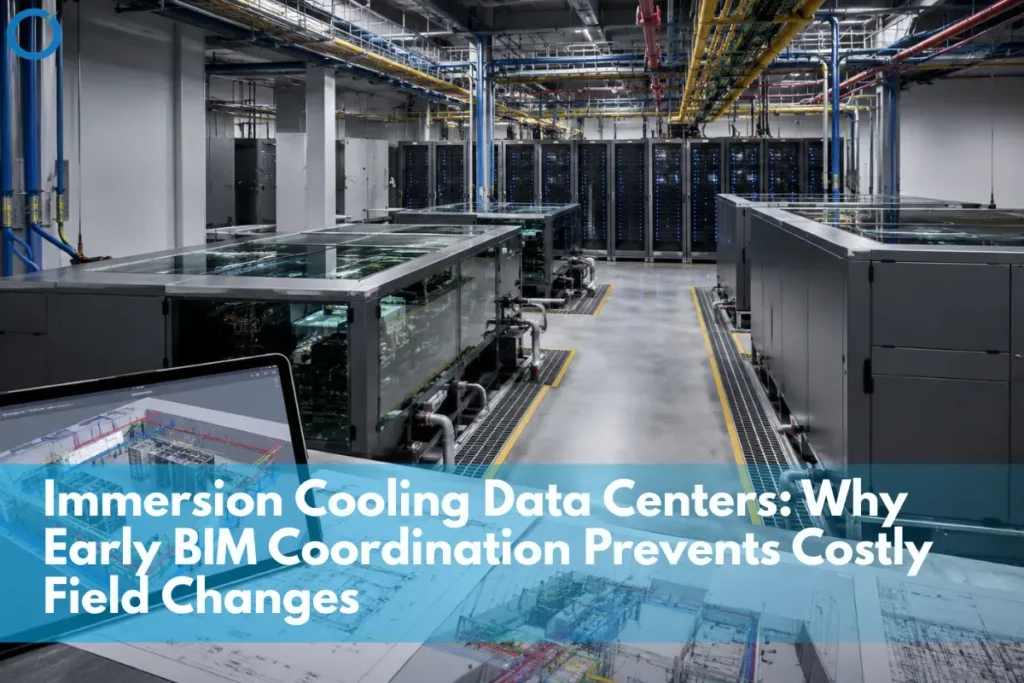
Immersion cooling introduces coordination requirements that don’t show up in a standard MEP clash detection process. Teams that treat immersion cooling as just another mechanical system often discover coordination gaps only after crews install the tanks and rough in the drainage, when field changes cost far more than model revisions.
This is a narrower problem than “high-density cooling generally needs more coordination.” It’s specifically about three requirements immersion cooling introduces that a standard clash detection scope built around ductwork, piping, and conduit doesn’t automatically account for, and that a team can miss entirely even while running a thorough coordination process on every other system in the building.
Quick Answer
Early BIM coordination prevents costly field changes on immersion cooling projects by identifying three issues that standard MEP clash detection may not automatically cover: dielectric fluid containment and drainage paths that require coordination with fire suppression and structural drainage systems, tank servicing clearances that differ significantly from standard rack maintenance access, and power distribution routing to submerged connections, which requires different sealing and routing than standard rack-mounted power. Teams that coordinate these three areas in the model avoid discovering them as field changes after installing the tanks.
What Makes Immersion Cooling Coordination Different
Traditional MEP conflict detection processes are based on conflicts among ducts, pipes, conduits, and cable trays competing for space, a well-established and recognized aspect of coordination. These interfaces require more detailed MEP BIM services when cooling, electrical, drainage, and fire protection systems occupy the same constrained areas. Immersion cooling introduces new elements that traditional coordination processes do not cover. As a result, teams can receive a clean clash detection report and still discover coordination problems after installing the tanks.
Dedicated BIM coordination services bring immersion cooling, structural, electrical, drainage, and fire protection models into the same coordinated environment before installation begins.
Field Changes That Show Up Without Early Coordination
- Fluid containment and drainage conflicts — dielectric fluid containment and spill drainage paths need coordination with fire suppression and structural drainage systems, since a containment berm or drainage route planned independently of these systems can conflict with them physically or functionally.
- Inadequate tank servicing access — immersion tanks are serviced differently than vertical racks, often requiring overhead crane access or specific aisle clearance for lid removal and module swaps, which standard rack-aisle planning doesn’t automatically accommodate.
- Power distribution routing conflicts — power connections to submerged hardware require sealed routing paths distinct from standard rack-mounted power distribution, and retrofitting this routing after tanks are placed is significantly more disruptive than planning it in the model.
Coordination Gap vs. Field Change Consequence
| Coordination Gap | Field Change Consequence |
|---|---|
| Fluid containment not coordinated with fire suppression or drainage | Containment or drainage rework after the team discovers the conflict on site |
| Tank servicing access not planned into aisle and clearance layout | Restricted maintenance access that requires layout modifications |
| Power routing to submerged connections not modeled early | Retrofit of sealed routing paths after crews have already placed the tanks |
What to Confirm Before Tanks Are Placed
- Confirm containment and drainage routing against fire suppression and structural drainage design in the same coordination pass, not as a separate review.
- Model the servicing access requirements for each tank explicitly, including the overhead clearance required for cranes to perform module swaps. Detailed BIM services also help teams model equipment geometry and maintenance zones accurately enough to identify clearance problems before installation.
- Route power distribution to submerged connections in the model before crews place the tanks, since teams can plan sealed routing paths far more easily upfront than retrofit them later.
Coordinating an Immersion Cooling Data Center Project?
Optimar Precon provides immersion cooling coordination through the same clash detection process used across other MEP systems, including fluid containment, servicing access, drainage, and power routing for submerged hardware. Contact us to discuss your project scope.
The Field Change Costs More Than the Coordination Would Have
Immersion cooling adds another layer to the common challenges in MEP BIM modeling, particularly where cooling, electrical, fire protection, drainage, and maintenance clearances compete for limited space.
Every field change on this list is cheaper to resolve in a coordinated model than after tanks, drainage, and power routing are already physically in place. Late coordination is also one of the most common data center preconstruction mistakes, because conflicts that remain unresolved during design often become rework, RFIs, or installation delays on site. Extending clash detection to specifically cover immersion cooling’s fluid containment, servicing access, and power routing requirements rather than assuming standard MEP coordination already accounts for them is what keeps these issues from becoming expensive field corrections.
None of these three requirements are difficult to coordinate once a team knows to look for them. The risk isn’t complexity; it’s assumption. A clash detection process that’s thorough for ductwork and piping but was never explicitly extended to cover immersion-specific requirements will still return a clean report, right up until the field change makes the gap obvious.
FAQs
Not automatically; standard clash detection is built around ductwork, piping, and conduit conflicts, and needs to be deliberately extended to cover fluid containment, servicing access, and submerged power routing specific to immersion cooling.
Immersion tanks are often serviced from above or require crane access for module swaps, rather than the front-and-rear aisle access standard rack maintenance assumes, which changes the clearance and layout requirements around each tank.
Containment and drainage paths for the fluid need to be coordinated alongside fire suppression and structural drainage design, since these systems can physically or functionally conflict with each other if planned independently.
Yes, power connections to hardware submerged in fluid require sealed routing paths that standard rack-mounted power distribution doesn’t need, which is a coordination requirement specific to immersion cooling rather than cooling systems generally.
It should start alongside standard MEP coordination; not after treating immersion-specific requirements as a later addition is what causes them to surface as field changes instead of being resolved in the model.
This depends on the specific tank and module design, but the servicing method should be confirmed with the equipment manufacturer early, since assuming standard front-access maintenance without checking can lead to a layout that doesn’t actually support the required service method.