
- What Is Historic Building Information Modeling (HBIM)?
- How HBIM Differs from Traditional BIM
- Why HBIM Is Critical for Heritage Projects
- The HBIM Workflow Explained
- Common Challenges in HBIM Projects
- Why Firms Outsource HBIM Modeling
- The Business Value of HBIM in Construction
- Preparing for Digital Twin Integration
- Choosing the Right HBIM Partner
- Protect Heritage Assets with Structured Digital Precision
- FAQs
Historic buildings require precision, sensitivity, and structured documentation. Traditional drawings and manual surveys are often not enough to capture irregular geometries, aged materials, and undocumented alterations.
This is where Historic Building Information Modeling (HBIM) becomes essential.
HBIM is not simply BIM applied to old buildings. It is a specialized modeling process designed specifically for heritage and historic structures. When implemented correctly, HBIM supports accurate documentation, restoration planning, conservation analysis, and long-term asset management.
For construction firms, architects, conservation consultants, and public sector clients, understanding HBIM in construction is no longer optional. It is becoming a standard for responsible heritage project delivery.
Let’s break it down clearly and practically.
What Is Historic Building Information Modeling (HBIM)?
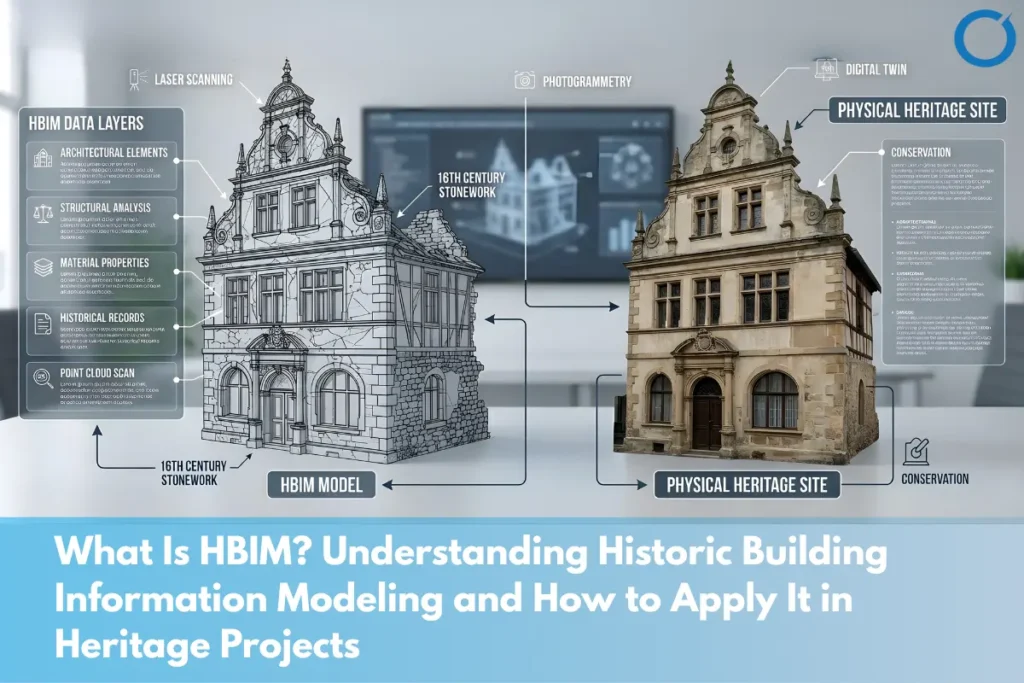
Historic Building Information Modeling (HBIM) is a reality-based digital modeling process used to document, analyze, and manage historic or heritage buildings.
Unlike traditional BIM, which is design-oriented and used primarily for new construction, HBIM modeling begins with existing physical conditions.
The process typically involves:
- 3D laser scanning of the structure
- Point cloud data processing
- Survey validation
- Modeling irregular geometries
- Embedding historical and material data
The result is a highly accurate digital model that reflects the actual condition of the historic asset.
HBIM in construction bridges the gap between preservation intent and technical execution.
How HBIM Differs from Traditional BIM
Understanding the difference between traditional BIM and heritage BIM is critical for project success.
Reality-Based vs Design-Based
Traditional BIM models are built from design drawings.
HBIM models are built from scanned reality. Every wall deviation, structural distortion, and historical modification is captured and reflected.
Irregular Geometry Handling
Historic buildings rarely follow modern design symmetry. HBIM modeling accommodates:
- Uneven walls
- Deformed arches
- Settled foundations
- Complex ornamental detailing
Traditional modeling workflows often struggle with this level of irregularity.
Conservation-Focused Data
HBIM includes data layers such as:
- Material degradation analysis
- Construction phases across centuries
- Structural assessment
- Preservation constraints
This transforms HBIM services from simple modeling into strategic conservation tools.
For a deeper breakdown of how HBIM modeling supports conservation strategy and multi-disciplinary coordination, refer to our detailed guide on Historic Building Information Modeling (HBIM).
Why HBIM Is Critical for Heritage Projects
Historic buildings often have:
- Incomplete documentation
- Unrecorded structural modifications
- Hidden deterioration
- Structural misalignments
Relying solely on 2D drawings or assumptions increases risk.
HBIM services provide:
- Accurate digital documentation
- Clear coordination between architects and engineers
- Early detection of structural issues
- Structured planning for restoration
- Reduced on-site surprises
For heritage BIM projects, digital clarity reduces conservation risk.
The HBIM Workflow Explained
Many firms want to implement HBIM but lack clarity on the structured process.
A professional HBIM workflow typically includes:
Data Capture
Laser scanning and photogrammetry capture precise geometry. Point cloud to HBIM workflows ensure accurate digital reference.
Data Processing
Point cloud data is cleaned, aligned, and structured for modeling.
HBIM Modeling
This often involves advanced Architectural BIM Services and detailed bim 3d modeling workflows to accurately represent complex historic geometries.
Information Enrichment
Material properties, historical data, and structural assessments are embedded into the model.
Restoration & Coordination Support
The model supports:
- Clash detection for new interventions
- Restoration sequencing
- Preservation strategy validation
- Multi-disciplinary coordination
This structured process transforms heritage BIM from documentation into decision-making infrastructure.
Common Challenges in HBIM Projects
Despite its benefits, HBIM implementation presents challenges:
- Internal teams lack scanning experience
- Irregular geometry increases modeling complexity
- Heritage data standards are inconsistent
- Modeling timelines extend due to manual adjustments
- Conservation constraints limit design flexibility
Most architecture and construction firms do not have dedicated in-house HBIM teams.
That is why many choose to outsource HBIM services.
Why Firms Outsource HBIM Modeling
HBIM requires specialized workflows, experienced modeling teams, and strong coordination capabilities.
Outsourcing HBIM services allows firms to:
- Access experienced modeling specialists
- Handle complex geometry accurately
- Reduce internal workload pressure
- Improve documentation quality
- Accelerate restoration planning timelines
- Maintain cost control
Instead of stretching internal BIM teams beyond their expertise, firms operate with extended digital capacity.
For restoration projects with tight grant deadlines or public funding oversight, structured outsourcing reduces risk significantly.
The Business Value of HBIM in Construction
Historic Building Information Modeling provides measurable value beyond documentation.
HBIM improves:
- Cost predictability
- Risk reduction
- Restoration sequencing clarity
- Stakeholder transparency
- Long-term asset management
When integrated with professional BIM consulting services, HBIM strategies become more structured, scalable, and aligned with long-term digital asset goals.
Digital documentation allows conservation teams to make informed decisions without compromising the integrity of the building.
For public institutions and heritage authorities, this level of accuracy builds confidence and accountability.
Preparing for Digital Twin Integration
Many heritage projects now extend beyond restoration into operational performance monitoring.
HBIM models can serve as the foundation for future Digital Twin integration.
When structured correctly, HBIM enables:
- Lifecycle asset tracking
- Ongoing maintenance planning
- Energy performance analysis
- Facility management alignment
This forward-thinking approach increases the long-term value of heritage investments.
Choosing the Right HBIM Partner
HBIM is not standard BIM with minor adjustments. It requires:
- Expertise in laser scanning integration
- Experience modeling irregular geometry
- Understanding of conservation principles
- Strong LOD discipline
- Coordination across restoration teams
With 29+ years of group experience in preconstruction and BIM delivery, Optimar Precon supports architectural firms, conservation consultants, and contractors with structured HBIM modeling services.
We provide:
- Point cloud to HBIM modeling
- Architectural and structural heritage BIM support
- Restoration coordination modeling
- LOD-driven model development
- Scalable offshore HBIM support
Our teams integrate into your workflow, follow project standards, and deliver accurate digital documentation aligned with heritage objectives.
Protect Heritage Assets with Structured Digital Precision
Historic buildings deserve precision, not approximation.
If your upcoming restoration or conservation project requires:
- Accurate digital documentation
- Structured coordination
- Risk-controlled restoration planning
- Scalable HBIM modeling support
Now is the right time to evaluate your digital strategy.
Delays caused by incomplete documentation or inaccurate surveys increase cost and conservation risk.
Structured HBIM implementation prevents those issues before they escalate.
If you are planning a heritage or restoration project and need reliable HBIM modeling services, a focused consultation can clarify:
- Your data capture requirements
- Modeling scope and LOD levels
- Coordination strategy
- Delivery timelines
Heritage assets require technical precision and conservation sensitivity.
Let’s build the digital foundation that protects both.
FAQs
Historic Building Information Modeling (HBIM) is a reality-based digital modeling process used to document, analyze, and manage historic or heritage buildings using laser scans, point cloud data, and structured BIM workflows.
Traditional BIM is design-focused for new construction, while HBIM models existing historic structures based on real-world data, irregular geometry, and conservation requirements.
HBIM should be implemented at the early documentation stage of restoration or conservation projects to reduce risk, improve coordination, and support accurate planning.
HBIM requires 3D laser scans, point cloud data, site surveys, photographs, historical drawings, and material assessments to ensure accurate modeling of existing conditions.
Yes. HBIM improves restoration planning by identifying structural issues, documenting material conditions, coordinating interventions, and reducing unexpected on-site complications.
Many firms outsource HBIM services because historic modeling requires specialized expertise, handling irregular geometry, managing large point cloud datasets, and maintaining conservation accuracy.
Project timelines depend on building size, data complexity, and required LOD levels. Structured offshore HBIM support can significantly reduce modeling turnaround time.
Yes. When properly structured, HBIM models can support lifecycle asset management, maintenance planning, and future Digital Twin integration for heritage buildings.
Get Your Instant Quote

