
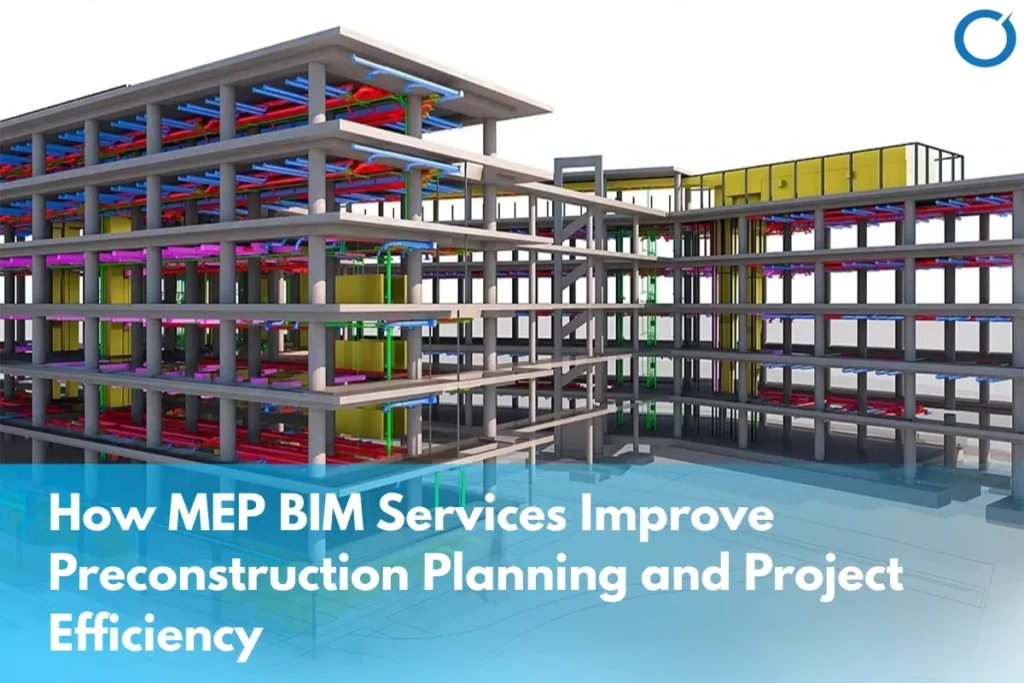
It is the stage of preconstruction, which is considered to be where the results of projects are determined before actual construction starts. It is at this stage that decisions regarding cost certainty, coordination quality, and construction efficiency are made. In projects that have complex mechanical, electrical, and plumbing systems, planning may not be sufficient, and this is where MEP BIM services in preconstruction are really making an impact.
Instead of depending on incomplete drawings and coordination well into the process, BIM-based MEP planning helps teams visualize the systems early on, resolve issues, and get to construction with confidence.
Why MEP Systems Create Challenges During Preconstruction
The MEP systems are considered one of the major space-consuming and coordination-sensitive systems of any building. During the pre-construction stage, these systems are incorporated into the architectural intent and structural considerations.
Common challenges include:
- Congested Ceiling Void Space and Service Corridors
- Conflicts between structure and MEP routing
- Insufficient clearance for access and maintenance
- Late design changes affecting costs and schedules
Without early coordination of these factors, these issues usually manifest themselves during construction, resulting in RFIs and construction delays.
Understanding the Role of MEP BIM in Preconstruction
The role of MEP BIM during preconstruction extends far beyond visualization. In MEP disciplines, preconstruction involves a coordinated and data-rich environment where MEP systems are developed, reviewed, and validated.
In practice, this includes:
- Federating architectural, structural, and MEP models
- Reviewing the coordination of space and the layout of the system
- Validating access, clearance, and installation logic
- Supporting informed design and planning decisions
This approach replaces assumption-based planning with coordinated, build-ready information.
MEP BIM for Preconstruction Planning and Coordination
MEP BIM for Pre-Construction Planning makes it easier for the team to identify and solve coordination problems before the project, when change is quicker and less expensive. This way, the team will have a better understanding of how the components work with each other within the building.
This process supports:
- Early identification of system clashes
- Clear definition of routing and zoning strategies
- Improved alignment between disciplines
- Reduced coordination-related design revisions
This results in better-coordinated information being received, which gives better support for execution.
Improving Project Efficiency Before Construction Begins
Efficiency gains from MEP BIM services for project planning start during preconstruction. When systems are coordinated early, installation sequencing becomes clearer and planning decisions more reliable.
A coordinated approach to MEP BIM workflow allows teams to:
- Reduce rework due to design conflicts
- Enhance installation sequencing and logistics
- Minimise delays linked to late coordination
- Support predictable construction schedules
The efficiencies gained have a direct impact on time and money savings.
MEP BIM Coordination in Preconstruction
Effective MEP BIM coordination during pre-construction ensures that the mechanical, electrical, and piping systems are coordinated with other systems, such as the structure or architecture.
Through structured coordination reviews, teams can:
- Conflict resolution digitally, not physically
- Validate the constructability of system layouts
- Improve confidence in coordinated construction documents
In this manner, the coordination process eliminates uncertainty and enhances collaboration between the team.
BIM-Based MEP Planning and Clash Detection
One of the most valuable BIM-based MEP planning strengths is the early detection of conflicts. MEP BIM Clash detection before construction takes place helps to systematically identify conflicts that are often not easily identifiable using 2D drawings.
With BIM coordination tools, the following can be accomplished:
- Detect clashes between MEP systems and structure
- Prioritise conflicts based on construction impact
- Resolve issues collaboratively during preconstruction
- Validate updates before issuing information
This approach, which is proactive in its application, minimizes RFI, CO, and site disruption
Supporting Better Cost and Risk Management
MEP systems represent a significant portion of the project cost. When design is incomplete or poorly coordinated in the preconstruction phase, the budget is not reliable.
BIM-driven preconstruction planning supports:
- More accurate quantity extraction
- Early identification of high-risk design elements
- Better evaluation of design alternatives
- Enhanced confidence in pre-construction budgets
If changes occur, the impact of those changes can be assessed immediately.
Enhancing Collaboration Across Disciplines
Contemporary preconstruction uses cooperative relationships. BIM creates a common environment where architects, engineers, and contractors can operate with common coordinated information.
This collaborative approach:
- Reduces Misinterpretation of Drawings
- Encourages early problem-solving
- Strengthens accountability throughout teams
- Improves communication throughout preconstruction
Through preconstruction BIM coordination, we are able to transition away from silos and toward integration.
Applying MEP BIM to Complex Project Types
BIM MEP delivers the greatest value on projects with dense services or strict performance requirements, including:
- Commercial and Mixed-Use Developments
- Healthcare and Laboratory Facilities
- Data centers and infrastructure development
- High-rise residential buildings
In such environments, early coordination is considered critical in preventing costly redesign as well as construction delays.
The Growing Importance of MEP BIM in Preconstruction
As projects get more complicated and schedules get tighter, BIM adoption in the preconstruction phase continues to grow. This is due to clients’ increasing demand for coordinated models, better planning strategies, and reduced construction risks.
MEP BIM workflows in preconstruction are now used to:
- Support early contractor involvement
- Improve approval processes
- Validate design intent before construction
- Deliver more predictable project outcomes
Companies that incorporate BIM systems into their preconstruction process enjoy a competitive advantage due to effective planning and reduced uncertainties.
Strengthening Preconstruction Outcomes Using the Right BIM Approach
MEP BIM in preconstruction is not about adding complexity. It is about removing uncertainty. By coordinating systems early on, validating layouts, and resolving conflicts before the start of the project, better cost, schedule, and quality control can be achieved.
We, at Optimar Precon, assist AEC firms with a structured BIM process that enhances preconstruction planning and coordination. Through state-of-the-art technologies, BIM experts, and with over 29+ years of collective experience in the market, we can help ensure a smoother preconstruction phase and a confident entry into the construction phase.
If your projects require better coordination, planning, and fewer surprises in the field, then investigating BIM-led preconstruction approaches could bring value to every phase.
FAQs
In pre-construction planning, MEP BIM involves creating coordinated mechanical, electrical, and plumbing designs to identify clashes, validate layouts, and provide information to make informed decisions before starting construction.
Coordination: BIM MEP makes coordination easier by facilitating review and coordination between all disciplines in the model environment. Improved coordination reduces conflicts and coordination-related changes.
Early use of MEP BIM reduces design uncertainty, improves constructability, and reduces site-level problems that could cause costly conflicts. Addressing problems in the preconstruction environment is faster and less costly than addressing them on the site.
Yes. Clashes and coordination issues identified during the preconstruction stage are minimized by MEP BIM, thereby achieving better predictability in construction schedules.
Heavy-service or performance-defined projects such as commercial buildings, healthcare facilities, data centers, and high-rise buildings are likely to benefit the most from early MEP BIM coordination.
Get Your Instant Quote

