
- What Value Engineering Actually Means in Construction
- How the Value Engineering Process Works
- When to Use Value Engineering and When Not To
- Value Engineering by Trade: What Gets Changed and What Doesn't
- Three VE Mistakes That End Up Costing More
- The Projects That Benefit Most Are the Ones That Start VE Earliest
- FAQs
Every construction project has a budget. Most also have a gap: the difference between what the design costs and what the client can actually spend. It is through value engineering that such a discrepancy can be resolved without destroying the project itself.
Value engineering is perhaps one of the most misinterpreted phrases within the construction industry. While some contractors see it strictly in terms of minimizing costs, others think of it as compromising on the quality of the construction process. In reality, value engineering is a systematic process of analyzing what a project is supposed to do and how it can do exactly that at the lowest cost possible.
The following article will discuss what value engineering entails, its process, its applications, how it is applied in different construction trades, and mistakes to avoid when implementing it.
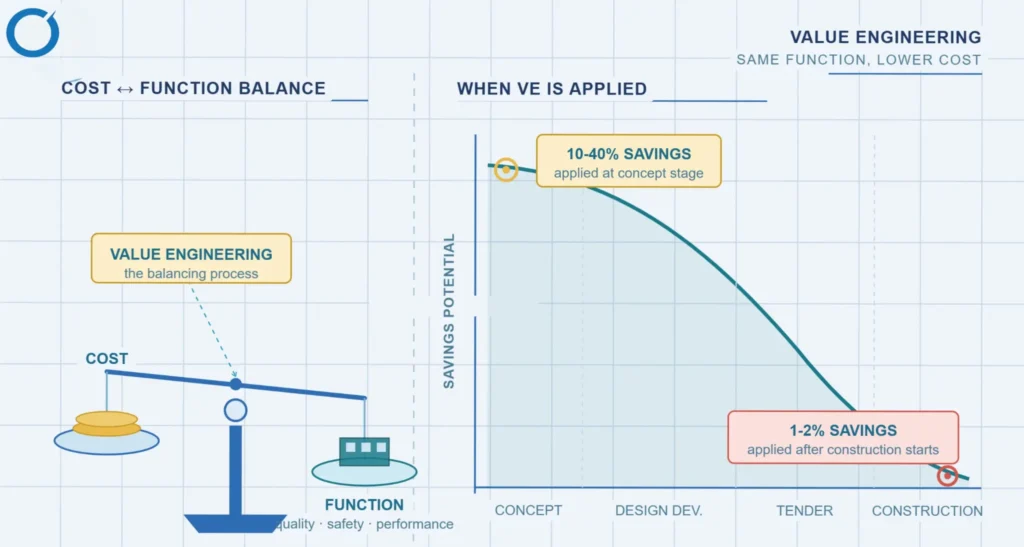
Construction value engineering (VE) is a comprehensive evaluation process conducted to ensure that a given function of the construction project is provided for less money without compromising the quality, safety, or functionality. Value engineering can be implemented before the design phase, before construction starts, and before any procurement is undertaken.
What Value Engineering Actually Means in Construction
The practice of value engineering was initially designed for supply chain management at General Electric in the 1940s. The use of value engineering services in construction rose rapidly in the 1970s in government projects, where budget overruns occurred.
In construction, VE is a formal analysis of a project’s components and systems. Its first inquiry into all the components is this: is there an effective performance of its function in the project, and is it the most economical method for this?
That question sounds simple. In practice it requires:
- An accurate appreciation of what each component should do rather than just what it will look like on the drawings
- Information about other materials, methods, and specifications capable of achieving the same objective
- The skill to quantify how much cheaper one option may be than another
- The insight to know when two options truly are comparable and when they contain built-in compromises
This is where value engineering often falls. A cheaper material that performs the same function is a VE win. A cheaper material that fails in five years, requires more maintenance, or creates programme risk is not even if the upfront number is lower.
How the Value Engineering Process Works
A structured VE exercise follows a defined sequence. The process is the same whether it is carried out by an in-house team or a specialist pre-construction partner.
| Phase | What Happens | Who Leads |
|---|---|---|
| 1. Information | Gather full project documentation, drawings, specs, programme, cost plan. Understand the design intent and project constraints. | Estimator / QS |
| 2. Function analysis | Determine the principal purpose of each major component. Distinguish between needs and wants. | VE lead / Design team |
| 3. Creative | Devise alternatives for each major component: different components, ways of doing things, criteria, and order. | Multi-discipline team |
| 4. Evaluation | Evaluate each alternative based on its cost, impact on the programme, quality, risk, and regulatory compliance. Reject those with trade-offs that are concealed. | Estimator + Engineer |
| 5. Development | Detail the shortlisted alternatives: revised drawings, updated specifications, re-costed quantities. | Design team |
| 6. Presentation | Present recommendations to the client with full cost, programme, and quality analysis for each option. | Project lead |
The function analysis phase is what separates genuine VE from simple cost-cutting. When a team skips straight from ‘this is expensive’ to ‘use a cheaper version’, they are not doing value engineering; they are just reducing specification. The function analysis forces the question: what does this actually need to do?
Accurate quantities are essential at phases 1 and 4. You cannot evaluate cost alternatives without reliable base quantities to apply unit rates to. See our guide on construction takeoff and estimation for how this works in practice.
When to Use Value Engineering and When Not To
VE is not appropriate for every project or every stage. Used at the right time, it can generate significant savings. Used at the wrong time, it creates abortive design costs, programme disruption, and contractor disputes.
| Use VE when… | Avoid VE when… |
|---|---|
| The project is at Stage 2 or 3 (RIBA, UK) / Schematic or Design Development (USA) | Construction has already started; changes generate variations and delay costs |
| The cost plan exceeds the client budget and design needs to be reviewed | The design is already at tender stage with contractor prices received |
| A specific package comes in significantly over budget at tender | The specification reflects a client requirement that cannot be changed (heritage, planning condition) |
| New materials or methods have become available since the design was fixed | The savings identified are marginal relative to the redesign cost and programme risk |
| The programme has flexibility to accommodate design revisions | The VE exercise is being used to justify cutting safety-critical elements |
The earlier VE is applied, the greater the potential saving. SAVE International data consistently shows that VE applied at concept stage can generate savings of 10-40% of construction cost. VE applied after construction starts rarely achieves more than 1-2%, and often costs more in redesign fees than it saves. Understanding how much construction estimating actually costs before the VE exercise helps set realistic expectations for what savings are achievable.
For contractors managing multiple concurrent bids, the VE exercise is often handled most efficiently by an offshore pre-construction team that can work through alternatives quickly without pulling in-house estimators off live bids. Read how offshore preconstruction teams help contractors scale during peak bid periods.
Value Engineering by Trade: What Gets Changed and What Doesn’t
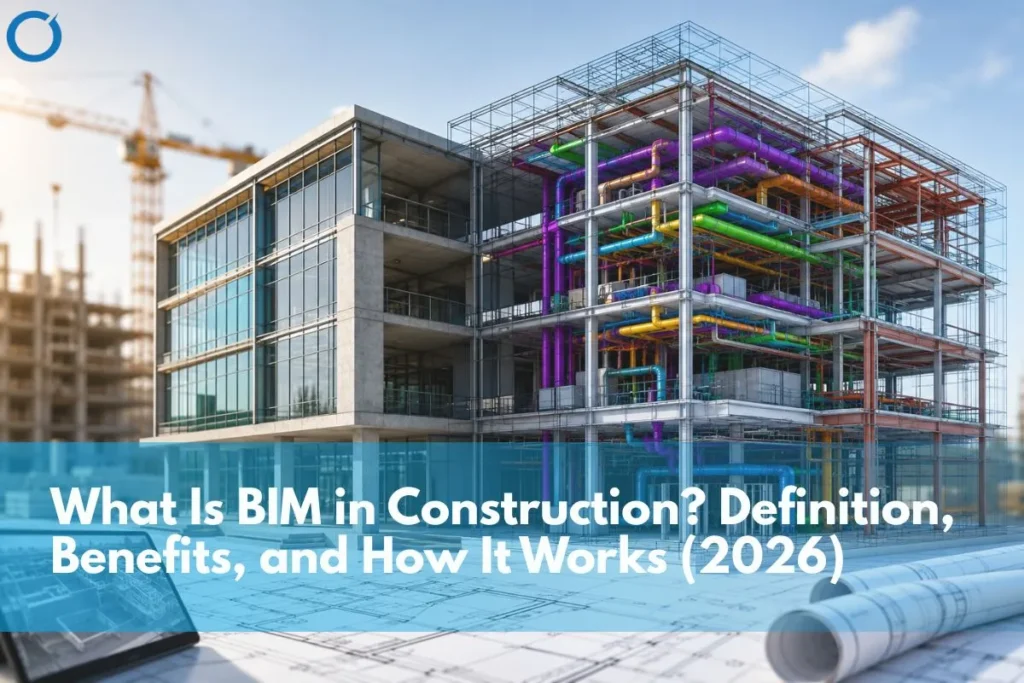
VE opportunities vary significantly by trade. Some elements have many viable alternatives. Others have few or no alternatives that appear cheaper but carry hidden costs in programme, maintenance, or compliance risk. For larger projects, BIM Services can support value engineering by showing how structural, MEP, facade, and layout alternatives affect the project before the design is fixed.
Structural frame
Structural steel estimating services vs concrete frame is one of the most common VE decisions on commercial projects. The right answer depends on the structural spans, the programme, and the local labour market. Neither is universally cheaper, and getting this wrong adds weeks to the programme, not days.
External envelope
Facade systems offer significant VE scope: panel systems, brick, render, rainscreen cladding, and curtain wall all perform the same weather-exclusion function at very different costs. The VE risk here is thermal performance and maintenance lifespan. A cheaper facade that requires resealing every 10 years often costs more over the building’s life.
MEP systems
Mechanical, electrical, and plumbing systems are consistently the highest-value VE opportunity on commercial and residential projects. Equipment specification, plant sizing, pipe sizing, and distribution layouts all have genuine alternatives. MEP VE requires specialist trade knowledge; general estimators without MEP estimating services experience routinely miss the best opportunities here.
BIM-based VE is becoming the norm for larger projects. If the building is modeled using BIM, then different options for MEP systems and structural systems can be assessed before design commitment, thus avoiding the rework that makes VE after tendering very costly. Read about how BIM reduces rework on construction projects to understand the practical impact.
Finishes
Internal finishes flooring estimating services, wall finishes, ceiling systems, ironmongery offer VE opportunities with the lowest risk of hidden costs. The function is largely aesthetic rather than structural or performance-critical. The VE decision is cleaner: equivalent appearance and durability at lower cost.
What not to VE
Fire protection, structural tie-ins, waterproofing layers, and safety-critical MEP systems cannot be value engineered solely based on cost savings. The costs of failure for these items are not construction costs; they are liabilities. Liability costs are always greater than construction costs.
Three VE Mistakes That End Up Costing More
Mistaking specification reduction for value engineering
Specifying a cheaper product without analysing its functional equivalence is not VE. This will help reduce costs. The distinction is important from the legal standpoint (if the less expensive product should prove to be faulty), contractual aspect (if it was part of the contract requirements) and practical angle (if the two products do not perform equivalently).
Applying VE too late
The most common VE mistake on commercial projects is commissioning the exercise after tender packages have been issued. At that point, contractors have priced against a fixed specification. Any VE change generates variation in contractor mark-up, redesign costs, and programme risk. The saving on the material is rarely greater than the cost of the change.
For larger projects, BIM Coordination Services can help review VE options in a federated model before tender packages are issued, allowing teams to check clashes, access conflicts, ceiling spaces, service routes, and structural constraints before changes become expensive.
VE without whole-life cost analysis
This material will be cheaper by 20 percent when purchasing; however, it will need to undergo maintenance work that is 50 percent more compared to another type of material. It is important to conduct a whole-life costing analysis to recommend any type of VE for building components, mechanical equipment, or exterior envelope systems.
Need a Value Engineering Analysis for Your Next Project?
Optimar Precon provides value engineering services as part of our pre-construction offer, reviewing design alternatives, re-costing specifications, and identifying material and method substitutions that maintain performance at lower cost. Available for commercial, residential, and industrial projects across the USA, UK, UAE, and Ireland. Contact us to discuss your project.
The Projects That Benefit Most Are the Ones That Start VE Earliest
Value engineering is not a rescue operation for projects that have gone over budget. When the project gets to that stage, the design is set, procurement is underway, and there are limited choices. Those who make the most use out of value engineering are the ones who incorporate it at an early stage, before construction, viewing it not as an answer to an existing problem but as an integral part of their pricing system.
The design is still flexible, there are real choices, and there is potential for saving. An hour of structured function analysis at RIBA Stage 2 consistently delivers more value than a week of cost-cutting at the construction stage.
The question is not whether to do value engineering. It is when. And the answer is always: earlier than you think. If you’re interested in incorporating VE into your pre-construction process, reach out to us, and we’ll show you what that means for your type of project.
FAQs
What is the difference between value engineering and value management?
Value management is a broader field that takes into account project objectives and stakeholders’ interests. Value engineering, on the other hand, is a technique used to examine design components with respect to their cost-function. In practice, the terms are often used interchangeably in construction, though on major infrastructure projects the distinction is maintained.
Who should carry out value engineering on a construction project?
A VE exercise is most effective when led by an experienced estimator or quantity surveyor supported by trade specialists relevant to the elements under review. For MEP-heavy projects, MEP engineers must be in the room. For facade-heavy projects, envelope specialists. A VE exercise led entirely by non-technical management tends to focus on specification reduction rather than genuine functional alternatives.
Does value engineering affect the contractor’s programme?
It can both positively and negatively. Some VE alternatives, such as off-site prefabrication, genuinely reduce programme duration. Others, such as design changes after procurement or substitute materials with longer lead times, add programme risk. Every VE recommendation should include a programme impact assessment alongside the cost analysis.
Can value engineering help you win more bids?
Yes, but only if it is applied before tender, not during. Contractors who run a VE exercise during pre-construction can submit a more competitive bid price without reducing their margin. Clients increasingly expect VE analysis as part of a tender submission on larger projects. For the broader picture of how pre-construction accuracy affects bid outcomes, see our guide on how to improve your bid success rate in construction.
Is value engineering only relevant for large projects?
No. The principle applies at any scale. On smaller residential or commercial projects, the VE exercise is less formal, a structured review of specification and method alternatives rather than a multi-day workshop. The savings are proportionally smaller, but so is the cost of the exercise. For contractors regularly bidding projects in the $500K-$5M range, a consistent VE approach to specification can meaningfully improve margin across a portfolio of work.