- What Clash Detection Actually Catches
- Why Dubai High-Rises Carry More Clash Risk Than Most Projects
- What Happens When Clashes Aren't Caught Before Construction
- How the Clash Detection Process Should Work on a High-Rise
- What to Look for in a Clash Detection Partner for a Dubai Project
- The Conflicts You Don't See on the Drawings Are the Ones That Stop the Tower Crane
- FAQs
The construction pace in Dubai is much higher than in any other region in the world. The height of each floor of a high-rise is reduced significantly due to the presence of several building elements in the same space. Add a construction programme measured in months rather than years, and the conditions are set for exactly the kind of conflict that clash detection exists to catch.
Most contractors understand clash detection in the abstract. Far fewer understand why it matters more on a Dubai high-rise than on a comparable project almost anywhere else. It is the density of these, the speed at which they work, and the sheer numbers of them that increase the chances of unnoticed collisions being more costly than those on average low-rise commercial projects.
In this article, I will examine the problems that arise when there are no collision detections performed in Dubai high-rises, why it is structurally more risky here, and what elements should be included in the process to keep it on track.
What Clash Detection Actually Catches
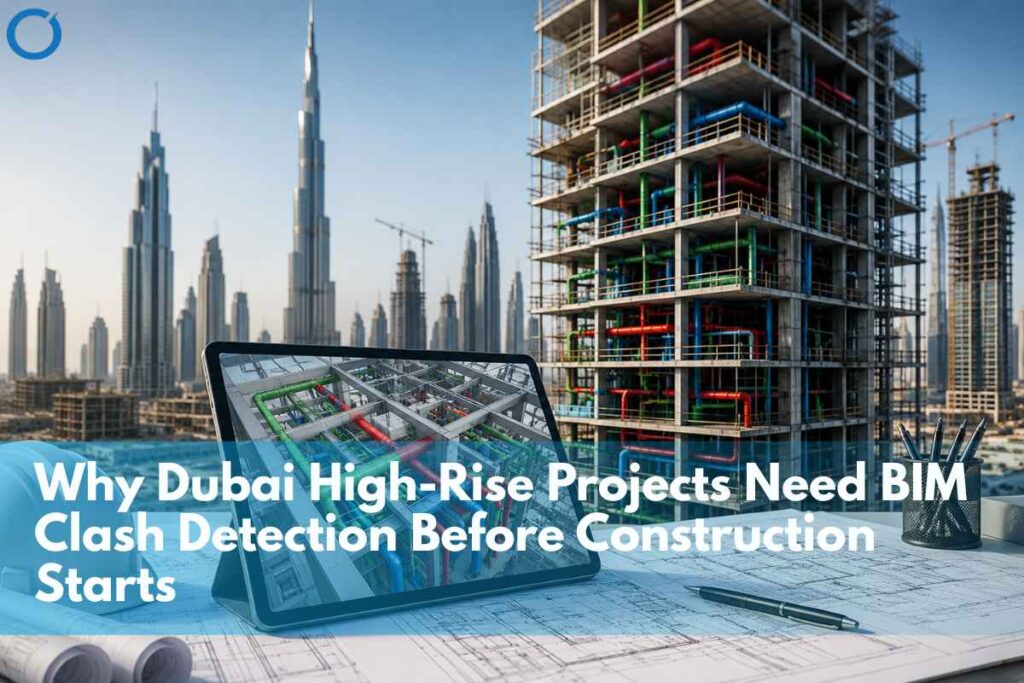
Clash detection is the process of checking a coordinated 3D model for physical conflicts between building systems before construction begins. A structural beam routed through the exact space reserved for a ductwork run. A sprinkler main clashing with a cable tray. A column that lands inside a planned lift shaft. On paper, in 2D drawings, none of these conflicts are visible. In a federated 3D model, they are flagged automatically.
There are three broad categories of clash that matter on a high-rise project:
- Hard clashes: Two physical elements occupying the same space a duct and a beam, a pipe and a column. These are unbuildable as drawn and must be resolved before fabrication.
- Soft clashes: Elements that technically fit but violate clearance requirements insufficient space for insulation, maintenance access, or fire-rated separation.
- Workflow clashes: Sequencing conflicts where one trade’s installation blocks another trade’s access, even if the final elements don’t physically overlap.
Why Dubai High-Rises Carry More Clash Risk Than Most Projects
The conflict risk on a Dubai tower isn’t theoretical. It comes from three structural realities of how these buildings are designed and delivered.
Vertical density compresses every system into less space
Floor-to-floor heights on Dubai residential and mixed-use towers are tightly optimised to maximise saleable area. That leaves a narrow ceiling void to fit structure, MEP distribution, and fire protection often in a fraction of the space available on a typical US or UK commercial floor plate. The tighter the void, the higher the probability that a structural element, a duct run, and a sprinkler main are all competing for the same few hundred millimetres. See our guide on MEP BIM modeling services for how these systems are coordinated within compressed ceiling zones.
Podium and amenity levels concentrate the most complex MEP
The lower podium levels of a Dubai high-rise parking, retail, amenity floors, central plant rooms carry a disproportionate share of the building’s total MEP load. Chillers, main switchgear, and primary distribution all converge in these levels before branching upward through risers. This is consistently where the highest density of MEP-to-MEP and MEP-to-structure clashes occurs on any tower project.
Fast-track delivery leaves no time to discover clashes on site
Dubai’s construction market is built around speed. Design-and-build delivery, overlapping design and procurement, and aggressive handover dates are the norm rather than the exception. On a fast-track programme, there is no slack to absorb a clash discovered during installation every conflict found on site becomes a direct hit to the critical path. This is why 4D BIM sequencing linking the coordinated model to the construction programme has become standard practice on larger Dubai towers rather than an optional extra.
What Happens When Clashes Aren’t Caught Before Construction
The cost of an undetected clash scales with how late it’s discovered. A conflict caught in the model costs a coordination meeting. The same conflict caught on site costs fabrication rework, a stalled trade, and a schedule recovery plan.
| Stage Discovered | Typical Resolution | Relative Cost |
|---|---|---|
| In the coordinated model | Adjust routing or element position before issue | Lowest design time only |
| During shop drawing review | Re-detail and re-issue fabrication drawings | Moderate drafting and approval delay |
| During fabrication | Scrap and re-fabricate the affected component | High material and lead time loss |
| On site during installation | Cut, reroute, or rebuild in the field | Highest labour, delay, and disputes |
Industry research consistently shows MEP-related conflicts account for the majority of coordination issues on commercial high-rise projects, and that structured BIM coordination materially reduces rework. For a detailed breakdown of the mechanisms involved, see our article on how BIM modeling reduces rework on construction projects.
On a Dubai high-rise specifically, the multiplier effect is worse. A clash discovered late on level 30 doesn’t just delay level 30 it delays every trade scheduled to follow behind it up the building, on every level above. Vertical construction sequencing means a single unresolved conflict can cascade through dozens of floors of programme.
How the Clash Detection Process Should Work on a High-Rise
The effective clash detection procedure in a tower project always has the same sequence of stages, no matter who provides it:
- Assembly of the federated model: The architectural, structural, and MEP models are assembled into a unified coordinated model, normally using Navisworks or Solibri software rather than analyzing each discipline separately.
- Appropriate LOD level: Clash detection is carried out at LOD 350 or higher, where objects have real dimensions and connections. Detection run on under-detailed models catches far fewer real conflicts.
- Coordination schedule: Weekly clash review meetings for active coordination while design is being carried out where all disciplines get together to resolve any issues detected.
- Tracking and closure: All clashes identified are recorded, assigned, and followed up to closure.
This coordination structure is what separates clash detection as a genuine discipline from a one-off model check. See our overview of BIM coordination services for how the full process fits together across project phases.
What to Look for in a Clash Detection Partner for a Dubai Project
Not every BIM provider runs clash detection to the same standard. For a Dubai high-rise specifically, four things matter most:
- Software fluency: Genuine working knowledge of Navisworks and Solibri, not just model authoring in Revit. Clash detection is a distinct skill from BIM modeling.
- MEP coordination experience: Given how much of the conflict risk concentrates in MEP systems, a provider without deep MEP coordination experience will miss the conflicts that matter most.
- Time zone overlap: Dubai-based design teams need real working-hour overlap with their coordination partner to keep weekly clash cycles on schedule, particularly on fast-track programmes.
- Standards familiarity: Working knowledge of ISO 19650 information management principles, which increasingly underpin BIM delivery on larger UAE developments.
For a broader framework on vetting any BIM provider not just for clash detection see our guide on how to choose a BIM modeling service provider.
Need Clash Detection for a Dubai High-Rise Project?
Optimar Precon provides BIM clash detection and coordination services for high-rise and mixed-use developments across Dubai and the wider UAE using Navisworks and Solibri, working to ISO 19650 principles, with coordination cycles structured around fast-track delivery schedules. For project-specific support, explore our BIM clash detection services in Dubai or contact us to discuss your project.
The Conflicts You Don’t See on the Drawings Are the Ones That Stop the Tower Crane
Every clash that makes it past coordination and into the field has the same root cause: it wasn’t visible in 2D, and nobody checked the 3D model closely enough to catch it before fabrication. On a low-rise project, that’s an inconvenience. On a Dubai high-rise running a fast-track programme with dozens of floors of repeating sequence behind it, it’s a direct hit to the handover date.
The towers that hold their schedule aren’t the ones that got lucky with a clean design. They’re the ones where clash detection was treated as a structured, ongoing discipline from design development onward not a box-ticking exercise run once before tender.
FAQs
As early as the design development stage, once architectural, structural, and MEP models have enough detail to be meaningfully coordinated. Starting clash detection only at construction documentation stage is too late to influence major routing decisions without costly redesign.
No, though the risk and cost of skipping it scales with building height and system complexity. Since a 40-story building with compact floor heights has more chances of clash compared to a low-rise villa project, the use of coordination has almost become mandatory for high rise construction in Dubai.
It is not an isolated event but rather a continuous process that proceeds side-by-side with design and development of the project, usually done on a weekly basis. The total duration scales with building complexity and the number of disciplines involved, rather than being a fixed number of days.
Not effectively. Clash detection depends on having coordinated 3D models for every discipline. Without BIM models for architecture, structure, and MEP, there’s no federated model to run clash detection against 2D drawing review simply can’t catch the same conflicts.
Yes, provided the provider maintains sufficient working-hour overlap and uses the same software stack as the design team. Many Dubai contractors now use offshore BIM coordination teams specifically because it allows continuous clash review cycles without expanding in-house headcount.