
- 10 Benefits At A Glance
- Benefit 1 – Significant RFI Reduction
- Benefit 2 – Rework Elimination
- Benefit 3 – Programme Certainty
- Benefit 4 – Cost Control and Budget Protection
- Benefit 5 – Comprehensive Clash Prevention
- Benefit 6 – Accurate Cost Estimating From The Model
- Benefit 7 – Stakeholder Alignment and Communication
- Benefit 8 – Faster Design Approvals
- Benefit 9 – Improved Facility Management and Lifecycle Value
- Benefit 10 – Sustainability and Green Certification Support
- Why Are These Benefits Amplified On Large Projects?
- Accessing BIM Coordination Quality For Your Large Project
- Deliver All 10 Benefits On Your Next Large Project
- FAQs
In short: BIM coordination deliver ten measurable advantages on large construction projects: fewer RFIs, reduced rework, stronger programme control, better cost management, clash prevention, improved estimating accuracy, stronger stakeholder alignment, faster design approvals, better facility management, and stronger sustainability compliance. A 2026 study found that BIM-based coordination can reduce design conflicts by 52%, cut rework costs by 29%, and improve design approval timelines by 34%. These benefits become even stronger on large projects with dense MEP systems, multiple trade packages, and higher costs when coordination failures reach the site.
Large-scale projects such as commercial skyscrapers, healthcare facilities, data centers, and industrial plants gain the highest value from BIM coordination services because coordination errors cost more on complex projects. As project complexity increases, teams need to coordinate more disciplines, manage denser MEP systems, and prevent clashes before they reach the site.
According to Market Growth Reports, the BIM software market reached $4.33 billion in 2026 and may grow to $8.76 billion by 2035 as more project teams adopt BIM for coordination, clash prevention, and construction planning. More than 72% of medium and large organizations worldwide now use BIM technology, including over 75% of architecture firms in the US.
This article breaks down the ten specific benefits that BIM coordination services deliver on large projects, with the research evidence behind each one.
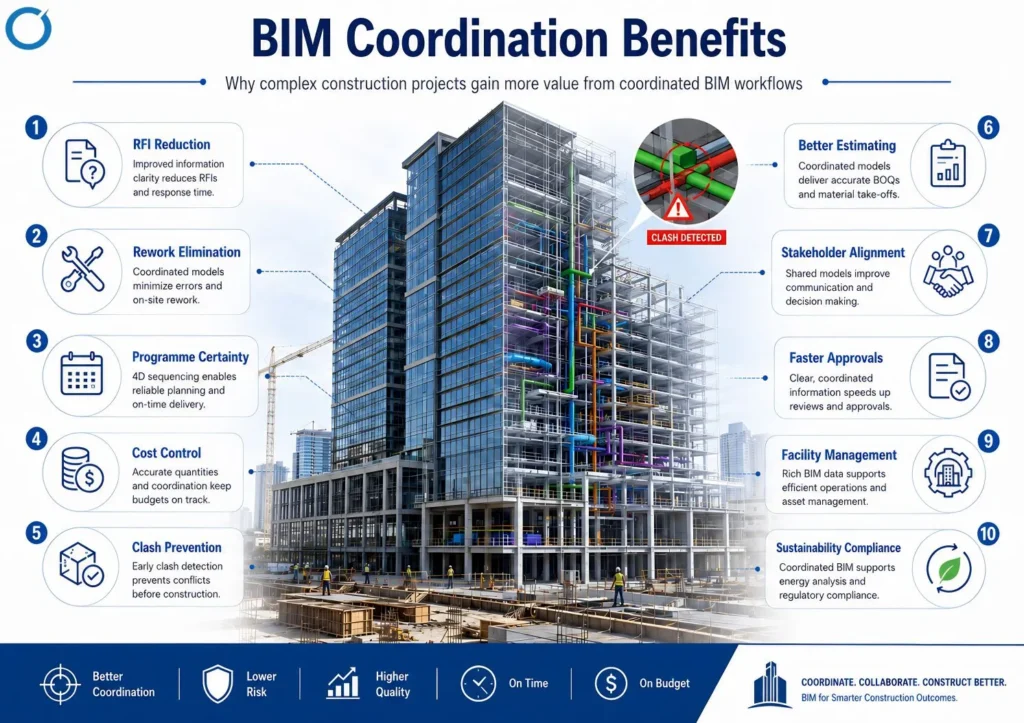
10 Benefits At A Glance
The table below summarizes all ten benefits, what each one prevents, and the research statistic behind it.
| Benefit | What it Prevents | Stat/Source |
|---|---|---|
| RFI Reduction | Documentation gaps, ambiguity, and site queries | BIM-enabled coordination reduces design conflicts by 52% (Market Growth Reports, 2026) |
| Rework Elimination | Costly re-fabrication, demolition of completed work | Cost of rework was cut by 29% through BIM-enabled coordination (Market Growth Reports, 2026) |
| Programme Certainty | Sequence conflicts, trade stoppages, and critical path overruns | 4D BIM reduces schedule overruns by up to 30% and improves site productivity by 15–20% (Arkance, 2025) |
| Cost Control | Change orders, variation claims, and material over-procurement | Up to 40% reduction in unbudgeted changes (Stanford CIFE) |
| Clash Prevention | MEP conflicts, structural interference, clearance violations | Timely clash detection saves up to 10% of contract value (Stanford CIFE) |
| Better Estimating | Inaccurate takeoffs, under-procurement, and budget overruns | 71% of US contractors use BIM for cost estimation (Market Growth Reports, 2026) |
| Stakeholder Alignment | Misunderstanding, design conflicts, and late changes | Better design understanding and faster approvals |
| Faster Approvals | Design review delays, permit resubmissions | 3D BIM models reduce interpretation gaps and resubmission cycles, giving reviewers a clear, unambiguous view of the design |
| Facility Management | Incomplete as-built records, costly post-completion surveys | More useful building information after completion |
| Sustainability Compliance | Missed energy targets, green certification failures | Projects using BIM for sustainability design from the outset achieve green certification targets more reliably (RIBA, 2025) |
Benefit 1 – Significant RFI Reduction
Requests for Information (RFIs) are one of the most disruptive and expensive problems in large project delivery. Every RFI represents a gap in the documentation, something that was not resolved before construction began. On a complex commercial or industrial project, RFI volumes can run into the hundreds, each one triggering a chain of administrative burden, potential work stoppage, and programme risk.
BIM coordination services address this at the source. Strong BIM modeling services give each discipline an accurate model foundation, while coordination brings those models into a federated environment and resolves conflicts before documentation reaches the site team. Research from Market Growth Reports (2026) found that BIM-enabled coordination reduces design conflicts by 52% compared to traditional workflows.
For a detailed breakdown of which BIM coordination services reduce RFIs most effectively, see: What BIM modeling services work best for reducing RFIs?
Benefit 2 – Rework Elimination
Reworking work that has to be done a second time because it was done the first time incorrectly is one of the largest controllable cost items on any large project. The Construction Industry Institute (CII) consistently finds rework accounts for 5–15% of total project costs on commercial and industrial projects. BIM coordination is one of the most effective documented interventions for reducing this figure.
BIM-driven coordination reduces rework costs by 29% on US commercial projects, according to Market Growth Reports (2026). The mechanism is straightforward: every clash resolved in the federated model is a conflict that does not become rework on site. On a large project with complex MEP systems, this can represent hundreds of resolved conflicts before a single trade mobilises.
ScienceDirect case study: A peer-reviewed case study found that BIM coordination and clash detection proved instrumental in cost reduction by minimising rework in the field. Problems were identified at an early stage through clash detection on building systems, allowing swift and coordinated installation. The project proceeded without cost overruns. (ScienceDirect, 2024)
Benefit 3 – Programme Certainty
Large projects regularly overrun their programmes, and coordination failures are among the most common causes. Two trades scheduled for the same zone simultaneously. An installation sequence may require crews to install a structural element before running MEP services, even if the programme does not show that element on the critical path. Access routes blocked by preceding work.
BIM coordination services improve schedule reliability by 27% through integration with project management systems, according to Market Growth Reports (2026). When teams add 4D sequencing to the coordination process, they validate the construction sequence spatially before any trade mobilizes and eliminate sequence conflicts that can cause programme-critical delays.
To understand how 4D BIM sequencing avoids programme delays, refer to the following: What is 4D BIM sequencing?
Benefit 4 – Cost Control and Budget Protection
Large projects face budget overruns from multiple directions, including change orders, variation claims, material over-procurement, and the cascading cost of coordination failures. BIM coordination services address each of these directly.
A Stanford CIFE study of 32 projects found BIM reduced unbudgeted changes by up to 40% and saved up to 10% of contract value through clash detection. The Journal of Construction Engineering and Management reported an average return of $8.53 for every $1 invested in BIM, driven largely by reduced rework and change orders.
For large projects where even a 1% budget overrun can represent millions of dollars, this ROI is compelling. BIM coordination shifts cost from the construction phase, where it is most expensive, to the pre-construction phase, where it costs a fraction.
Benefit 5 – Comprehensive Clash Prevention
Clash prevention is the core technical benefit of BIM coordination. By running automated clash detection services across the federated model, every hard clash, soft clash, clearance violation, and workflow conflict is identified before construction begins. Clash detection accuracy improves by 65% compared to traditional CAD workflows, according to Market Growth Reports (2026).
In cases of big MEP-intensive buildings like hospitals, data centers, and industrial sites, the number of clashes could easily reach into the thousands. Every clash the team resolves during preconstruction prevents a potential site stoppage, RFI, or rework issue. The aggregate value of clash prevention on a complex large project consistently represents a multiple of the coordination fee.
For a detailed breakdown of clash types and how the detection process works, see: What is clash detection in BIM?
Benefit 6 – Accurate Cost Estimating From The Model
Model-derived quantities from a coordinated BIM model are more accurate than manual takeoffs from 2D drawings and update automatically when the model changes. 71% of US contractors use BIM for cost estimation, according to Market Growth Reports (2026). For large projects with numerous trade packages and complex material schedules, this accuracy directly protects the bid and the budget. For more on how BIM-derived quantities improve estimating, see our construction estimating services.
Benefit 7 – Stakeholder Alignment and Communication
In big construction projects, there are numerous stakeholders, including the client, the architect, the structural engineer, MEP, subcontractors, planners, and end users. Coordinating all stakeholders regarding the intent of the project, the program, and the budget is among the most challenging tasks in big projects.
BIM coordination services facilitate this process by making use of a common virtual model available to everyone involved. 3D models and 4D animations ensure that non-technical stakeholders have a clear understanding of the project despite being unable to comprehend 2D plans. According to Technavio, BIM-based collaboration decreases mistakes in projects by up to 15% due to enhanced coordination.
The practical benefit is fewer late-stage design changes, one of the most expensive events in large project delivery. The early decisions made by stakeholders based on their understanding of the design in three dimensions result in more informed decision-making.
Benefit 8 – Faster Design Approvals
Design approvals from clients, planning authorities, and regulatory bodies are a persistent source of programme delay on large projects. The review and approval process for complex designs is slower when documentation is produced from 2D drawings that require interpretation, and when reviewers cannot visualise the design in three dimensions.
BIM coordination services improve design approval timelines by 34% according to Market Growth Reports (2026). Accurate construction documentation services also help reviewers assess drawings, coordination outputs, and model-based details with fewer interpretation gaps. 3D coordinated models give reviewers a clear picture of the design. This reduces resubmissions and speeds up design approvals significantly.
Benefit 9 – Improved Facility Management and Lifecycle Value
At LOD 500, the as-built level of a BIM model becomes a field-verified digital record of the completed building. When owners need accurate as-built records, Scan to BIM services help capture existing conditions and support reliable LOD 500 handover data. This model supports facility management, planned maintenance, asset tracking, and future renovation planning. 58% of US contractors and facility managers now use BIM for lifecycle management in healthcare, education, and transportation projects (Market Growth Reports, 2026). For large buildings with long operational lives, the LOD 500 model can reduce facility management costs significantly by enabling planned rather than reactive maintenance. For a full explanation of LOD levels and what each delivers, see: BIM LOD levels explained.
Benefit 10 – Sustainability and Green Certification Support
Large-scale commercial, healthcare, and institutional projects now face increasing demands for sustainability, LEED, BREEAM, and net-zero carbon performance. Project teams need to address these requirements from the start instead of treating them as late-stage additions. BIM coordination services help teams integrate energy models, material properties, and environmental impact data into the coordinated model early in the design process
According to Market Growth Reports (2026), BIM improves energy simulation accuracy by 29% and supports compliance with green building standards used in 58% of commercial developments. Projects that use BIM for sustainability design from the start achieve green certification targets more reliably than projects that rely on separate manual checks at the end of the design phase.
Why Are These Benefits Amplified On Large Projects?
Every benefit on this list scales with project complexity. On a simple commercial fit-out, BIM coordination might resolve 50 clashes and save a modest amount in rework. On a complex hospital, data centre, or industrial facility, the same coordination process might resolve several thousand clashes representing millions in avoided rework, weeks of saved programme time, and a significantly lower RFI volume throughout the build.
The relationship is not linear. Project complexity amplifies the value of BIM coordination. More trades, denser MEP systems, and more stakeholders mean greater coordination gains, which is why the most advanced construction companies invest in it most.
For large projects with ongoing coordination needs, contractors can hire a dedicated BIM modeler to keep model updates, clash reviews, and coordination deliverables moving without adding permanent in-house overhead.
Statistics: The most widespread use of BIM technology is recorded in commercial and high-rise constructions like offices, clinics, educational institutions, and big infrastructure projects. All that happens because of complicated designs, several stakeholders, and high costs, which make the functions of BIM coordination necessary. (Polaris Market Research, 2026)
Accessing BIM Coordination Quality For Your Large Project
Building in-house BIM coordination capability for large projects requires specialist BIM coordinators, software licences, and enough project volume to keep that capability fully utilised. For many contractors and developers, this overhead is not commercially viable, particularly when project demand fluctuates.
Offshore BIM coordination services provide a practical alternative. A dedicated offshore team handles the full coordination workflow at a fraction of equivalent in-house costs. The team handles BEP development, federated modeling, clash detection, and MEP coordination. We also support 4D sequencing and construction documentation, scaling with your project pipeline.
For a guide to choosing the right BIM coordination partner, see: How to choose the right BIM modeling service provider.
Deliver All 10 Benefits On Your Next Large Project
At Optimar Precon, our dedicated BIM coordination team supports federated model development, clash detection, MEP BIM coordination, 4D sequencing, and construction documentation. For contractors, developers, and engineers across commercial, industrial, healthcare, and residential projects globally. Our offshore team delivers coordination quality at offshore rates, without the overhead of an in-house team. Get in touch to discuss your next project.
FAQs
BIM coordination services deliver ten proven benefits on large construction projects. These include fewer RFIs, reduced rework, stronger schedule reliability, and better cost control. Clash prevention, accurate cost estimating, and faster design approvals also rank among the top outcomes. Facility management and sustainability compliance round out the list. The research evidence is strong. BIM coordination reduces design conflicts by 52% and cuts rework costs by 29%. Schedule reliability improves by 27% and unbudgeted changes fall by up to 40%. Clash detection accuracy improves by 65%, project errors drop by 15%, and design approval timelines improve by 34%.
Research clearly documents the return on investment from BIM coordination. The Journal of Construction Engineering and Management found an average return of $8.53 for every $1 invested in BIM implementation. The Stanford CIFE study found savings of up to 10% of contract value from timely clash detection alone. Offshore BIM coordination services further improve the cost equation by delivering the same coordination quality at 40–70% below local rates. Making the ROI case compelling for projects of all scales.
Healthcare facilities, data centers, commercial high-rises, and industrial facilities gain the most from BIM coordination services. These projects have dense MEP systems, multiple trades working at the same time. And high costs when coordination failures reach the site. Infrastructure and large residential developments also benefit significantly. As a general rule, the more overlapping disciplines and trades, the greater the return from BIM coordination.
BIM coordination minimizes the RFIs by fixing the problems that create the RFIs before they even hit the construction site. Each coordination problem the team resolves through the BIM coordination process prevents one RFI from being raised during the project. Research found BIM-enabled coordination reduces design conflicts by 52% compared to traditional workflows. On large projects, reducing hundreds of potential RFIs can improve programme control, lower costs, and strengthen team coordination.
Yes, through offshore BIM coordination services. Building in-house coordination capability requires significant investment in specialist staff and software. Offshore BIM teams deliver the same coordination quality at 40–70% below local rates. They can also scale team size based on project demand. This gives contractors access to full BIM coordination benefits without building a large in-house BIM department.