- Quick Answer
- Reason 1: Data Center Projects Don't Come Often Enough to Justify a Permanent In-House Team
- Reason 2: Redundancy and MEP Density Require Coordination Reps Most In-House Teams Don't Have
- Reason 3: Compressed Schedules Leave No Room for a Learning Curve
- Reason 4: One Combined BIM, CAD, and Estimating Team Removes Handoff Delays
- Reason 5: The Decision Has to Be Made Before Breaking Ground, Not During Construction
- Planning a Data Center Project?
Data center developers are making the outsourcing decision earlier than other building types, often before the site is even cleared. That’s not a cost story. It’s a specialization and timing story: data center projects don’t come around often enough to justify a permanent in-house team, and the coordination stakes are too high to figure it out as you go.
This isn’t the general case for outsourcing BIM or CAD; it’s specific to why data center projects push that decision earlier and for different reasons than a typical commercial build.
Quick Answer
Data center developers outsource BIM and CAD before breaking ground for five reasons: their projects are too infrequent to justify a permanent specialist team, redundancy and MEP density require coordination experience most in-house teams lack, compressed schedules leave no room for a learning curve, a combined BIM/CAD/estimating team avoids handoff delays, and the decision has to be made in preconstruction because bringing in outside help mid-project disrupts a model that’s already underway.
This Isn’t the Same Conversation as General BIM Outsourcing
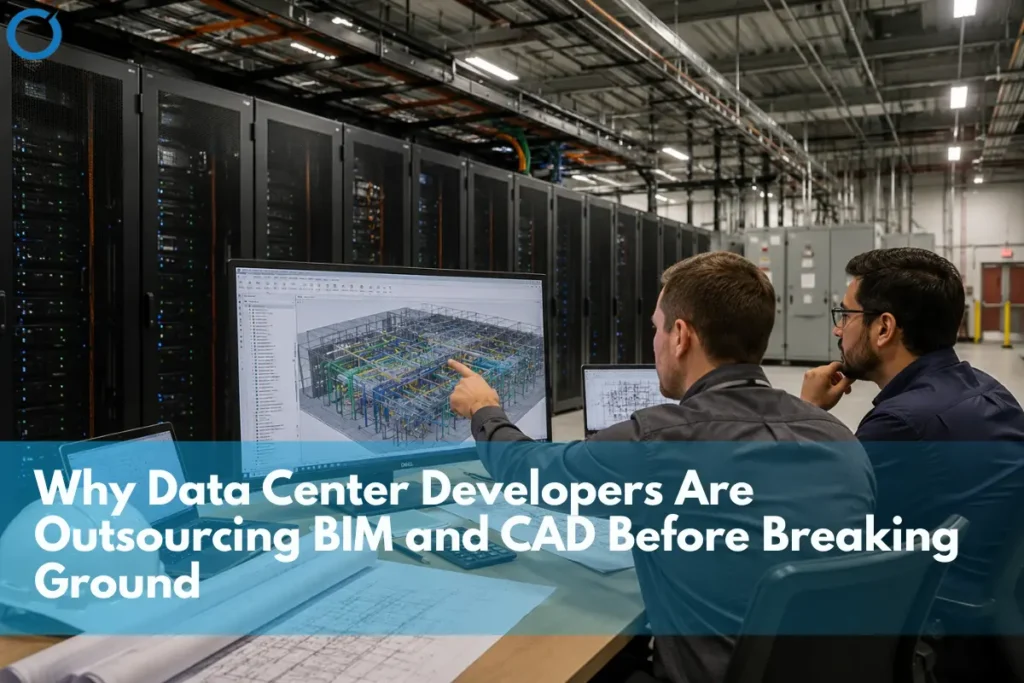
The broader case for outsourcing BIM cost savings, access to skilled modelers, and scaling a team up or down is well covered in our guide on outsourcing BIM modeling to save costg. That article applies to construction generally. Data centers are a narrower case with different drivers: it’s less about reducing overhead and more about accessing coordination experience that a general commercial team simply hasn’t built up, because most in-house teams don’t touch enough data center projects to develop it.
Reason 1: Data Center Projects Don’t Come Often Enough to Justify a Permanent In-House Team
A general contractor might build office fit-outs or mid-rise residential every quarter, enough volume to keep an in-house BIM and CAD team fully utilized. Data center projects are larger, less frequent, and often won by developers who don’t have another one in the pipeline for a year or more. Building a permanent specialist team for that cadence means paying for idle capacity between projects, or letting the team’s data center-specific skills go stale.
Reason 2: Redundancy and MEP Density Require Coordination Reps Most In-House Teams Don’t Have
Chiller plants, CRAC and CRAH systems, UPS and battery rooms, and redundancy tiers that change the entire electrical layout these aren’t things a generalist MEP BIM services team encounters regularly. Coordination knowledge in this space comes from repetition, not training. A team that’s coordinated ten data center MEP packages catches conflicts that a team on their first one won’t even know to look for.
Reason 3: Compressed Schedules Leave No Room for a Learning Curve
Business demand often fast-tracks data center projects and compresses the schedule beyond typical development timelines. There’s no room in that schedule for a team to learn data center clash detection patterns on the job. Outsourcing to a team that already runs this coordination regularly means earlier projects have already absorbed the learning curve, so your project does not have to pay for it.
Reason 4: One Combined BIM, CAD, and Estimating Team Removes Handoff Delays
Where BIM Coordination, CAD Drafting, and Construction Estimating exist under three different vendor firms, all changes need to be relayed thrice, and all discrepancies need to be sorted out, each time by someone from the developer’s end. An outsourcing company that takes care of all three will ensure that the model, the drawings, and the figures stay in sync without involving the developer.
Reason 5: The Decision Has to Be Made Before Breaking Ground, Not During Construction
Bringing in an outsourced BIM and CAD team after design has already started forces the project team to re-onboard them onto a model or drawing set that is already partway built. Your team then spends extra time explaining project context, coordination logic, and earlier decisions that the outsourced team would have understood naturally if they had joined from the start. On a data center project, early model structure directly affects raised floor coordination, electrical room planning, and mechanical routing, so timing matters far more than it does on a simpler build. That is why developers should make the outsourcing decision during preconstruction, not treat it as a mid-project rescue option.
In-House vs. Outsourced: What Changes for a Data Center Project
| Factor | Generalist In-House Team | Dedicated Outsourced Data Center Team |
|---|---|---|
| Project frequency | Data centers are occasional, not core workload | Coordinates data center MEP across multiple concurrent clients |
| Redundancy tier experience | Learns N+1/2N/2N+1 cost impact on this project | Has priced and modeled multiple redundancy tiers before |
| Ramp-up time | Needs time to build a data center-specific process | Applies an existing, repeatable coordination workflow |
| Service scope | Often split across separate BIM, CAD, and estimating hires | One team covers BIM, CAD, and estimating together |
| Onboarding timing | Brought in as needed, sometimes mid-design | Engaged in preconstruction, before permitting drawings |
Planning a Data Center Project?
Optimar Precon provides combined BIM coordination, CAD drafting, and cost estimating for data center developers engaged in preconstruction, not as a mid-project rescue. Contact us to discuss your project timeline and scope.
The Earlier the Decision, the More Coordination Passes Happen Before Permitting
Data center developers aren’t outsourcing BIM and CAD because it’s cheaper in the abstract; they’re outsourcing it because the alternative is asking an in-house team to learn data center coordination in real time, on a schedule that doesn’t allow for it. Making that call before breaking ground is what buys the coordination passes that catch problems on screen instead of in the field.
FAQs
No. In fact, the rarity argument is even more applicable to small companies because they develop data centers less frequently than larger hyperscale companies and thus have even less need for their own full-time specialists.
It’s generally more efficient. Coordinated delivery from one team keeps the model, drawings, and cost data aligned, whereas splitting the work across separate vendors means someone on the developer’s side has to reconcile any differences between them.
As early as site selection or concept design, and no later than the start of schematic design. Waiting until construction documents are underway means the partner is coordinating around decisions already made instead of shaping them.
No, the developer and design team retain design authority. The outsourced team executes coordination, modeling, and estimating within that direction, typically through scheduled review cycles rather than working independently.
General BIM outsourcing is usually framed around cost and scalability across any building type. For data centers, the driver is different: it’s about accessing redundancy and MEP coordination experience that most in-house or generalist teams haven’t built up, because they don’t work on this building type often enough.